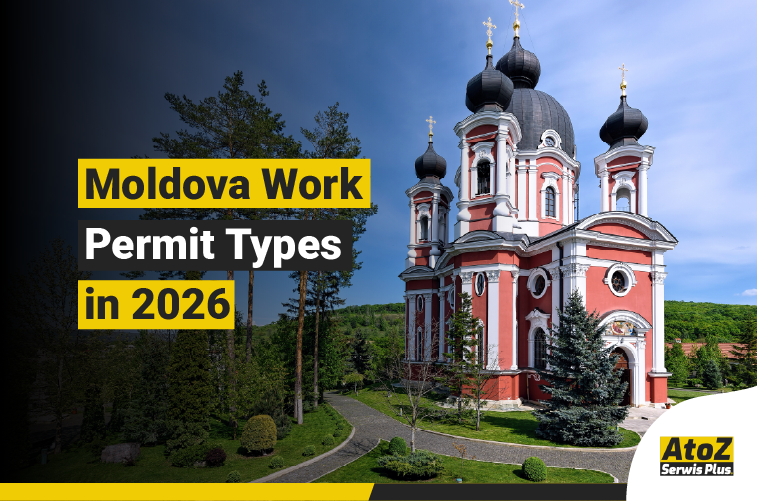
Moldova Work Permit Types in 2026

Moldova, an EU-candidate country in Eastern Europe, offers a very low cost of living, a flat tax on foreign income for remote workers, and a fast-growing IT sector anchored by the Moldova IT Park. For foreign workers in 2026, the system pairs a long-stay work visa with a temporary residence permit for employment, administered by the Bureau for Migration and Asylum (BMA), alongside a new digital nomad visa and investor routes.
This guide explains how Moldovan work authorisation works in 2026, the main permit types, the salary rules, the process and timelines, and the path to settlement. The Moldovan authorities decide each application, and the labour market is protected, so foreigners are hired mainly where local workers are unavailable.
Moldova protects its domestic labour market: foreign workers are generally hired only when the National Employment Agency (ANOFM) cannot fill the role locally. But two routes stand out — employment through a Moldova IT Park resident (a shorter path) and the new Digital Nomad Visa with a 12% flat tax on foreign income.
HowMoldova’ss Work Permit System Works in 2026
Non-EU nationals generally need a long-stay (Type D) work visa, with the employer holding a work permit (autorizație de muncă) issued by ANOFM for the specific hire, and then a temporary residence permit for employment from the BMA after arrival. A labour-market test applies in many sectors (with exemptions for ANOFM shortage-list occupations). The salary must meet the relevant minimum (for standard hires, at or above the forecast average monthly wage; certain rules set a floor of 50% of that figure). Health insurance is required.
Temporary Residence Permit for Employment
The standard route. Purpose: to reside and work in Moldova for a specific employer. Eligibility: a confirmed job offer, the employer’s ANOFM work permit, a salary meeting the threshold, and (often) a labour-market test. Validity: typically up to one year, renewable on continued employment and ANOFM authorisation. Note: ANOFM authorisation must be obtained before the BMA can issue the residence permit, so plan the timeline accordingly.
Moldova IT Park (MITP) Employment Route
For foreigners employed by a resident of the Moldova IT Park, obtaining residence on an employment basis follows a shorter, simpler path than the standard route. Why it matters: the IT Park is the engine of Moldova’s tech sector and benefits from a favourable single-tax regime, making it the most attractive route for IT professionals.
Digital Nomad Visa
Launched under Law 144/2025, this allows remote professionals to live in Moldova while earning income abroad. Eligibility: employees of non-Moldovan companies, independent providers with foreign clients, or shareholders in foreign companies. Income threshold: at least three times the forecast national average salary — around €2,700–2,800 per month for 2026. Validity: one year, renewable once (two years total). Tax: a 12% flat personal income tax, with exemption from social contributions and mandatory health insurance on foreign-sourced income. Local Moldovan employment is excluded.
Investor and Other Routes
Under Article 36¹ of Law 200/2010, residence is open to those who contribute capital (around €100,000, equivalent to roughly 30 average monthly salaries) or create jobs (at least one full-time position at or above the average wage). Permit duration is tiered from two to eight years for significant contributions. Highly Skilled Worker visas are available for specialists in IT, engineering, healthcare, and education, and family reunification routes are also available.
Why Work in Moldova
Moldova offers one of the lowest costs of living in Europe, a simple flat-tax environment, EU candidate status, modern internet infrastructure, and a growing IT scene. English is increasingly used in tech and international firms. The trade-offs are lower wages outside IT, a smaller job market, and a labour-market-protective system that prioritises local hiring.
Labour Market and Economy
Moldova’s economy spans agriculture and food processing, a fast-growing IT and outsourcing sector (centred on the IT Park), manufacturing, and services. Demand is strongest in IT and software, engineering, healthcare and education — the sectors where skilled-migration provisions are most active. Emigration has created genuine gaps in several fields.
Salaries, Cost of Living and Tax
Wages are low by EU standards but rising, especially in IT, while the cost of living is among the lowest in Europe, so purchasing power can be reasonable for specialists. Moldova has a flat personal income tax (with the IT Park’s favourable single-tax regime and the nomad route’s 12% flat tax on foreign income). Confirm current figures with the State Tax Service and the National Bureau of Statistics.
In-Demand Jobs and Best Cities
The strongest demand is in IT and software, engineering, healthcare, and customer support and services. Chișinău, the capital, dominates in IT, services and government; Bălți is the main northern industrial and services hub.
Documents, Process and Settlement
Applicants generally need a valid passport, a job offer and the eemployer’sANOFM work permit, a legalised and translated criminal-record certificate, qualifications, health insurance and proof of accommodation. The sequence: the employer secures the ANOFM work permit; the worker obtains the Type D visa; on arrival, applies to the BMA for the temporary residence permit; processing takes several weeks. Permanent residence generally follows after five years of legal residence across statuses, and citizenship by naturalisation after a longer qualifying period. Confirm current rules before applying.
Work Culture, Hours and Leave
Moldova’s standard working week is 40 hours, with a statutory minimum of 28 calendar days of paid annual leave, plus public holidays. The IT Park and outsourcing sectors are internationalised and English-speaking, while traditional industries operate in Romanian and Russian. Written contracts, tax registration, and social insurance enrolment are mandatory.
Common Reasons for Refusal and How to Avoid Them
Common pitfalls include a salary below the threshold, a failed labour-market test (where required), missing the ANOFM-then-BMA sequence, or an incomplete, unlegalised document pack. Avoid them by confirming the threshold, ensuring the employer secures the ANOFM work permit first, planning the two-stage timeline, and legalising and translating documents in advance.
Final Thoughts
Moldova in 2026 is an affordable, low-tax, EU-candidate destination that particularly rewards IT professionals and remote workers — through the Moldova IT Park employment route and the new Digital Nomad Visa. For standard employment, expect a labour market test and ANFO authorisation before obtaining the residence permit. Match your situation to the right route and budget for the two-stage timeline. The decision rests with the Moldovan authorities, so verify current rules before applying.
Official Government Sources
- Bureau for Migration and Asylum (BMA): https://bma.gov.md
- National Employment Agency (ANOFM): https://www.anofm.md
- Moldova IT Park: https://moldovaitpark.md
- State Tax Service: https://sfs.md
- National Bureau of Statistics: https://statistica.gov.md
Register With Us Today
Take the first step toward your Europe career. Choose the option that fits you best.
Advertising & Sponsorships
Please complete this form, and an account executive will get back to you quickly.
Register Now!Need Help With a Moldova Work Permit?
Explore Moldova’s employment residence permit, IT Park route and Digital Nomad Visa, with document guidance from AtoZ Serwis Plus.
Important Information About Moldova Work Permits
Moldovan work authorisation pairs a Type D work visa and an employer ANOFM work permit with a temporary residence permit from the BMA, and the labour market is protected to prioritise local hiring. Rules, thresholds and fees may change, so always check the latest requirements before applying.
Disclaimer: AtoZ Serwis Plus provides guidance and documentation support only. Moldovan permits and residence approvals remain subject to the decisions of the Moldovan authorities.