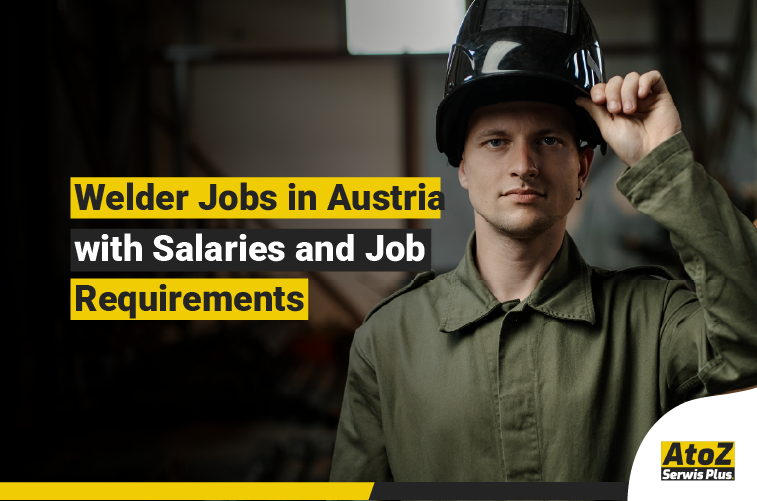
Welder Jobs in Austria with Salaries and Job Requirements

Welding is a steady skilled trade across much of Europe, and Austria is no exception. Welding vacancies appear across Austria’s manufacturing, metal fabrication, construction, and industrial maintenance sectors, though demand varies by region, process, and industry. This guide explains where the welder jobs are, what you can realistically earn by process and specialism, exactly what employers require, and how EU and non-EU welders can apply.
Are welder jobs available in Austria?
Yes. Employers in Austria advertise welding vacancies across fabrication, manufacturing, construction, and maintenance, with extra demand where shipbuilding, energy, or heavy industry is strong. Demand is not uniform, so target the processes and industries actually hiring, and be ready to prove your certificate scope and weld to standard.
Common welder jobs
The welder roles most commonly recruited in Austria include the following. The mix depends on the local industry.
| Welder Role | Typical Work | Common Requirements |
|---|---|---|
| MAG production / structural welder (135/136) | Carbon-steel production and steel structures | Process, positions and a job-specific weld test |
| TIG welder (141) | Stainless, thin sections and precision work | TIG scope, material, positions |
| Coded pipe welder | Pipe joints, often all-position with root runs | Pipe qualification scope, diameter and position range |
| Aluminium (MIG) welder (131) | Aluminium and non-ferrous fabrication | 131 scope and material experience |
| Welder-fabricator | Welding plus cutting, forming and assembly | Both welding scope and fabrication skill |
Which welding processes are in demand
A vacancy labelled only“welder” is too broad, so define your process: 111 (MMA) for maintenance and site work, 131 (MIG) for aluminium and non-ferrous, 135 and 136 (MAG solid and flux-cored wire) for carbon and structural steel, and 141 (TIG) for stainless, thin sections and pipe roots. MIG and MAG are not the same, and a strong TIG stainless pipe welder is not automatically a MAG structural welder, and vice versa. Employers also care about the material (carbon steel, stainless steel, aluminium, duplex), the product (plate, structural, pipe, pressure equipment), and the welding positions, so apply for what you actually weld.
Welder salaries in Austria
Different welding profiles are paid differently, so production, TIG and coded pipe welders are shown separately below. Figures are approximate gross guides; pay also depends on experience, certification, region, shifts and overtime. Always check whether a figure is gross or net.
| Welder Role | Typical Pay | Notes |
|---|---|---|
| Production / MAG welder | approx. EUR 2,400 to 3,400 gross/month | Structural and production work |
| TIG welder | approx. EUR 2,900 to 4,200 gross/month | Precision, stainless and thin sections |
| Coded pipe/specialist welder | approx. EUR 3,500 to 5,000 gross/month | Highly certified; demanding scope pays more |
Where a metal-industry collective agreement applies, it can set classification, minimum pay, shift premiums and overtime, so ask which agreement covers the role.
Job requirements: what employers expect
Employers hire on proven competence, not a CV alone. Expect to provide a welder qualification, often to EN ISO 9606, and to pass a practical weld test.
Welding certificate and its scope
A welder qualification is not a universal welding licence. Each certificate has a defined qualification range covering the process, material group, filler, thickness, pipe diameter, position, joint and backing, and it is valid only within that scope, subject to continuity and revalidation. A valid certificate can still fall outside what a job needs, so know exactly what yours covers and keep it current.
Practical weld test
Almost every serious employer runs a job-specific weld test on the actual process, material, thickness and position, checking preparation, machine setup, arc control, bead profile, penetration and fusion, defects and safety. Prepare to weld rather than relying on a certificate scan or photo.
Experience, safety and language
“Welder, ten years” is not enough; be specific about processes, materials (plate or pipe), positions, and industries. On safety, expect a site induction, PPE, fume extraction and, for site work, a hot-work permit, all national and site-specific. On language, German is normally expected for domestic work; some international operators accept English. You need enough to read a WPS and drawings and follow safety instructions; international workshops may run in English, but many employers expect the local language.
Can EU and non-EU welders work in Austria?
EU and EEA citizens can work in Austria without a work permit, with residence registration, tax, and any qualification checks handled. A non-EU welder generally needs a genuine job offer, a national work and residence permit and, in most cases, a visa, arranged largely by the employer, sometimes with a labour-market test. There is no single European welder visa, and immigration is decided nationally, separate from any requirement to prove you can weld.
How to find welder jobs in Austria
Legitimate channels include the EU-wide EURES portal, national employment services and welding training centres, the careers pages of fabrication, manufacturing, shipbuilding and construction companies, and specialist welding recruitment agencies. Verify the employer and vacancy through official sources, and be cautious of anyone asking for money up front or guaranteeing a job or visa.
Useful official resources include oesterreich.gv.at (the official portal) and the EU jobs network, EURES (eures.europa.eu).
How to apply
- Identify your process, materials and positions, and target matching roles.
- Prepare a clear CV listing processes, materials, plate or pipe, positions and industries.
- Gather your welding certificates and note their exact scope and validity.
- Check whether you can work freely or need a permit or visa, and start that early if required.
- Apply through official portals, company careers pages or reputable agencies.
- Prepare for a practical weld test that mirrors real-world work.
- Get the offer in writing, including pay basis, hours, overtime and any deductions.
Avoiding job scams
Be wary of anyone guaranteeing a job, visa or work permit, offering fake certificates, advertising vague welding jobs with no process or duties, or asking for payment to a personal account. Verify the employer and vacancy through official channels, and never pay for a guaranteed outcome.
In practice
Welding is a genuine, durable trade in Austria for welders who can prove the right process and certificate scope. Define your process, know your certificate range, be ready for a practical weld test, benchmark pay by specialism, and, for non-EU applicants, plan the immigration route early. Do that, and you compete strongly for the roles that match your real skill.
Register With Us Today
Take the first step toward your Europe career. Choose the option that fits you best.
Advertising & Sponsorships
Please complete this form, and an account executive will get back to you quickly.
Register Now!Looking for Welding Work in Austria?
AtoZ Serwis Plus helps skilled welders explore legitimate opportunities in Austria and across Europe, from understanding the scope of certificates, weld tests, and salaries to the work and residence steps for non-EU candidates. We provide practical guidance and recruitment support, not guaranteed jobs, salaries, permits or immigration outcomes.
Before Applying for Welder Jobs in Austria
Before you apply for welding work in Austria, confirm the exact process, materials, and positions the role requires, and check your certificate scope against them rather than assuming any certificate will suffice. Be ready for a practical weld test, confirm the salary basis (gross or net), hours, overtime and any accommodation deductions, and verify the employer. For non-EU applicants, confirm the work and residence routes separately, as welding skills and the right to work are not the same.
Disclaimer: This article is general information for welders and is not legal or immigration advice. Labour markets, salaries, certificate scopes and immigration rules vary by country and can change, and a job offer does not guarantee a permit or visa. Readers should verify current requirements with the competent national authorities before acting. AtoZ Serwis Plus provides guidance and recruitment support and does not guarantee any job, salary, certificate recognition, permit or visa.