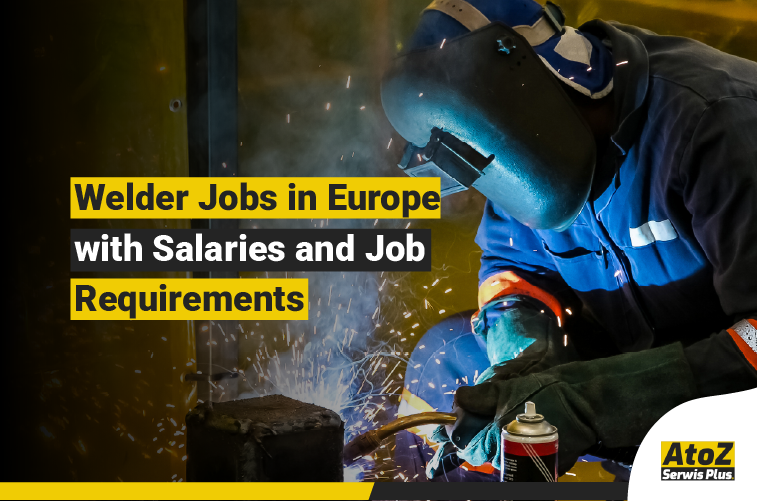
Welder Jobs in Europe with Salaries and Job Requirements

Welding is one of Europe’s steadier skilled trades, with vacancies across manufacturing, metal fabrication, construction, shipbuilding, energy and industrial maintenance. Demand is real but uneven, varying by country, region, welding process and industry, so a welder who can prove the right process and certificate scope is usually in a strong position. This overview covers where the jobs are, realistic salaries, and what employers require. Rules and pay are national, so always check the specific destination country.
Define your welding process.
A vacancy labelled only “welder” is too broad. Define your process: 111 (MMA), 131 (MIG, aluminium and non-ferrous), 135 and 136 (MAG solid and flux-cored wire for carbon and structural steel), or 141 (TIG, for stainless, thin sections and pipe roots). MIG and MAG are not the same, and a TIG stainless pipe welder is not automatically a MAG structural welder. Employers also care about material, product and welding position.
Salaries vary widely
Pay varies by role, country, certification, and shift, with coded pipe and specialist welders earning more than general production welders. As a guide, Germany is around EUR 20 to 24 gross per hour, a nd the Netherlands around EUR 18 to 22. The Nordic countries are among the best-paid under collective agreements; Southern Europe is lower, and Central and Eastern Europe is lower in nominal terms and quoted in local currency. Always check gross versus net.
Job requirements
Employers hire on proven competence: a welder qualification, often to EN ISO 9606 with a defined scope of process, material, thickness, position and diameter, and a job-specific practical weld test. A certificate is not a universal licence, so match your scope to the job, keep it current, and be ready to weld. Expect safety induction, PPE and, for site work, a hot-work permit, and enough language to read a WPS and drawings.
EU and non-EU welders
EU and EEA citizens can work across the EU and EEA without a work permit. Non-EU welders generally need a job offer, a national work and residence permit and usually a visa, arranged with an employer. There is no single European welder visa, and immigration is separate from proving you can weld.
How to find work
Use official channels: the EU EURES portal, national employment services, welding training centres, established fabrication and manufacturing companies, and reputable welding recruitment agencies. Verify any employer or agency, and avoid upfront fees or guaranteed-job or guaranteed-visa claims.
In practice
Welding offers durable work across Europe for welders who can prove the right process and certificate scope. Define your process, know your certificate range, prepare for a weld test, benchmark pay by specialism, and plan the immigration route early for non-EU work, checking the rules for the specific destination country.
Register With Us Today
Take the first step toward your Europe career. Choose the option that fits you best.
Advertising & Sponsorships
Please complete this form, and an account executive will get back to you quickly.
Register Now!Looking for Welding Work in Europe?
AtoZ Serwis Plus helps skilled welders explore legitimate opportunities in Europe, from understanding the scope of certificates, weld tests, and salaries to the work and residence steps for non-EU candidates. We provide practical guidance and recruitment support, not guaranteed jobs, salaries, permits or immigration outcomes.
Before Applying for Welder Jobs in Europe
Before you apply for welding work in Europe, confirm the exact process, materials, and positions the role requires, and check your certificate scope against them rather than assuming any certificate will suffice. Be ready for a practical weld test, confirm the salary basis (gross or net), hours, overtime and any accommodation deductions, and verify the employer. For non-EU applicants, confirm the work and residence routes separately, as welding skills and the right to work are not the same.
Disclaimer: This article is general information for welders and is not legal or immigration advice. Labour markets, salaries, certificate scopes, and immigration and migration rules vary by country and can change; an offer or change does not guarantee a permit or visa. Readers should verify current requirements with the competent national authorities before acting. AtoZ Serwis Plus provides guidance and recruitment support and does not guarantee any job, salary, certificate recognition, permit or visa.