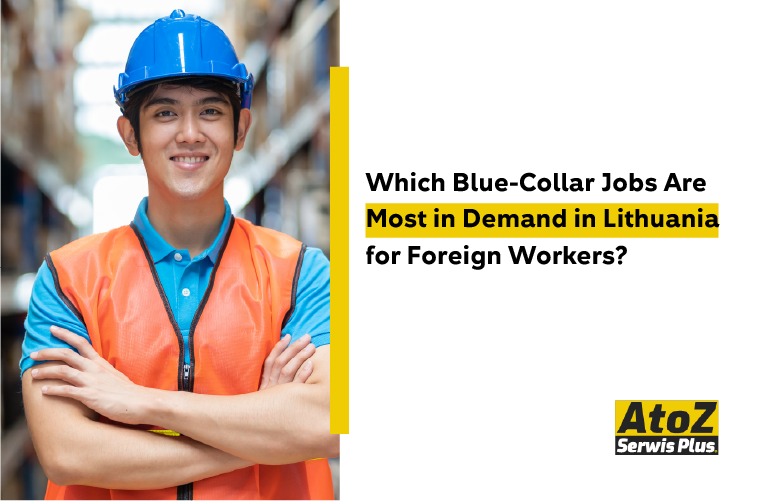
Which Blue-Collar Jobs Are Most in Demand in Lithuania for Foreign Workers?
Lithuania's rapidly growing economy, its ageing domestic workforce, and two decades of significant emigration of working-age Lithuanians to Western Europe have created a genuine, well-documented, and sustained shortage of blue-collar workers across a wide range of sectors. For foreign workers seeking stable employment, a competitive cost of living, and a clear pathway to EU residency, Lithuania represents one of the most accessible and rewarding blue-collar labour markets in the European Union today.
This complete guide covers the most in-demand blue-collar jobs in Lithuania for foreign workers — including sector-by-sector analysis, average gross salary ranges, employer examples, work permit requirements, and practical advice for securing employment and legal work authorisation as quickly and efficiently as possible.
Ready to find a blue-collar job in Lithuania right now? Register as a worker with AtoZ Serwis Plus and connect with verified Lithuanian employers who are actively hiring foreign workers today.
Why Lithuania Needs Foreign Blue-Collar Workers
Lithuania faces a structural blue-collar labour shortage that has been building for over two decades. The primary drivers are well understood and unlikely to reverse in the short or medium term.
Between 2004 — when Lithuania joined the European Union — and the present day, an estimated 600,000 to 800,000 Lithuanians emigrated to the United Kingdom, Ireland, Germany, Norway, and other Western European countries in search of higher wages. This emigration disproportionately affected working-age men and women in exactly the trades, construction, logistics, manufacturing, and care sectors where demand is now most acute.
At the same time, Lithuania's economy has grown strongly — particularly in construction, logistics, and manufacturing — creating demand for blue-collar labour that the domestic workforce can no longer meet in the required volumes. The result is a labour market where foreign blue-collar workers are genuinely needed, genuinely welcomed by employers, and able to access legal work authorisation through a relatively efficient process compared with many other EU member states.
Key facts about Lithuania's blue-collar labour market:
- Lithuania's unemployment rate has remained consistently low — below 7% in recent years — reflecting genuine labour market tightness rather than economic weakness
- The construction sector alone has reported consistent unfilled vacancy rates of 15–25% in recent years, driven by a residential and commercial development boom in Vilnius and Kaunas.
- The logistics and transportation sector faces a documented shortage of HGV drivers — a shortage shared across the EU but particularly acute in Lithuania, given the country's strategic role as a transit corridor.
- The care and social services sector faces an urgent and growing shortage, driven by Lithuania's rapidly ageing population and the emigration of younger care workers to higher-paying Western European markets.s
- Lithuania's government has progressively simplified and accelerated the work permit process for foreign workers in shortage occupations, reflecting the strategic importance of international labour recruitment
How the Lithuanian Work Permit System Works for Blue-Collar Workers
Before examining the specific in-demand occupations, it is important to understand how the Lithuanian work authorisation system applies to blue-collar workers, because the process differs slightly depending on whether the occupation is on the official shortage list and whether the worker qualifies for an exemption from the labour market test.
The standard blue-collar work permit route in Lithuania works as follows:
- The Lithuanian employer identifies a foreign worker they wish to hire and initiates a work permit application with the Lithuanian Labour Exchange (Lietuvos darbo birža — LDB)
- For standard occupations, the employer must demonstrate that the vacancy was advertised and that no suitable Lithuanian or EU/EEA candidate was available — this is the labour market test
- For occupations on the official shortage occupation list published by the LDB, the labour market test is waived entirely — significantly accelerating the process
- Once the LDB issues the work permit, the worker applies for a national long-stay visa (Type D) or a Temporary Residence Permit (Leidimas laikinai gyventi — LLG) at the Lithuanian embassy or consulate in their home country
- Processing time for the Type D visa route is typically 6–10 weeks from the employer initiating the LDB application to the worker arriving in Lithuania
- Upon arrival, the worker must register their place of residence at the local eldership office (seniūnija) within 7 days — a strict legal requirement
- The employer registers the worker with Sodra (the State Social Insurance Fund Board) from the first working day, activating state health insurance and all social benefits
Blue-collar workers who most benefit from the shortage occupation exemption — avoiding the labour market test and accelerating the process — include HGV drivers, electricians, welders, plumbers, HVAC technicians, care workers, construction operatives, and agricultural workers, among others. Employers and workers should verify the current shortage occupation list with the LDB at the time of application, as the list is reviewed and updated periodically.
Are you a Lithuanian employer looking to hire qualified foreign blue-collar workers? Register as an employer with AtoZ Serwis Plus and connect with pre-screened, work-permit-ready candidates across all in-demand sectors today.
The Most In-Demand Blue-Collar Jobs in Lithuania for Foreign Workers
Are you ready to find your blue-collar job in Lithuania? Register your worker profile with AtoZ Serwis Plus and connect with verified Lithuanian employers who are actively hiring foreign workers right now.
HGV / Heavy Vehicle Driver (Category C+E)
Demand level: Critical
HGV driving is one of the most acutely and consistently shortage-affected blue-collar occupations in Lithuania — and across the EU as a whole. Lithuania's strategic position as a major east-west transit corridor, the Port of Klaipėda's role as a Baltic Sea cargo gateway, and the country's large international road transport sector create sustained and intense demand for qualified HGV drivers holding a Category C+E driving licence.
Lithuanian transport companies — including Girteka Logistics (one of Europe's largest road transport companies), Vtrans, Vilsped, and hundreds of smaller operators — actively recruit internationally, including from Ukraine, Belarus, Moldova, Georgia, and other non-EU countries. Many of these companies have established international recruitment programmes and can provide full support with the LDB work permit process and Lithuanian consulate visa applications.
|
Detail |
Information |
|---|---|
|
Average Gross Monthly Salary |
€1,500 – €2,800 (domestic routes); €2,500 – €4,500+ (international routes) |
|
Required Qualification |
Category C+E driving licence; CPC (Certificate of Professional Competence); digital tachograph card |
|
Language Requirement |
Basic Lithuanian or English for domestic roles; English is widely used in international transport |
|
Labour Market Test |
Waived — documented shortage occupation |
|
Key Employers |
Girteka Logistics, Vtrans, Vilsped, Ekotransas, and smaller regional operators |
|
Practical Note |
International route drivers may earn significantly above the domestic range; accommodation is often provided by the employer for international drivers |
Are you a qualified HGV or heavy vehicle driver looking for work in Lithuania? Register your driver profile with AtoZ Serwis Plus and connect directly with Lithuanian and international transport companies who are actively recruiting licensed drivers right now.
Electrician (Industrial and Construction)
Demand level: Critical
Electricians — both in the industrial and construction sectors — are among the most consistently in-demand trades in Lithuania. The residential and commercial construction boom in Vilnius and Kaunas, combined with ongoing industrial maintenance and expansion at manufacturing facilities, creates a sustained need for qualified electricians that the domestic workforce cannot meet at the required volume.
Demand covers the full range of electrical work — residential wiring, commercial fit-out, industrial panel installation, maintenance of manufacturing equipment, and infrastructure projects. Workers with certifications in high-voltage systems, PLC (programmable logic controller) programming, or industrial automation are particularly sought after and command premium salaries.
|
Detail |
Information |
|---|---|
|
Average Gross Monthly Salary |
€1,400 – €2,500 (residential/commercial); €2,000 – €3,500 (industrial) |
|
Required Qualification |
Electrical trade qualification or apprenticeship certificate; industrial electricians typically require additional certifications |
|
Language Requirement |
Basic Lithuanian for site communication; some employers accept Russian or English |
|
Labour Market Test |
Waived — documented shortage occupation |
|
Key Employers |
Axis Industries, YIT Lithuania, Skanska Lithuania, and regional electrical contractors |
|
Practical Note |
Electricians with industrial automation or PLC experience can command salaries at the top of the range; certification recognition may be required for some regulated electrical work |
Welder (MIG/MAG/TIG)
Demand level: Critical
Welders — particularly those qualified in MIG, MAG, and TIG welding processes — are in strong and consistent demand across Lithuania's manufacturing, metalworking, shipbuilding support, and construction sectors. The Port of Klaipėda's maritime repair and maintenance operations, the growing automotive component manufacturing cluster in Panevėžys and Kaunas, and the wider manufacturing base all create sustained welding demand.
Workers holding internationally recognised welding certifications — such as those issued under the EN ISO 9606 standard or equivalent national qualifications — are particularly sought after, as certification recognition facilitates faster integration into Lithuanian workplaces.
|
Detail |
Information |
|---|---|
|
Average Gross Monthly Salary |
€1,300 – €2,300 (standard); €2,000 – €3,500 (specialist/certified) |
|
Required Qualification |
Recognised welding qualification; EN ISO 9606 certification preferred; employer may arrange recognition |
|
Language Requirement |
Basic Lithuanian or Russian for most manufacturing roles |
|
Labour Market Test |
Waived — documented shortage occupation |
|
Key Employers |
Lifosa (fertiliser manufacturing), Baltic Canopies, Klaipėdos laivų remonto įmonė (Klaipėda Ship Repair), and regional metalworking companies |
|
Practical Note |
TIG welders and those certified for pressure vessel or pipeline welding typically command the highest salaries in this category |
Are you a qualified welder looking for work in Lithuania? Register your welding profile with AtoZ Serwis Plus and connect directly with Lithuanian employers in the manufacturing, maritime, and construction sectors who are actively hiring certified welders right now.
Plumber / Pipefitter
Demand level: Critical
Plumbers and pipefitters are in consistent and strong demand across both the residential construction and industrial sectors in Lithuania. The residential construction boom in Vilnius and Kaunas creates a steady pipeline of plumbing work — covering new installations, bathroom and kitchen fit-outs, and district heating system connections. The industrial sector — particularly chemical manufacturing, food processing, and pharmaceutical facilities — requires experienced pipefitters for process piping installation and maintenance.
|
Detail |
Information |
|---|---|
|
Average Gross Monthly Salary |
€1,300 – €2,200 (residential); €1,800 – €3,200 (industrial pipefitting) |
|
Required Qualification |
Plumbing trade qualification or apprenticeship certificate; industrial pipefitters may require pressure system certifications |
|
Language Requirement |
Basic Lithuanian for site communication |
|
Labour Market Test |
Waived — documented shortage occupation |
|
Key Employers |
YIT Lithuania, Skanska Lithuania, Axis Industries, regional plumbing contractors, and industrial facility operators |
|
Practical Note |
Workers with experience in district heating system installation — a widely used heating method in Lithuania — are particularly sought after |
Construction General Operative / Labourer
Demand level: Critical
General construction operatives and labourers are among the highest-volume blue-collar vacancies in Lithuania — driven by an active and sustained construction pipeline across Vilnius, Kaunas, and regional cities. The demand covers a wide range of tasks — site preparation, concrete pouring, formwork, block laying, demolition, material handling, and general site support.
This is one of the most accessible entry points for foreign blue-collar workers in Lithuania — the qualification requirements are lower than for skilled trades, and many employers provide on-site training and progression opportunities for workers who demonstrate reliability and commitment.
|
Detail |
Information |
|---|---|
|
Average Gross Monthly Salary |
€1,100 – €1,900 |
|
Required Qualification |
No formal qualification typically required; physical fitness and site safety awareness essential |
|
Language Requirement |
Basic Lithuanian or Russian for site communication; safety briefings typically in Lithuanian |
|
Labour Market Test |
Waived — documented shortage occupation |
|
Key Employers |
Skanska Lithuania, YIT Lithuania, Citus, Hanner, and regional construction contractors |
|
Practical Note |
Workers who demonstrate skills — such as formwork carpentry, reinforced concrete work, or block laying — can progress rapidly to higher-paid skilled operative roles |
HVAC Technician (Heating, Ventilation, and Air Conditioning)
Demand level: High
HVAC technicians are in strong and growing demand in Lithuania — driven by both new construction activity and the national energy efficiency retrofit programme, which is progressively upgrading older Soviet-era residential and public buildings with modern heating, ventilation, and insulation systems. Lithuania's cold Baltic climate makes efficient heating systems a high priority, and the government's commitment to EU energy efficiency targets is driving consistent investment in this sector.
|
Detail |
Information |
|---|---|
|
Average Gross Monthly Salary |
€1,400 – €2,400 (installation); €1,800 – €3,000 (industrial HVAC) |
|
Required Qualification |
HVAC trade qualification; refrigerant handling certification (F-Gas) where applicable |
|
Language Requirement |
Basic Lithuanian for residential work; English accepted in some industrial and commercial roles |
|
Labour Market Test |
Waived — documented shortage occupation |
|
Key Employers |
Axis Industries, Termosistem, and regional HVAC installation and maintenance companies |
|
Practical Note |
Workers with experience in heat pump installation — a rapidly growing technology in Lithuania — command a premium |
Carpenter / Joiner
Demand level: High
Carpenters and joiners are in consistent demand across both the construction and furniture manufacturing sectors in Lithuania. Lithuania has a significant furniture manufacturing industry — including companies producing for IKEA, Scandinavian furniture retailers, and the domestic market — creating sustained demand for skilled woodworking professionals alongside the construction sector's requirements for formwork carpenters, interior fit-out joiners, and roof carpenters.
|
Detail |
Information |
|---|---|
|
Average Gross Monthly Salary |
€1,200 – €2,100 (construction carpentry); €1,400 – €2,400 (furniture manufacturing) |
|
Required Qualification |
Carpentry or joinery trade qualification; furniture manufacturing employers may provide on-the-job training |
|
Language Requirement |
Basic Lithuanian for construction roles; some furniture manufacturing employers operate partially in English or Russian |
|
Labour Market Test |
Waived — documented shortage occupation |
|
Key Employers |
Vakarų medienos grupė (VMG), Baldų fabrikas, and regional construction contractors |
|
Practical Note |
CNC woodworking machine operators are particularly sought after in the furniture manufacturing sector and command higher salaries |
Scaffolder
Demand level: High
Scaffolders are in consistent demand across Lithuania's construction and industrial maintenance sectors. The active construction pipeline in Vilnius and Kaunas, combined with scheduled maintenance shutdowns at industrial facilities — particularly in the chemical, food processing, and energy sectors — creates sustained scaffolding demand that domestic contractors struggle to meet from the available local workforce.
|
Detail |
Information |
|---|---|
|
Average Gross Monthly Salary |
€1,200 – €2,100 |
|
Required Qualification |
Scaffolding qualification or demonstrable experience; PASMA or equivalent certification advantageous |
|
Language Requirement |
Basic Lithuanian for site communication |
|
Labour Market Test |
Waived — documented shortage occupation |
|
Key Employers |
Regional scaffolding contractors; industrial facility operators; major construction companies |
|
Practical Note |
Industrial scaffolders working at scheduled maintenance shutdowns — particularly at energy and chemical facilities — can earn significantly above the standard range through overtime |
Forklift Operator
Demand level: High
Forklift operators are in strong demand across Lithuania's growing warehousing, logistics, and manufacturing sectors. The expansion of e-commerce logistics — driven by Amazon, DHL, and major Lithuanian retailers — the growth of the Kaunas Free Economic Zone as a logistics hub, and the consistent activity at the Port of Klaipėda all create sustained demand for forklift operators.
|
Detail |
Information |
|---|---|
|
Average Gross Monthly Salary |
€1,200 – €2,000 |
|
Required Qualification |
Valid forklift operator licence (counterbalance, reach truck, or articulated — depending on the role) |
|
Language Requirement |
Basic Lithuanian or Russian for warehouse communication |
|
Labour Market Test |
Waived — documented shortage occupation |
|
Key Employers |
DHL Lithuania, Amazon Lithuania, Lidl Lithuania logistics centres, and Kaunas Free Economic Zone operators |
|
Practical Note |
Operators qualified on multiple forklift types — counterbalance, reach truck, and articulated — are more employable and command higher rates |
Care Worker / Home Carer
Demand level: Critical
Care workers and home carers represent one of the most urgently and consistently shortage-affected blue-collar categories in Lithuania. Lithuania's population is ageing rapidly — the proportion of the population aged 65 and over is growing consistently — and the emigration of younger Lithuanian care workers to higher-paying care markets in Germany, the United Kingdom, and Scandinavia has created a severe supply gap that domestic recruitment alone cannot address.
Both residential care homes and home care providers actively recruit internationally — particularly from Ukraine, Moldova, Georgia, and the Philippines — and the Lithuanian government has prioritised care work in its shortage occupation policy.
|
Detail |
Information |
|---|---|
|
Average Gross Monthly Salary |
€1,100 – €1,900 |
|
Required Qualification |
Care qualification preferred but not always required; first aid certification advantageous; specific roles (such as senior care worker) require formal qualifications |
|
Language Requirement |
Basic Lithuanian strongly preferred for patient-facing roles; some employers accept Russian |
|
Labour Market Test |
Waived — documented shortage occupation |
|
Key Employers |
Socialinės globos įstaigos (state social care institutions), private care home networks, and home care agencies |
|
Practical Note |
Workers who develop Lithuanian language proficiency to a conversational level progress significantly faster to senior care roles and higher salary bands |
Warehouse Operative
Demand level: High
Warehouse operatives are in strong and consistent demand across Lithuania's growing logistics, e-commerce, and manufacturing distribution sectors. The Kaunas Free Economic Zone — one of the largest free economic zones in the Baltic states — hosts major distribution and logistics operations, creating high-volume, stable employment for warehouse operatives.
|
Detail |
Information |
|---|---|
|
Average Gross Monthly Salary |
€1,100 – €1,900 |
|
Required Qualification |
No formal qualification typically required; forklift licence advantageous |
|
Language Requirement |
Basic Lithuanian or Russian for warehouse communication |
|
Labour Market Test |
Standard route; some operators qualify for shortage exemption |
|
Key Employers |
Amazon Lithuania, DHL Lithuania, Lidl Lithuania, and Kaunas Free Economic Zone operators |
|
Practical Note |
Shift work — including night shifts and weekend shifts — typically attracts premium supplements above the base gross salary |
Food Processing Operative
Demand level: High
Food processing operatives are in consistent demand across Lithuania's significant food and beverage manufacturing sector. Major producers — including dairy companies, meat processors, bakeries, and confectionery manufacturers — operate large production facilities that require a stable workforce of processing operatives for production line work, quality checking, packaging, and hygiene maintenance.
|
Detail |
Information |
|---|---|
|
Average Gross Monthly Salary |
€1,100 – €1,900 |
|
Required Qualification |
No formal qualification typically required; food hygiene certificate advantageous |
|
Language Requirement |
Basic Lithuanian for production line communication and safety instructions |
|
Labour Market Test |
Standard route; shortage exemption applies for some specific roles |
|
Key Employers |
Žemaitijos pienas (dairy), Vičiūnai Group (seafood processing), Rimi Lithuania, and regional food producers |
|
Practical Note |
Production line operatives who demonstrate quality awareness and reliability progress to quality control and team leader roles |
Agricultural / Horticultural Worker (Seasonal)
Demand level: High (seasonal)
Agricultural and horticultural workers are in strong seasonal demand in Lithuania — particularly during the spring planting and autumn harvest seasons. Lithuania produces significant volumes of grain, sugar beet, vegetables, berries, and fruit — all of which require seasonal labour in volumes that the domestic workforce cannot meet. Seasonal work permits for agricultural workers are available for up to 9 months per calendar year and are processed through a simplified and faster procedure than standard work permits.
|
Detail |
Information |
|---|---|
|
Average Gross Monthly Salary |
€950 – €1,600 (seasonal; may include accommodation) |
|
Required Qualification |
No formal qualification required; agricultural machinery operation experience advantageous |
|
Language Requirement |
Basic Lithuanian preferred; some farms operate in Russian |
|
Labour Market Test |
Waived for seasonal agricultural workers |
|
Key Employers |
Dotnuva Baltic, regional farming cooperatives, berry farms, and vegetable producers |
|
Practical Note |
Many agricultural employers provide accommodation and meals as part of the seasonal employment package — significantly improving the effective net income relative to the gross salary figure |
Painter and Decorator
Demand level: Moderate to High
Painters and decorators are in consistent demand across Lithuania's residential and commercial construction sectors. The new-build residential market in Vilnius and Kaunas, combined with commercial interior fit-out projects and public building refurbishment programmes, creates a steady pipeline of painting and decorating work.
|
Detail |
Information |
|---|---|
|
Average Gross Monthly Salary |
€1,100 – €2,000 |
|
Required Qualification |
Trade qualification preferred; demonstrable experience accepted by most employers |
|
Language Requirement |
Basic Lithuanian for site communication |
|
Labour Market Test |
Standard route |
|
Key Employers |
Regional painting and decorating contractors; major construction companies' finishing subcontractors |
|
Practical Note |
Painters with specialist skills — such as decorative plasterwork, specialist coatings, or industrial painting — command significantly higher rates |
Ship / Port Operative (Klaipėda)
Demand level: High
The Port of Klaipėda — Lithuania's only seaport and a major Baltic Sea cargo and passenger ferry hub — creates consistent demand for port operatives, stevedores, ship repair technicians, and maritime support workers. The port handles significant volumes of general cargo, Ro-Ro (roll-on/roll-off) freight, bulk cargo, and passenger traffic, requiring a stable and experienced operational workforce.
|
Detail |
Information |
|---|---|
|
Average Gross Monthly Salary |
€1,300 – €2,300 |
|
Required Qualification |
Port safety certification; role-specific qualifications for crane operation, stevedoring, or ship repair |
|
Language Requirement |
Basic Lithuanian; some roles require Russian or English for international vessel communications |
|
Labour Market Test |
Standard route; shortage exemption may apply for specific technical roles |
|
Key Employers |
Klaipėdos Smeltė, DFDS Seaways, Klaipėdos laivų remonto įmonė, and port terminal operators |
|
Practical Note |
Port operatives working rotating shifts — including night and weekend shifts — typically earn premium supplements above the base monthly gross |
Roofer / Waterproofing Specialist
Demand level: Moderate to High
Roofers and waterproofing specialists are in consistent demand across Lithuania's active residential and commercial construction sectors. Lithuania's wet Baltic climate makes quality roofing and waterproofing work essential for all construction projects — creating steady demand for skilled roofers across the full construction cycle.
|
Detail |
Information |
|---|---|
|
Average Gross Monthly Salary |
€1,200 – €2,100 |
|
Required Qualification |
Roofing trade qualification or demonstrable experience; flat roof and waterproofing membrane installation experience is particularly valued |
|
Language Requirement |
Basic Lithuanian for site communication |
|
Labour Market Test |
Standard route |
|
Key Employers |
Regional roofing and waterproofing contractors; major construction companies' roofing subcontractors |
|
Practical Note |
Seasonal demand peaks in spring and summer; employers typically offer year-round contracts covering winter maintenance and interior finishing work during slower construction months |
Security Guard
Demand level: Moderate
Security guards are in consistent demand across Lithuania's corporate, retail, events, and public infrastructure sectors. The growth of Vilnius as a corporate and fintech hub, the expansion of retail centres, and the consistent demand from logistics warehouses and manufacturing facilities all create stable security employment.
|
Detail |
Information |
|---|---|
|
Average Gross Monthly Salary |
€1,100 – €1,900 |
|
Required Qualification |
State-recognised security guard licence (required by Lithuanian law for all professional security operatives) |
|
Language Requirement |
Lithuanian proficiency typically required for client-facing and public-facing security roles |
|
Labour Market Test |
Standard route |
|
Key Employers |
G4S Lithuania, Securitas Lithuania, and regional security companies |
|
Practical Note |
The Lithuanian security guard licence is a legal requirement and must be obtained before commencing work; employers typically assist with the licensing process for recruited foreign workers |
CNC Machine Operator
Demand level: High
CNC (computer numerical control) machine operators are in strong demand across Lithuania's manufacturing sector — particularly in automotive component production, precision metalworking, and furniture manufacturing. Lithuania's growing role as a supplier to Scandinavian and German manufacturing companies creates consistent demand for skilled CNC operators capable of working to high precision tolerances.
|
Detail |
Information |
|---|---|
|
Average Gross Monthly Salary |
€1,300 – €2,200 |
|
Required Qualification |
CNC operator certification or demonstrable industrial experience; knowledge of G-code programming advantageous |
|
Language Requirement |
Basic Lithuanian or Russian for production communication |
|
Labour Market Test |
Standard route; shortage exemption may apply for specialist CNC roles |
|
Key Employers |
Kitron Lithuania, Hella Lithuania, and regional precision manufacturing companies |
|
Practical Note |
CNC operators who can also perform basic machine setup, tooling changes, and G-code editing command salaries at the top of the range |
Hotel Housekeeper
Demand level: Moderate
Hotel housekeepers are in consistent demand in Vilnius and Kaunas — reflecting the growth of both business and leisure tourism in Lithuania's two main cities. Vilnius, in particular, has seen significant hotel development over the past decade, with international hotel brands including Marriott, Radisson, Hilton, and Kempinski operating properties in the city.
|
Detail |
Information |
|---|---|
|
Average Gross Monthly Salary |
€1,000 – €1,700 |
|
Required Qualification |
No formal qualification required; experience in a hotel or hospitality environment advantageous |
|
Language Requirement |
Basic Lithuanian preferred; some international hotel brands accept English |
|
Labour Market Test |
Standard route |
|
Key Employers |
Radisson Blu Vilnius, Marriott Vilnius, Kempinski Hotel Cathedral Square, and regional hotels |
|
Practical Note |
Housekeeping supervisors and team leaders earn above the standard range; progression from housekeeper to supervisory roles is a realistic short-term career pathway |
Truck / Van Driver (Category B/C — Domestic)
Demand level: High
Domestic truck and van drivers — holding Category B or Category C licences — are in strong demand across Lithuania's last-mile delivery, domestic distribution, and retail logistics sectors. The growth of e-commerce, the expansion of parcel delivery networks, and the consistent demand from retail distribution all create sustained driver demand.
|
Detail |
Information |
|---|---|
|
Average Gross Monthly Salary |
€1,200 – €2,100 |
|
Required Qualification |
Category B (van) or Category C (truck) driving licence; CPC required for Category C drivers |
|
Language Requirement |
Basic Lithuanian for customer interaction and delivery documentation |
|
Labour Market Test |
Waived — documented shortage occupation (Category C); standard route for Category B |
|
Key Employers |
DHL Lithuania, Omniva, Lietuvos paštas (Lithuanian Post), Rimi Lithuania, and regional distribution companies |
|
Practical Note |
Category C domestic drivers who also hold the Category C+E licence (articulated vehicle) are significantly more employable and command higher salaries |
Are you a licensed truck or van driver seeking employment in Lithuania? Register your driver profile with AtoZ Serwis Plus and let our team match you with the right domestic or international driving opportunity today.
Salary Comparison Table — Top Blue-Collar Jobs in Lithuania
|
No. |
Job Title |
Avg. Gross Monthly Salary (EUR) |
Demand Level |
Labour Market Test |
|---|---|---|---|---|
|
1 |
HGV Driver (Cat. C+E) — International |
€2,500 – €4,500+ |
⭐⭐⭐⭐⭐ |
Waived |
|
2 |
Industrial Electrician |
€2,000 – €3,500 |
⭐⭐⭐⭐⭐ |
Waived |
|
3 |
Specialist Welder (TIG / Pressure Vessel) |
€2,000 – €3,500 |
⭐⭐⭐⭐⭐ |
Waived |
|
4 |
Industrial Pipefitter |
€1,800 – €3,200 |
⭐⭐⭐⭐⭐ |
Waived |
|
5 |
HVAC Technician (Industrial) |
€1,800 – €3,000 |
⭐⭐⭐⭐ |
Waived |
|
6 |
HGV Driver (Cat. C+E) — Domestic |
€1,500 – €2,800 |
⭐⭐⭐⭐⭐ |
Waived |
|
7 |
Construction Electrician |
€1,400 – €2,500 |
⭐⭐⭐⭐⭐ |
Waived |
|
8 |
CNC Machine Operator |
€1,300 – €2,200 |
⭐⭐⭐⭐ |
Standard / Exemption |
|
9 |
Port Operative (Klaipėda) |
€1,300 – €2,300 |
⭐⭐⭐⭐ |
Standard / Exemption |
|
10 |
Industrial Welder (Standard) |
€1,300 – €2,300 |
⭐⭐⭐⭐⭐ |
Waived |
|
11 |
Plumber (Residential) |
€1,300 – €2,200 |
⭐⭐⭐⭐⭐ |
Waived |
|
12 |
Carpenter / Joiner |
€1,200 – €2,400 |
⭐⭐⭐⭐ |
Waived |
|
13 |
Scaffolder |
€1,200 – €2,100 |
⭐⭐⭐⭐ |
Waived |
|
14 |
Roofer / Waterproofing Specialist |
€1,200 – €2,100 |
⭐⭐⭐ |
Standard |
|
15 |
Truck / Van Driver (Cat. C) |
€1,200 – €2,100 |
⭐⭐⭐⭐ |
Waived |
|
16 |
Forklift Operator |
€1,200 – €2,000 |
⭐⭐⭐⭐ |
Waived |
|
17 |
Painter and Decorator |
€1,100 – €2,000 |
⭐⭐⭐ |
Standard |
|
18 |
Care Worker / Home Carer |
€1,100 – €1,900 |
⭐⭐⭐⭐⭐ |
Waived |
|
19 |
Warehouse Operative |
€1,100 – €1,900 |
⭐⭐⭐⭐ |
Standard / Exemption |
|
20 |
Food Processing Operative |
€1,100 – €1,900 |
⭐⭐⭐⭐ |
Standard / Exemption |
|
21 |
Security Guard |
€1,100 – €1,900 |
⭐⭐⭐ |
Standard |
|
22 |
Construction General Operative |
€1,100 – €1,900 |
⭐⭐⭐⭐⭐ |
Waived |
|
23 |
Agricultural Worker (Seasonal) |
€950 – €1,600 |
⭐⭐⭐⭐ |
Waived |
|
24 |
Hotel Housekeeper |
€1,000 – €1,700 |
⭐⭐⭐ |
Standard |
Key Advantages of Blue-Collar Work in Lithuania for Foreign Workers
- A genuine and well-documented labour shortage — foreign blue-collar workers are not competing against a large pool of available domestic candidates; they are filling genuine vacancies that Lithuanian employers cannot fill locally
- An efficient work permit process — particularly for shortage occupations, where the labour market test is waived, the LDB work permit process is among the fastest and most accessible in the EU
- A very low cost of living — Lithuania's cost of living is significantly below the EU average; workers earning even modest gross salaries in Lithuania can achieve a comfortable standard of living, particularly outside Vilnius city centre
- A favourable gross-to-net salary ratio — Lithuania's personal income tax (GPM) rate of 20% and employee Sodra contributions of approximately 19.5% produce a net take-home of approximately 65–75% of gross salary — considerably more favourable than Belgium, Germany, or France
- A clear EU residency pathway — blue-collar workers who maintain continuous, lawful employment and registered residence in Lithuania for 5 years qualify for the Permanent Residence Permit (LNG) — providing an unrestricted and indefinite right of residence and work in Lithuania
- Full EU, Schengen Area, and Eurozone membership — Lithuania's EU membership provides EU-standard employment rights, Schengen travel freedom, and Euro currency stability for all legally employed workers
Take the first step toward your Lithuanian blue-collar career today. Apply now through AtoZ Serwis Plus and let our team match you with the right employer and permit category for your skills and experience.
How AtoZ Serwis Plus Can Help Blue-Collar Workers Get a Job in Lithuania
AtoZ Serwis Plus provides comprehensive, end-to-end support for foreign blue-collar workers and their Lithuanian employers — covering the complete journey from initial job matching through to work permit card collection and ongoing compliance management.
Services for blue-collar workers include:
- Job matching and placement across all in-demand blue-collar sectors — construction, logistics, manufacturing, care, agriculture, hospitality, and port operations
- Identification of shortage occupation status — confirming whether the labour market test is waived for the specific role and accelerating the LDB work permit application accordingly
- Complete LDB work permit application management — including employer Sodra and VMI compliance verification, document preparation, certified translation into Lithuanian, and apostille coordination
- Lithuanian consulate national visa (Type D) guidance and application support for all applicable nationalities
- Place of residence registration support at the local seniūnija within the mandatory 7-day window upon arrival
- Sodra social insurance registration coordination from the first working day
- State health insurance (PSD) activation and private supplementary insurance guidance
- Ongoing Temporary Residence Permit (LLG) renewal management throughout the employment relationship
- Permanent Residence Permit (LNG) application support for workers approaching the 5-year qualifying period
Are you a Lithuanian employer looking to hire qualified foreign blue-collar workers? Register as an employer with AtoZ Serwis Plus and connect with pre-screened, work-permit-ready candidates across all in-demand sectors today.
Are you a recruiter or staffing agency specialising in international blue-collar placements? Register as a recruiter with AtoZ Serwis Plus and access our network of pre-screened foreign workers ready for placement across Lithuania's most in-demand sectors.
Legal Disclaimer
IMPORTANT LEGAL NOTICE — PLEASE READ CAREFULLY
The information contained in this article has been prepared for general informational and educational purposes only. It does not constitute legal advice of any kind. Nothing in this article should be read or relied upon as a substitute for specific professional legal counsel tailored to your individual circumstances, employment situation, nationality, or immigration objectives.
Lithuanian immigration legislation, LDB work permit procedures, shortage occupation lists, Sodra registration requirements, salary figures, processing timelines, and government fee schedules are all subject to change without advance notice. Users of this guide are responsible for independently verifying all current requirements with the appropriate Lithuanian government authorities — particularly through migracija.lt, ldb.lt, and sodra.lt — before making any application or commitment.
No guarantee is made that any work permit, visa, or residence permit application will be approved. All decisions are subject to the sole discretionary authority of the relevant Lithuanian government institution.
For legally binding immigration advice, foreign workers and employers are strongly encouraged to consult a qualified Lithuanian immigration lawyer (advokatas) registered with the Lithuanian Bar Association (Lietuvos advokatūra).