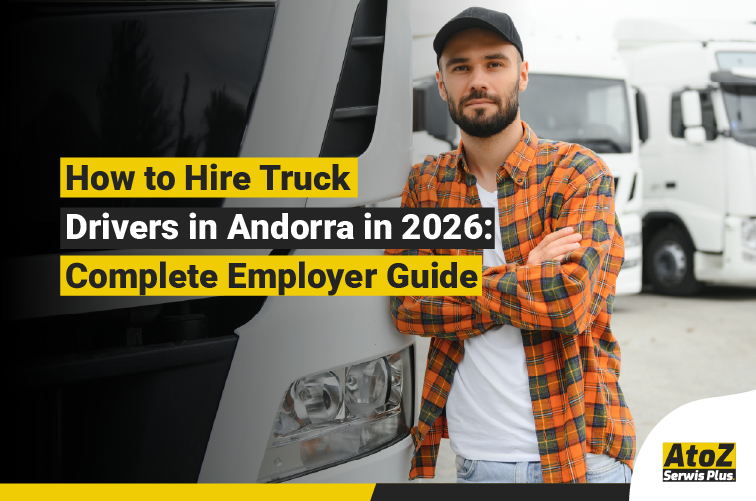
How to Hire Truck Drivers in Andorra in 2026 Complete Employer Guide

Hiring truck drivers in Andorra in 2026 requires honesty about the country’s small size. Andorra is a small Pyrenean principality between Spain and France, with around 80,000 residents, no airport or railway, and a mountainous road network. Goods arrive almost entirely by road from Spain and France, and the haulage that exists is small-scale and tied to those neighbours. For nearly all employers, the realistic place to recruit and base drivers is in the surrounding areas of Spain and France.
This guide is written for employers and is honest throughout about the micro-sized market. It explains the reality in Andorra and points to the far larger driving markets next door.
Be realistic about Andorra. It is a Pyrenean micro-state with a tiny, mountain road-freight market tied to Spain and France. Employers realistically recruit and base drivers in surrounding Spain or France, not inside Andorra.
Can You Hire Truck Drivers in Andorra in 2026?
- Andorra is not in the EU and has its own immigration and work-permit system, with limited quotas.
- The labour market is small, and residence and work authorisations are restricted.
- Most freight is short-haul supply from Spain and France, often handled by drivers based on the other side of the border.
The Realistic Alternative: Spain and France
The large, accessible driving markets are in neighbouring Spain and France, both EU countries with strong CE-driver availability, standard EU qualifications, and clear work-authorisation routes for non-EU drivers. For nearly all employers, recruiting through Spanish- or French-language operations, including routes that touch Andorra, is the practical path.
Licences and Qualifications
For the surrounding EU markets, drivers need category C and ideally C+E (CE), plus the EU Driver CPC (Code 95). Mountain-driving experience is valued on Pyrenean routes.
Work Authorisation In Andorra, expect a restricted, quota-based work and residence permit issued by the Andorran authorities. In Spain or France, EU drivers work freely, and non-EU drivers use those countries’ established routes. Confirm the current rules before relying on them.
Pay and Conditions
Andorra uses the euro and has a relatively high cost of living, but the driving market is tiny. Pay and recruitment opportunities are far greater in the broader Spanish and French markets.
Where to Find Drivers
- Spanish and French driver recruiters, including for routes serving Andorra.
- Operations based in Catalonia and southern France.
- EURES for EU candidates considering Spain or France.
Compliance and Avoiding Pitfalls
For Andorra itself, confirm the restricted-permit status. For the surrounding EU markets, apply the EU driving hours, tachograph, and posting rules. Verify each driver’s status and keep records.
Recruiting in the Spanish and French Market: How It Works
Because Andorra itself offers so little, the practical route for employers is to recruit and base drivers in the Spanish and French markets next door, where the rules are clear and the supply of qualified drivers is far deeper. Treat that market as your real hiring ground: advertise there, work with recruiters who know it, and structure routes, including any that touch Andorra, around operations based across the border. This is how transport companies in the region actually staff work connected to Andorra.
Start by confirming the driver’s nationality, because that determines the route. EU and EEA drivers can be engaged under free movement with a simple registration, while non-EU drivers need the relevant work authorisation route in the country where they will be based. Build the job offer first, then the authorisation, then the contract, and never let a driver begin before each is complete.
Licences, Code 95, and Qualifications to Require
Whichever side of the border your drivers are based on, require category C for rigid trucks and, ideally, category C+E (CE) for articulated vehicles, plus the EU Driver CPC (Code 95), valid medical fitness, and a tachograph driver card. For non-EU drivers running international routes within the EU, you must also obtain the driver attestation, which proves lawful employment for cross-border carriage. Confirm and copy every qualification before the driver starts.
Costs and Timeline to Plan For
Budget for the work-authorisation application, any visa and residence fees, recognition or completion of the professional qualification, medical checks, and the tachograph card. Processing times vary by authority and season, so plan for several weeks to a few months on non-EU routes and build that lead time into your fleet planning. Starting early is the single biggest factor in getting a driver on the road on schedule.
Driving Hours, Rest, and the Tachograph in Practice
Strict driving-hours and rest rules govern operations in the Spanish and French markets, and you are responsible for compliance. Daily driving is capped (commonly nine hours, extendable to ten hours twice a week); a break is required after four and a half hours; and daily and weekly rest must be observed. Download, store, and monitor tachograph data and act on infringements. Realistic route planning keeps drivers legal and rested, reducing accidents and penalties.
Onboarding, Retention, and Duty of Care
In a tight driver market, retention matters as much as recruitment. A structured induction covering your vehicles, routes, and expectations gets drivers productive faster, and fair pay, predictable schedules, well-maintained vehicles, and respect for rest rules keep good drivers. For foreign drivers, help with the initial administrative steps and communicate clearly about pay and routes to build trust and encourage long-term service.
Verifying Right to Work and Avoiding Illegal Employment
Before any driver starts, verify their right to work in the country where they are based and keep the evidence on file. Employing a driver without the correct authorisation, or operating international routes without the required attestation, can result in significant fines, vehicle and operator licence consequences, and reputational damage—re-check documents before they expire and take qualified advice whenever a driver’s status is unclear.
Quick Summary: Hiring Truck Drivers in Andorra in 2026
- Recognise that Andorra is a micro-state with a tiny road freight market.
- Recruit and base drivers in the larger Spanish and French markets.
- Ensure drivers hold category C/C+E and the EU Driver CPC for those markets.
- Use EU free movement or the work authorisation routes of those countries.
- Verify documents and keep records.
Useful Official Links
- Andorra Government portal: https://www.govern.ad
- Spain and France have work-authorisation authorities for the wider market.
- EURES (EU job mobility): https://eures.europa.eu
- Always verify any arrangement independently.
Register With Us Today
Take the first step toward your Europe career. Choose the option that fits you best.
Advertising & Sponsorships
Please complete this form, and an account executive will get back to you quickly.
Register Now!Need to Hire Truck Drivers near Andorra?
Andorra’s micro-market offers few drivers. AtoZ Serwis Plus can help employers recruit truck drivers across Spain and France, with guidance on CE licences, the Driver CPC, and work authorisation.
Important Information About Hiring Truck Drivers in Andorra
Work authorisation rules, licence and professional qualification requirements, driver attestation, wages, tax and social security, and tachograph and EU rules for hiring truck drivers in Andorra are subject to the relevant authorities and current law, all of which are subject to change. Employers remain responsible for verifying each driver’s right to work and qualifications, and for meeting pay, contribution, and compliance obligations.
Disclaimer: AtoZ Serwis Plus provides guidance and informational support only and is not a substitute for qualified legal or tax advice. Work permits, visas, and driver attestations remain subject to the decisions of the relevant authorities.