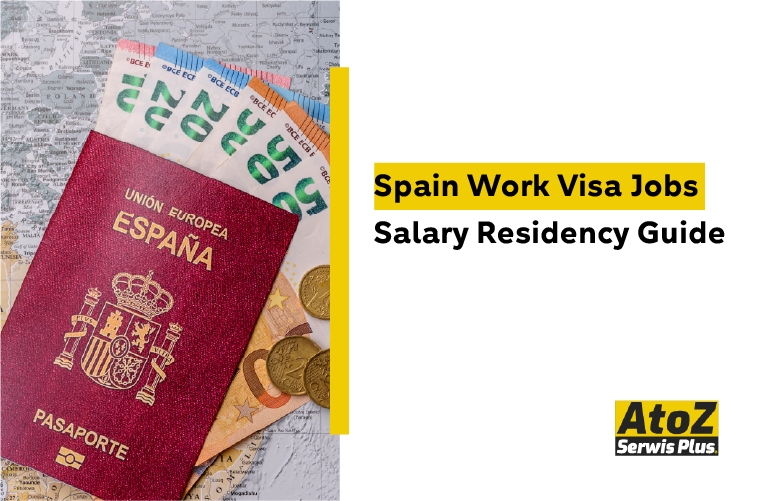
Spain Work Visa Jobs Salary Residency Guide

Spain Work Visa Guide for Foreigners: Jobs, Salary, Requirements & PR Pathway
Spain work visa applications have grown significantly as Spain — the EU's fourth-largest economy, Europe's most visited tourist destination, a growing technology and startup hub, and a country with genuine labour shortages across agriculture, construction, and services — opens its immigration framework through new digital nomad, startup, and tech worker visa categories that are transforming access for internationally mobile professionals and skilled foreign workers worldwide.
About Spain – Country Overview for Foreign Workers
Spain (Reino de España) is a southwestern European country occupying most of the Iberian Peninsula, plus the Canary Islands in the Atlantic Ocean, the Balearic Islands in the Mediterranean Sea, and the cities of Ceuta and Melilla on the North African coast. Capital: Madrid. The population is approximately 47.4 million. EU founding member (EEC accession 1986); Schengen Area member since 1995; Eurozone member since 2002. Official language: Spanish (Castilian); Catalan, Galician, and Basque are co-official in their respective regions—currency: Euro (EUR).
Spain's economy is diverse — traditionally anchored by tourism (one of the world's top two tourist destinations receiving approximately 85 million annual visitors), agriculture (world's leading olive oil producer and one of Europe's top wine producers), automotive manufacturing (SEAT, Ford España), financial services, and real estate. Spain has undergone a significant economic transformation, with a growing technology sector (Barcelona emerging as one of Europe's top five tech cities), a world-leading startup ecosystem (Cabify, Glovo, Wallbox, Flywire), and active government investment in renewables (Iberdrola, Acciona, Endesa).
|
Key Detail |
Information |
|---|---|
|
Capital City |
Madrid |
|
Official Languages |
Spanish (Castilian); Catalan, Galician, Basque (regional co-official) |
|
Currency |
Euro (EUR) — Eurozone member |
|
EU Membership |
Yes — founding member since 1986 |
|
Schengen Area |
Yes — since 1995 |
|
Population |
Approximately 47.4 million |
|
GDP |
World's 14th largest; EU's 4th largest |
|
GDP Growth |
2–3% per year |
|
Time Zone |
CET (UTC+1) / CEST (UTC+2) |
|
Major Industries |
Tourism, Automotive, Agriculture, Financial Services, Renewable Energy, Technology, Real Estate, Aerospace |
|
Work Permit Authority |
Ministry of Inclusion, Social Security and Migration (Ministerio de Inclusión, Seguridad Social y Migraciones) |
Top Cities in Spain for Jobs and Employment Opportunities
|
City |
Key Industries |
Why Foreign Workers Choose It |
|---|---|---|
|
Madrid |
Finance, Technology, Government, Media, Corporate Services, Tourism |
National capital; highest salaries; most international; major startup ecosystem; Banco Santander, BBVA, Telefónica HQs |
|
Barcelona |
Technology, Tourism, Fashion, Architecture, Manufacturing, Logistics |
EU's top 5 tech cities; Mobile World Congress host; SEAT, Vueling; most cosmopolitan city; English widely used |
|
Valencia |
Automotive (Ford España), Logistics, Tourism, Agriculture |
Eastern Spain's largest city; Port of Valencia — major EU logistics hub; Ford España plant |
|
Seville (Sevilla) |
Aerospace (Airbus A400M), Tourism, Agriculture, Services |
Andalusia's capital, Airbus Spain, a major aerospace employer, and a growing digital sector |
|
Bilbao |
Industry, Finance, Tourism, Port Logistics |
Basque Country; BBVA origin; major industrial and banking hub; Guggenheim effect tourism |
|
Málaga |
Technology, Tourism, Real Estate, Digital Economy |
Silicon Valley of Spain; Amazon, Google, Vodafone investment; major expatriate community; lower cost than Madrid/Barcelona |
|
Zaragoza |
Logistics (Amazon), Automotive (Stellantis), Manufacturing |
Strategically located in central Spain, a major logistics hub, with Inditex (Zara) nearby, distribution |
|
Alicante / Costa Blanca |
Tourism, Real Estate, Digital Economy |
Growing digital nomad hub; lower cost of living; international community; Alicante Airport |
Why Work in Spain? Benefits of Working in Spain
Spain offers one of the most compelling combinations of immigration innovation, tax advantages, quality of life, and genuine employment opportunities among EU member states — anchored by landmark new legislation and genuinely transformative tax incentives for internationally mobile workers.
- Spain is a full EU and Schengen Area member — EU-standard employment rights and Schengen travel freedom across 29 European countries from day one of legal employment.
- Euro currency — no exchange rate risk; all salaries, savings, and costs in EUR
- The Beckham Law (Ley Impatriados — LIRNR) — Spain's landmark tax regime for internationally mobile workers; flat 24% income tax on Spanish income up to €600,000/year instead of progressive rates reaching 47%; available for workers transferring to Spain for a new employer or first assignment; available for 5 years; one of Europe's most financially transformative employment tax advantages
- The New Startup Act (Ley de Startups 2023) — Spain's landmark startup legislation; introduced the Digital Nomad Visa; startup founder visa; accelerated residence permits for tech talent; extended Beckham Law eligibility — transforming Spain's international talent attraction capacity
- The Digital Nomad Visa (Visa para Nómadas Digitales) — for remote workers earning at least €2,334/month from non-Spanish employers or clients; Beckham Law flat 24% tax applies; convertible to 3-year residence permit
- Barcelona's world-class tech ecosystem — Mobile World Congress; Amazon, Rakuten, King, Glovo, Cabif, and European tech hubs; English is widely used professionally
- Tourism employment — approximately 85 million tourists annually; the largest tourism sector in the EU by revenue; consistent and large-scale hospitality employment
- Renewable energy sector — Iberdrola (world's largest renewable energy company), Acciona, Endesa; Spain is a European leader in wind and solar energy
- Spanish language — world's second most spoken language by native speakers; 500 million+ speakers across Latin America, Europe, and beyond; learning Spanish in Spain while working is uniquely accessible
- Quality of life — Mediterranean and Atlantic climate; exceptional cuisine; rich culture; beach and mountain access; consistently rated among Europe's highest quality of life
- 30 calendar days paid annual leave — one of the EU's most generous statutory leave entitlements; guaranteed under the Workers' Statute
Safety in Spain for Foreign Workers (Living & Working Conditions)
Spain is safe — consistently ranked among Europe's safer countries with low violent crime rates and effective democratic institutions. EU legal standards apply throughout. Employment rights under the Workers' Statute (Estatuto de los Trabajadores — ET) — 40-hour working week; minimum 30 calendar days paid annual leave (one of Europe's most generous); mandatory social insurance through Seguridad Social; maternity and paternity leave provisions; protection against unfair dismissal.
The Labour Inspection and Social Security Body (Inspección de Trabajo y Seguridad Social — ITSS) enforces compliance with the Workers' Statute, collective agreements, and occupational health and safety standards. Healthcare through the SNS (Sistema Nacional de Salud) — universal public healthcare for all residents registered at the Ayuntamiento (empadronamiento). The SNS provides primary care, specialist services, hospitalisation, prescription medicines, and emergency care at no direct cost to registered workers contributing to Seguridad Social.
Who Can Apply for a Spanish Work Visa? (Eligibility Criteria)
|
Eligibility Criteria |
Requirement Details |
|---|---|
|
Nationality |
EU/EEA/Swiss nationals work freely; non-EU nationals require work authorisation. |
|
Job Offer |
Required for standard Work and Residence Authorisation; NOT required for Digital Nomad Visa or Startup Founder Visa |
|
Income Requirement (Digital Nomad) |
Minimum €2,334/month (200% of SMI — Spanish minimum wage) from non-Spanish employers or clients |
|
Labour Market Test |
Standard authorisation: employer must verify Catálogo de Ocupaciones de Difícil Cobertura; shortage occupations simplified; Startup Act categories exempt |
|
Minimum Age |
18 years for standard employment categories |
|
Criminal Record |
Clean criminal record required; apostilled certificate with certified Spanish Translation |
|
Passport Validity |
Minimum 1 year validity beyond the application date |
|
Accommodation |
Confirmed address in Spain is required for all residency categories |
|
Health Insurance |
Valid health insurance required until SNS registration through empadronamiento and Seguridad Social |
|
Employer Registration |
For standard authorisation, the employer must be registered with TGSS (Tesorería General de la Seguridad Social) and must be up to date with all social security contributions. |
|
Medical Certificate |
Required for standard work visa applications; confirming fitness for work |
|
Language |
Not formally required for visa; B1 Spanish required for citizenship (SIELE exam); effectively required for most non-IT employment. |
Spain Work Visa Overview for Foreign Workers
Spain's work authorisation framework for third-country nationals has undergone its most significant reform in decades through the Ley de Startups 2023 (Startup Act) and associated regulations. The traditional framework — centred on the work and residence authorisation (Autorización de Residencia y Trabajo) requiring a labour market test through the Catálogo de Ocupaciones de Difícil Cobertura — has been supplemented with genuinely fast-track instruments for technology, innovation, and remote workers.
The primary authority for work authorisation is the Delegación del Gobierno (national government representative in each province), which processes standard work authorisation applications. The Unidad de Grandes Empresas y Colectivos Estratégicos (UGE-CE) processes Startup Act permits, Digital Nomad Visas, Intra-Company Transfer permits, and EU Blue Cards — typically with significantly faster processing than standard provincial channels.
Non-EU nationals must obtain both a work authorisation and a long-stay visa (Type D) before entering Spain for employment purposes. Upon arrival, they must register with the Policía Nacional to obtain the NIE (Número de Identificación de Extranjeros) and apply for the TIE (Tarjeta de Identidad de Extranjero), a biometric residence card.
Types of Spain Work Visa and Employment Permits
|
Permit / Visa Type |
Who It Is For |
Maximum Duration |
Key Feature |
|---|---|---|---|
|
Work and Residence Authorisation (Autorización de Residencia y Trabajo por Cuenta Ajena) |
Non-EU employed workers with a Spanish employer |
1 year (renewable to 2, then 4 years) |
Most common standard route; labour market test required; employer-specific |
|
Highly Qualified Workers (Startup Act) |
Professionals meeting criteria under the 2023 Startup Act |
Up to 3 years |
Faster processing via UGE-CE; Beckham Law eligible; reduced bureaucracy |
|
Digital Nomad Visa (Visado para Nómadas Digitales) |
Remote workers for non-Spanish employers/clients; ≥€2,334/month |
1 year (convertible to 3-year residence) |
No Spanish employer required; Beckham Law flat 24% tax; processed via UGE-CE |
|
Startup Founder Visa |
Founders of innovative startup companies |
1 year (extendable) |
ENISA or ICEX evaluation; Beckham Law eligible; UGE-CE processed |
|
Intra-Company Transfer (ICT) |
Managers, specialists, or trainees transferred within multinationals |
Up to 3 years (managers/specialists); 1 year (trainees) |
No labour market test; fast-track UGE-CE processing |
|
EU Blue Card Spain (Tarjeta Azul UE) |
Highly qualified professionals; salary ≥ 1.5x average gross |
Up to 2 years (renewable) |
EU mobility after 18 months; no labour market test; UGE-CE |
|
Seasonal Work Permit (Contingente) |
Agriculture, horticulture, and seasonal tourism |
Up to 9 months |
Bilateral agreements (Morocco and others); simplified process |
|
Self-Employment Authorisation (Cuenta Propia) |
Non-EU nationals establishing a self-employment business |
1 year (renewable) |
Business plan; viability assessment; TGSS registration |
|
EU Long-Term Resident Permit (Residencia de Larga Duración UE) |
After 5 years of continuous legal residence |
5 years (renewable indefinitely) |
Permanent residency equivalent; EU-wide mobility rights |
Spain Work Visa Requirements for Non-EU Citizens
The following requirements apply to non-EU nationals applying for a Spanish Work and Residence Authorisation or Digital Nomad Visa. Specific requirements vary by permit category.
- Valid passport with at least 1 year validity beyond the application date, with sufficient blank pages
- Completed the national visa application form and submitted it at the Spanish embassy or consulate in the home country
- Recent passport-size photographs meeting Spanish consulate specifications — typically 2 photographs, 32x26mm, white background
- For standard authorisation: signed employment contract or binding job offer from a TGSS-registered Spanish employer specifying position, gross monthly EUR salary, working hours, workplace address, and duration.n
- For Digital Nomad Visa: proof of remote work income from non-Spanish sources — employment contract with foreign employer or service contracts with foreign clients; bank statements confirming ≥ €2,334/month
- NIE (Número de Identificación de Extranjeros) — applied for at the Policía Nacional upon arrival in Spain; essential for all subsequent procedures
- Proof of accommodation in Spain — signed tenancy agreement or certified owner declaration; verifiable Spanish address.s
- Criminal record certificate from home country and from any country of residence for more than 6 months in the past 5 years; apostille where required; certified Spanish Translation
- Medical certificate confirming fitness and absence of communicable diseases — issued by a physician recognised by the Spanish consulate.
- For the Beckham Law application: submitted to the Agencia Tributaria within 6 months of the first Spanish payslip
- For regulated professions: formal recognition of qualifications by the relevant Spanish professional body before employment commences
- Health insurance valid in Spain for the initial period until SNS registration is completed through empadronamiento and Seguridad Social
- Proof of payment of the Spanish visa application fee
Required Documents for Spain Work Visa Application
|
Document |
Source / Issuing Authority |
Key Requirements |
|---|---|---|
|
Valid Passport |
Government of the applicant's home country |
Minimum 1 year validity; sufficient blank pages |
|
Visa Application Form |
Spanish consulate / exteriores.gob.es |
Fully completed; signed; consistent with supporting documents |
|
Passport Photographs |
Certified photo studio |
2 photos; 32x26mm; white background; recent |
|
Employment Contract (Standard) |
Spanish employer |
Gross EUR monthly salary; position; working hours; address; start date |
|
Income Proof (Digital Nomad) |
Foreign employer/client contracts + bank statements |
Demonstrates ≥ €2,334/month from non-Spanish sources |
|
Employer TGSS Registration (Standard) |
Spanish employer |
Confirms Social Security registration; TGSS compliance |
|
Catálogo Verification (Standard) |
Delegación del Gobierno |
Confirms the shortage occupation status or the labour market test result |
|
Accommodation Proof |
Landlord or owner |
Signed tenancy or certified declaration; Spanish address |
|
Criminal Record Certificate |
Home country police authority |
Issued within 3 months; apostille; certified SpanishTranslationn |
|
Medical Certificate |
Consulate-approved physician |
Fitness for work; absence of communicable diseases |
|
Health Insurance |
Licensed insurer |
Valid in Spain; covers the initial period before SNS registration |
|
Professional Qualifications (regulated) |
Academic institutions + professional bodies |
Notarised copies; certified Spanish translations; Spanish authority recognition |
|
Fee Payment Receipt |
Spanish consulate |
Confirms payment of the visa application fee |
Spain Work Visa vs Residence Permit – What Is the Difference?
|
Aspect |
Spanish Work Authorisation + Type D Visa |
TIE (Tarjeta de Identidad de Extranjero) Residence Card |
|---|---|---|
|
Legal Function |
Authorises entry into Spain for employment purposes; the starting point for the process |
The biometric card confirming the right to reside and work in Spain is the primary physical identity document. |
|
Issued By |
Delegación del Gobierno (authorisation) + Spanish consulate (Type D visa) |
Policía Nacional — applied for after arrival in Spain |
|
Where You Apply |
Abroad — authorisation at Delegación del Gobierno; visa at Spanish diplomatic mission |
Inside Spain — at the Policía Nacional after arrival |
|
Typical Duration |
Type D visa: typically 3–6 months; authorisation: 1 year initially |
TIE card: mirrors authorisation duration (1, 2, or 4 years) |
|
Physical Form |
Visa sticker in passport |
Biometric plastic card with photograph and fingerprint data |
|
Tied to Employer? |
Standard: yes (employer named). Digital Nomad: no (remote work basis). |
Standard: employer-specific. Digital Nomad/Startup Act: not employer-specific |
|
Schengen Travel |
Full Schengen Area travel during validity |
Full Schengen Area travel throughout TIE validity |
|
Key Practical Note |
The employer must file the authorisation at the Delegación del Gobierno 1–3 months before the intended start date. |
TIE appointment at Policía Nacional must be booked early — slots are limited in major cities |
|
Contribution to PR |
Begins from the date of legal entry with a valid authorisation |
Each day of valid TIE residence counts toward the 5-year EU LTR qualifying period |
Top In-Demand Jobs in Spain for Foreigners
Spain's labour market faces documented shortages across multiple sectors driven by structural demographic changes, the rapid expansion of the technology and renewable energy sectors, and sustained emigration of Spanish workers during the economic crises of 2008–2014. The following sectors show the strongest and most consistent demand for foreign workers.
- Information Technology and Software Development: Barcelona and Madrid are internationally recognised technology hubs. The presence of Amazon Spain, Google Spain, Microsoft Spain, Booking.com Spain, King (Candy Crush), Glovo, Cabify, and a world-class startup ecosystem creates exceptional demand for software engineers, cloud engineers, data scientists, cybersecurity specialists, machine learning engineers, UX/UI designers, and IT project managers. Barcelona's Mobile World Congress ecosystem has made it one of Europe's top destinations for international technology professionals.
- Renewable Energy: Spain is a European leader in renewable energy — with Iberdrola (world's largest renewable energy company), Acciona, and Endesa driving massive investment in wind and solar infrastructure. The green energy transition creates sustained demand for electrical engineers, wind and solar installation technicians, energy project managers, grid engineers, and environmental specialists.s
- Healthcare: Spain faces a documented shortage of healthcare professionals — particularly in primary care (médicos de familia), specialist medicine (anaesthesiology, radiology, psychiatry, emergency medicine), nursing, and dental care. The Spanish public health system (SNS) and the growing private sector both actively recruit internationally.
- Construction and Civil Engineering: Spain's renewed construction boom — driven by housing shortages in major cities, tourism accommodation expansion, renewable energy infrastructure, and major EU-funded infrastructure projects — creates strong demand for civil engineers, architects, project managers, electricians, plumbers, scaffolders, and general construction operatives
- Tourism and Hospitality: Spain's 85 million annual visitors generate the EU's largest tourism employment base. Hotel managers, executive chefs, food and beverage professionals, tour guides, spa and wellness specialists, and front office professionals are in year-round demand in Madrid, Barcelona, and the Balearic, Canary, and Mediterranean coastal regions.
- Aerospace: Spain's aerospace sector — centred on Airbus España (CASA/A400M programmes), Indra, GMV, and Sener — creates demand for aeronautical engineers, systems engineers, software engineers, and aerospace manufacturing specialists, particularly in Madrid, Seville, and Cád.i.z.
- Financial Services: Madrid's financial sector hosts the headquarters of Banco Santander, BBVA, CaixaBank, Mapfre, and major international financial institutions; consistent demand for financial analysts, compliance specialists, risk managers, AML officers, and fintech professionals
- Agriculture and Food Production: Spain is the EU's largest agricultural exporter and the world's leading olive oil producer,r — with consistent demand for seasonal agricultural workers for strawberry, grape, olive, and citrus harvests throughout the southern and eastern regions
- Logistics and Transportation: Spain's central role in EU-Africa trade logistics, combined with the growth of e-commerce (Amazon, Zara/Inditex distribution), creates demand for HGV drivers, logistics managers, warehouse operatives, and supply chain specialists
Top 20 Blue-Collar Jobs in Spain for Foreign Workers
|
No. |
Job Title |
Sector |
Avg. Gross Monthly Salary (EUR) |
Notes |
|---|---|---|---|---|
|
1 |
Electrician (Industrial / Construction) |
Construction & Industry |
€1,600 – €3,000 |
Strong demand; housing and energy infrastructure boom |
|
2 |
Plumber / Pipefitter |
Construction |
€1,500 – €2,800 |
Residential and commercial construction demand |
|
3 |
Welder (MIG/MAG/TIG) |
Manufacturing / Construction |
€1,500 – €2,800 |
Automotive and industrial sector demand |
|
4 |
HGV / Heavy Vehicle Driver (Cat. C+E) |
Logistics & Transport |
€1,800 – €3,200 |
Significant shortage; Iberian Peninsula freight |
|
5 |
Construction General Labourer |
Construction |
€1,200 – €2,000 |
Housing boom and infrastructure demand |
|
6 |
Scaffolder |
Construction |
€1,400 – €2,500 |
Active construction pipeline nationwide |
|
7 |
Automotive Assembly Technician |
Automotive |
€1,400 – €2,500 |
SEAT, Ford España, Stellantis plants |
|
8 |
CNC Machine Operator |
Manufacturing |
€1,400 – €2,500 |
Automotive supply chain and industrial machining |
|
9 |
HVAC Technician |
Building Services |
€1,500 – €2,800 |
Growing demand; energy efficiency retrofit |
|
10 |
Roofer / Waterproofing Specialist |
Construction |
€1,300 – €2,300 |
Residential and tourism accommodation construction |
|
11 |
Carpenter / Joiner |
Construction |
€1,300 – €2,300 |
High-quality construction and interior fit-out |
|
12 |
Painter and Decorator |
Construction |
€1,200 – €2,000 |
Consistent residential and hospitality demand |
|
13 |
Forklift Operator |
Warehousing & Logistics |
€1,200 – €2,100 |
Amazon, Inditex, DHL logistics operations |
|
14 |
Agricultural / Farm Worker (Seasonal) |
Agriculture |
€1,000 – €1,600 |
Strawberry (Huelva), grape (Rioja), olive harvest |
|
15 |
Hotel Housekeeper |
Hospitality |
€1,100 – €1,700 |
Tourism sector: consistent year-round demand |
|
16 |
Kitchen Porter / Commis Chef |
Hospitality |
€1,100 – €1,700 |
Restaurant and hotel sector demand |
|
17 |
Security Guard |
Security Services |
€1,200 – €2,000 |
Tourism, corporate, and event security |
|
18 |
Care Worker / Home Carer |
Social Care |
€1,100 – €1,700 |
Ageing population; consistent and growing demand |
|
19 |
Warehouse Operative / Picker-Packer |
Logistics / E-commerce |
€1,200 – €1,900 |
Amazon Spain; Inditex/Zara; DHL |
|
20 |
Wind / Solar Installation Technician |
Renewable Energy |
€1,500 – €2,800 |
World's largest renewable energy expansion |
Note: All figures represent approximate gross monthly earnings in EUR. Net take-home pay is lower after Spanish income tax (standard progressive IRPF rates up to 47%, or a flat 24% under Beckham Law) and Seguridad Social employee contributions (approximately 6.35% of gross pay). Workers qualifying for Beckham Law pay a flat 24% income tax — a significant net income advantage over standard IRPF rates.
Top 20 White-Collar Jobs in Spain for Foreign Professionals
|
No. |
Job Title |
Sector |
Avg. Gross Monthly Salary (EUR) |
Notes |
|---|---|---|---|---|
|
1 |
Software Developer / Engineer |
IT / Technology |
€2,500 – €5,500 |
Barcelona and Madrid are higher-end, fastest-growing |
|
2 |
DevOps / Cloud Engineer |
IT |
€3,000 – €6,500 |
AWS, Google, and Microsoft cloud operations in Spain |
|
3 |
Data Scientist / ML Engineer |
IT / Analytics |
€3,000 – €6,000 |
Barcelona AI Hub; fintech and tech demand |
|
4 |
Cybersecurity Specialist |
IT / Security |
€3,000 – €6,500 |
Indra, GMV, banking sector demand |
|
5 |
IT Project Manager / Product Manager |
IT |
€2,800 – €5,500 |
Digital transformation cross-sector demand |
|
6 |
Aerospace Engineer |
Aerospace |
€2,500 – €5,000 |
Airbus España, Indra, SENER, GMV |
|
7 |
Automotive Engineer |
Automotive |
€2,200 – €4,500 |
SEAT (VW Group), Ford España supply chain |
|
8 |
Renewable Energy Engineer |
Renewable Energy |
€2,500 – €5,500 |
Iberdrola, Acciona, Endesa — world-scale employer |
|
9 |
Doctor / Medical Specialist |
Healthcare |
€2,500 – €6,000 |
SNS public; higher in the private sector |
|
10 |
Registered Nurse |
Healthcare |
€1,600 – €2,800 |
Documented shortage nationwide |
|
11 |
Civil / Structural Engineer |
Construction |
€2,000 – €4,000 |
Infrastructure and housing programme |
|
12 |
Financial Analyst / Controller |
Finance |
€2,200 – €4,500 |
Madrid financial sector |
|
13 |
Compliance / AML Officer |
Banking & Finance |
€2,500 – €5,000 |
Santander, BBVA, CaixaBank demand |
|
14 |
Hotel / Tourism Manager |
Hospitality |
€2,200 – €4,500 |
Premium tourism sector demand |
|
15 |
Executive Chef |
Hospitality |
€2,000 – €4,000 |
World-class Spanish gastronomy sector |
|
16 |
Marketing Manager / Digital Marketing |
Marketing |
€2,000 – €4,000 |
Tech, tourism, and FMCG demand |
|
17 |
HR Business Partner |
Human Resources |
€2,200 – €4,200 |
Multinational SSC environments |
|
18 |
Legal Counsel / Corporate Lawyer |
Legal |
€2,800 – €6,000 |
Madrid and Barcelona legal sectors |
|
19 |
Supply Chain / Logistics Manager |
Operations |
€2,200 – €4,500 |
Inditex, Amazon, automotive |
|
20 |
UX / UI Designer |
IT / Product |
€2,000 – €4,500 |
Tech startup and digital agency demand |
Average Salary in Spain by Industry
|
Industry / Sector |
Entry-Level (EUR/month gross) |
Mid-Level (EUR/month gross) |
Senior-Level (EUR/month gross) |
|---|---|---|---|
|
Information Technology |
€2,000 – €3,000 |
€3,200 – €5,500 |
€6,000 – €10,000+ |
|
Renewable Energy |
€2,000 – €3,000 |
€3,200 – €5,500 |
€6,000 – €10,000 |
|
Finance & Banking |
€1,800 – €2,800 |
€3,000 – €5,000 |
€5,500 – €9,500 |
|
Aerospace & Defence |
€2,000 – €3,200 |
€3,500 – €5,500 |
€6,000 – €10,000 |
|
Automotive & Manufacturing |
€1,600 – €2,600 |
€2,800 – €4,500 |
€5,000 – €8,500 |
|
Healthcare & Pharmaceuticals |
€1,600 – €2,600 |
€2,800 – €5,000 |
€5,500 – €9,000 |
|
Construction & Engineering |
€1,500 – €2,500 |
€2,700 – €4,200 |
€4,500 – €8,000 |
|
Tourism, Hospitality & Luxury |
€1,200 – €2,000 |
€2,200 – €3,800 |
€4,000 – €7,500 |
|
Legal & Compliance |
€1,800 – €2,800 |
€3,000 – €5,500 |
€6,000 – €11,000 |
|
Logistics & Transportation |
€1,300 – €2,200 |
€2,400 – €3,800 |
€4,000 – €7,000 |
|
Agriculture & Food |
€1,100 – €1,800 |
€1,900 – €3,000 |
€3,200 – €5,500 |
|
Retail & Consumer |
€1,184 – €1,800 |
€1,900 – €2,800 |
€3,000 – €5,000 |
Note: Spain's average gross monthly salary is approximately €2,200–€2,600. Madrid reports 15–25% above average; Barcelona reports 10–20% above average. Beckham Law flat 24% IRPF significantly improves the net salary position for qualifying workers compared to standard progressive rates.
Minimum Wage in Spain
Spain's statutory minimum wage is the Salario Mínimo Interprofesional (SMI) — set annually by the government through tripartite negotiation.
|
Period |
EUR/month (14 payments/year) |
Daily Rate (EUR) |
Annual Gross (EUR) |
Notes |
|---|---|---|---|---|
|
January 2022 |
€1,000 |
€33.33 |
€14,000 |
— |
|
January 2023 |
€1,080 |
€36.00 |
€15,120 |
8.0% increase |
|
January 2024 |
€1,134 |
€37.80 |
€15,876 |
5.0% increase |
|
January 2025 |
€1,184 |
€39.47 |
€16,576 |
Current statutory rate |
|
Projected 2026 |
~€1,250+ |
~€41.67+ |
~€17,500+ |
Government commitment |
Important: Spain pays salaries in 14 payments per year (12 monthly + 2 annual bonus payments — pagas extraordinarias — in July and December). The SMI figures above are per payment. The Digital Nomad Visa income threshold is set at 200% of the SMI — approximately €2,334/month (verify with authorities, as this adjusts with SMI changes).
Living Costs in Spain for Foreign Workers
|
Expense Category |
Madrid (EUR/month) |
Barcelona (EUR/month) |
Valencia / Seville (EUR/month) |
Málaga / Smaller Cities (EUR/month) |
|---|---|---|---|---|
|
Rent — 1-bedroom (city centre) |
€1,200 – €2,200 |
€1,300 – €2,500 |
€800 – €1,500 |
€700 – €1,300 |
|
Rent — 1-bedroom (outer areas) |
€900 – €1,600 |
€950 – €1,700 |
€600 – €1,100 |
€550 – €1,000 |
|
Utilities (electricity, water, gas) |
€100 – €200 |
€100 – €200 |
€90 – €185 |
€80 – €170 |
|
Groceries |
€280 – €450 |
€290 – €470 |
€250 – €420 |
€230 – €400 |
|
Public transport (monthly pass) |
€20 – €55 (Abono) |
€40 – €80 (T-Casual) |
€30 – €60 |
€20 – €50 |
|
Private health supplement |
€30 – €80 |
€30 – €85 |
€25 – €75 |
€22 – €70 |
|
Mobile/Internet |
€20 – €45 |
€22 – €48 |
€18 – €42 |
€15 – €40 |
|
Dining out (per meal) |
€10 – €28 |
€12 – €32 |
€8 – €24 |
€7 – €22 |
|
Entertainment, leisure, sport |
€150 – €400 |
€180 – €450 |
€120 – €350 |
€100 – €300 |
|
Total Monthly (single person) |
€1,800 – €3,500 |
€2,000 – €3,900 |
€1,400 – €3,000 |
€1,200 – €2,500 |
Note: Housing costs in Madrid and Barcelona have increased significantly since 2021. Many workers choose to live in outer districts or commute from surrounding municipalities where rent is 30–40% lower. Málaga offers excellent value with a growing professional community, warm climate, and significantly lower living costs than Madrid or Barcelona.
Job Market Trends and Employment Opportunities in Spain
|
Sector |
Current Market Status |
Growth Outlook |
Primary Roles for Foreign Workers |
|---|---|---|---|
|
Technology (Barcelona/Madrid/Málaga) |
Very strong; major multinationals expanding |
Very strong |
Software engineers, DevOps, data scientists, cybersecurity |
|
Renewable Energy |
World-leading; Iberdrola, Accion, a global expansion |
Very strong — strategic national priority |
Electrical engineers, wind/solar technicians, project managers |
|
Tourism & Hospitality |
Record visitor numbers; premium segment growing |
Very strong and sustained |
Hotel managers, chefs, F&B professionals, guides |
|
Healthcare |
Documented shortage — SNS recruitments are active |
Urgent |
Doctors, nurses, GPs, physiotherapists, pharmacists |
|
Construction |
Housing shortage; major infrastructure pipeline |
Very strong |
Civil engineers, electricians, plumbers, and site managers |
|
Aerospace (Airbus, Indra) |
Established and growing |
Strong |
Aerospace engineers, systems engineers, software |
|
Financial Services |
Madrid established a hub; fintech is growing |
Moderate to strong |
Financial analysts, compliance, and fintech developers |
|
Automotive (SEAT, Ford, Stellantis) |
EV transition underway |
Evolving |
EV engineers, quality specialists, production technicians |
|
Agriculture |
Consistent seasonal demand; agri-tech growing |
Stable |
Seasonal workers, agri-tech specialists |
|
Logistics |
Amazon, Inditex, and DHL operations are expanding |
Strong |
HGV drivers, warehouse managers, logistics coordinators |
Top Companies in Spain Hiring Foreign Professionals
|
Company |
Industry |
Location |
|---|---|---|
|
Banco Santander |
Banking & Finance |
Madrid (HQ) |
|
BBVA |
Banking & Finance |
Madrid (HQ) |
|
Inditex (Zara, Massimo Dutti, Pull&Bear) |
Fashion / Retail / Logistics |
Arteixo (A Coruña) + nationwide |
|
Telefónica |
Telecommunications / Technology |
Madrid |
|
Iberdrola |
Renewable Energy |
Bilbao (HQ) + worldwide |
|
Repsol |
Energy |
Madrid |
|
ACS Group |
Construction & Infrastructure |
Madrid |
|
Acciona |
Renewable Energy / Infrastructure |
Madrid |
|
Indra |
Technology / Aerospace / Defence |
Madrid |
|
Airbus España |
Aerospace Manufacturing |
Seville / Madrid |
|
SEAT (Volkswagen Group) |
Automotive |
Martorell (Barcelona) |
|
Ford España |
Automotive |
Valencia (Almussafes) |
|
Amazon Spain |
E-commerce / Logistics / Cloud |
Madrid / Barcelona |
|
Google Spain |
Technology |
Madrid / Barcelona |
|
Microsoft Spain |
Technology |
Madrid |
|
Booking.com Spain |
Travel Technology |
Barcelona |
|
Glovo |
Delivery Technology |
Barcelona |
|
Cabify |
Mobility Technology |
Madrid |
|
Deloitte Spain / PwC Spain / KPMG Spain / EY Spain |
Professional Services |
Madrid / Barcelona |
|
CaixaBank |
Banking |
Barcelona |
Step-by-Step Process to Apply for a Spanish Work Visa
|
Step |
Action |
What You Need to Know |
|---|---|---|
|
Step 1 |
Employer verifies Catálogo de Ocupaciones de Difícil Cobertura |
Check whether the occupation is listed in the shortage catalogue — listed occupations require a simplified labour market test; unlisted occupations require full documentation that no EU/EEA/Spanish candidate was available. The Startup Act and Digital Nomad categories are exempt. |
|
Step 2 |
Employer files work authorisation at Delegación del Gobierno |
Employer submits an application to the provincial Delegación del Gobierno, including the employment contract, company TGSS registration, labour market test documentation, workplace address details, and all required forms. |
|
Step 3 |
Delegación del Gobierno processes authorisation. |
Standard processing: 1–3 months. UGE-CE (Digital Nomad, Startup Act, ICT, Blue Card): typically 20 working days. Respond promptly to any requests for additional documentation. |
|
Step 4 |
Work authorisation approved; worker applies for Type D visa |
Present approved work authorisation, passport, apostilled criminal record certificate with certified Spanish Translation, medical certificate, accommodation confirmation, and health insurance at the Spanish embassy/consulate in the home country. |
|
Step 5 |
Spanish consulate processes Type D visa |
Typically 2–4 weeks. |
|
Step 6 |
Travel to Spain within visa validity |
Typically, within 90 days of visa issuance. |
|
Step 7 |
Obtain NIE (Número de Identificación de Extranjeros) |
Register with the Policía Nacional within 30 days of arrival, presenting the passport and visa. Receive NIE — essential for all Spanish administrative procedures. |
|
Step 8 |
Register at Ayuntamiento (Empadronamiento) |
Register the address at the Call municipality. Receive padrón municipal certificate — required for SNS, school enrolment, and many other services. |
|
Step 9 |
Apply for the TIE (Tarjeta de Identidad de Extranjero) biometric card |
Apply to Policía Nacional. Present passport, NIE, work authorisation approval, empadronamiento, photographs, and fee payment. TIE is your physical biometric residence and work permit card. |
|
Step 10 |
Employer registers with TGSS on the first working day |
Employer completes Seguridad Social (TGSS) registration from day one of employment. The worker receives a Social Security number. |
|
Step 11 |
Register with SNS Centro de Salud |
Present the empadronamiento certificate and TGSS registration at the local Centro de Salud to activate the SNS healthcare card. |
|
Step 12 |
Apply for Beckham Law status (if eligible) |
Submit the application to Agencia Tributaria (AEAT) within 6 months of the date of the first Spanish payslip. This window is critical — missing it forfeits Beckham Law eligibility for the entire qualifying period. |
Spain Work Visa Processing Time and Approval Timeline
|
Stage |
Process Description |
Typical Timeframe |
|---|---|---|
|
Stage 1 |
Catálogo verification or labour market test preparation |
2–4 weeks |
|
Stage 2 |
Employer work authorisation application submission |
1–3 working days |
|
Stage 3 |
Delegación del Gobierno processing (standard) |
1–3 months |
|
Stage 4 |
UGE-CE processing (Digital Nomad, Startup Act, ICT, Blue Card) |
20 working days |
|
Stage 5 |
Spanish consulate Type D visa processing |
2–4 weeks |
|
Stage 6 |
NIE registration at Policía Nacional after arrival |
Within 30 days of arrival |
|
Stage 7 |
Empadronamiento en el Ayuntamiento |
Within the first week of arrival |
|
Stage 8 |
TIE appointment and biometric card collection |
TIE appointment: 1–4 weeks; card collection: 1–3 weeks after appointment |
|
Stage 9 |
TGSS social security registration |
Day 1 of employment — employer responsibility |
|
Stage 10 |
Beckham Law application to AEAT |
Within 6 months of the first payslip — hard deadline |
|
Total — Standard Route |
Employer initiation of the TIE card in hand |
3–6 months |
|
Total — UGE-CE Fast-Track |
Digital Nomad / Startup Act / ICT |
6–10 weeks |
Spain Work Visa Cost and Government Fees
|
Fee Item |
Payable By |
Approximate Amount (EUR) |
|---|---|---|
|
Work Authorisation Application |
Employer |
€10.62 – €21.24 (Modelo 790 Code 052) |
|
TIE (Tarjeta de Identidad de Extranjero) Card |
Applicant |
€15 – €25 (Modelo 790 Code 012) |
|
Spanish Type D National Visa |
Applicant |
~€80 at the Spanish consulate |
|
NIE Registration |
Applicant |
~€10 (Modelo 790 Code 012) |
|
Apostille (criminal record and other documents) |
Applicant |
Varies by home country — typically €20–€60 per document |
|
Certified Spanish Translation (per page) |
Applicant |
€40–€90 per page, depending on translator and document |
|
Medical Certificate |
Applicant |
€50–€150 at consulate-approved clinic |
|
Health Insurance (pending SNS registration) |
Applicant |
€30–€100 per month |
|
Beckham Law AEAT Application |
Applicant |
Free — submitted online through the AEAT portal |
Note: Spain's government application fees are among the most affordable in the EU — the combined authorisation and TIE fees total approximately €30–€50. The high practical costs are certified translations, apostilles, and medical certificates rather than administrative fees. For Digital Nomad and Startup Act categories processed through UGE-CE, the same fee structure applies with faster processing.
Common Reasons for Spain Work Visa Rejection
|
Reason for Rejection |
Explanation and Prevention |
|---|---|
|
Labour market test inadequately documented |
For standard authorisations not on the Catálogo shortage list, the employer must document that no Spanish, EU/EEA, or legally resident non-EU candidate applied for the vacancy despite it being properly advertised. Incomplete documentation is a common cause of rejection. |
|
Employer TGSS non-compliance |
The Spanish employer must be current with all Seguridad Social (TGSS) contributions. Any outstanding TGSS debt or registration irregularity results in the authorisation being refused. |
|
Income below Digital Nomad threshold |
D8 Nomad Visa income requirement (200% of SMI — approximately €2,334/month) must be clearly documented with contracts and bank statements: income shortfall or inability to document the cause of refusal. |
|
Medical certificate expired or not from an approved source |
Medical certificates must be issued by a physician specifically approved by the Spanish consulate and must be valid for the specified period. |
|
Documents not apostilled and translated. |
All non-Spanish documents must have a valid apostille (for Hague Convention countries) and a certified Spanish translation by a sworn translator (traductor jurado). Missing either causes automatic delay or refusal. |
|
Criminal record concealed or certificate outdated |
All convictions must be disclosed; the certificate must be current (within 3 months) and properly authenticated. |
|
Beckham Law application filed late. |
The 6-month window from the first payslip is absolute. Missing it forfeits Beckham Law status entirely for the qualifying period — one of the most costly and avoidable administrative errors for qualifying workers. |
|
Occupation outside the authorised scope |
Workers cannot perform duties substantially different from those specified in the approved authorisation. Working outside the approved scope constitutes an immigration violation. |
|
Empadronamiento not completed |
Failure to register at the Ayuntamiento prevents TIE application and SNS registration. |
|
TIE renewal not filed before expiry |
Failure to renew the TIE before it expires creates a gap in legal status that can affect the calculation of the 5-year EU LTR qualifying period. |
Tips to Get a Job in Spain Faster (For Foreigners)
- Target the Beckham Law window immediately upon starting employment: The Beckham Law application must be submitted within 6 months of the first Spanish payslip. Eligible workers who miss this window lose the flat 24% tax advantage for their entire 5-year qualifying period — potentially losing tens of thousands of euros in net salary. Prioritise this application from day one.
- Digital Nomad Visa is the fastest and simplest entry route for remote workers: Processed by UGE-CE in approximately 20 working days; no Spanish employer needed; Beckham Law flat 24% tax applies. If you earn ≥€2,334/month from non-Spanish sources, this is the most accessible and financially advantageous route available.e
- Barcelona for technology — English is widely accepted professionally: Mobile World Congress ecosystem; Amazon, King, Booking.com, Glovo, Vueling tech operations; large international professional community; Startup Act fast-track processing via UGE-CE.
- Verify the Catálogo de Ocupaciones de Difícil Cobertura before accepting any job offer: If your occupation is listed, the labour market test is simplified — significantly reducing employer administrative burden and processing time. The Catálogo is updated quarterly by SEP.E.
- Learn Spanish — even at A2–B1 level — before arriving: Spanish proficiency is effectively required for most employment outside IT and multinational corporate environments in Barcelona and Madrid. It is formally required for citizenship (B1 SIELE exam) and strongly recommended for healthcare, construction, hospitality, and all positions in regional cities.s
- Use Spanish job portals actively: InfoJobs.net (Spain's largest — equivalent to LinkedIn for volume), Tecnoempleo.com (IT-specific, high quality), LinkedIn Spain (essential for professional, management, and international roles), Computrabajo.es, and direct employer career portals for Inditex, Iberdrola, Banco Santander, BBVA, Airbus España, and S.E.AT.
- Target Málaga as an alternative to Barcelona and Madrid: Amazon, Google, and Vodafone have made significant investments in Málaga's technology ecosystem; the cost of living is 35–45% lower than in Barcelona; a growing international professional community; excellent climate; Málaga Tech Park (PTA — Parque Tecnológico de Andalucía) hosts hundreds of technology companies
- Empadronamiento is your administrative foundation: Complete the Ayuntamiento address registration as soon as you have a Spanish address — it is required for TIE, SNS, school enrolment, and virtually every other administrative step. Bring passport, address proof (lease agreement), and padrón application form
Pathway from Spain Work Permit to Permanent Residency (PR)
|
Stage |
Legal Status |
Duration |
Key Requirements |
|---|---|---|---|
|
Stage 1 |
Work Authorisation + Type D Visa + NIE |
Initial entry period (months 1–3) |
Employer authorisation approved; NIE obtained; empadronamiento completed |
|
Stage 2 |
TIE (Tarjeta de Identidad de Extranjero) — Initial |
Year 1 |
Legal employment; TGSS contributions; empadronamiento maintained; TIE renewed before expiry |
|
Stage 3 |
TIE Renewal — Second Period |
Years 2–3 (2-year renewal) |
Continued qualifying employment; stable income; accommodation; TGSS compliance; Beckham Law active if applicable |
|
Stage 4 |
TIE Renewal — Third Period |
Years 4–5 (4-year renewal) |
Continued qualifying employment; full TGSS compliance; clean criminal record; no permit gaps |
|
Stage 5 |
EU Long-Term Resident Permit (Residencia de Larga Duración UE) |
After 5 years of continuous lawful residence |
5 full consecutive years legal residence; stable income above minimum subsistence; health insurance (SNS through employment); A1 Spanish language (may be assessed); clean criminal record |
|
Stage 6 (Optional) |
Spanish Citizenship (Ciudadanía Española) |
After 10 years of legal residence (2 years for Ibero-Americans) |
10 years residence; B1 Spanish (SIELE exam); CCSE Constitution and culture knowledge exam; clean record; renunciation may be required for non-Ibero-Americans |
Key requirements for the EU Long-Term Resident Permit after 5 years:
- 5 full, consecutive years of continuous lawful residence — any gap in valid TIE status resets the qualifying period
- Stable and regular income demonstrated through TGSS contribution records and employment documentation
- Valid health insurance — SNS (through Seguridad Social employment contributions) or private health insurance
- Empadronamiento (municipal registration) is maintained and current throughout the qualifying period
- No criminal convictions for serious offences under Spanish law
- Full compliance with Spanish tax (AEAT) and Seguridad Social (TGSS) obligations
Citizenship note: Spanish citizenship requires 10 years of legal residence for most nationalities. However, for nationals of Latin American countries, the Philippines, Equatorial Guinea, Andorra, and Portugal, and for Sephardic Jews, the qualifying period is reduced to only 2 years — one of the most significant advantages in Europe for these nationalities. Spain permits dual citizenship for Ibero-American nationals; it does not generally permit dual citizenship for other nationalities, which means renunciation of prior citizenship may be required.
Is Spain Good for Foreign Workers? (Pros & Cons)
|
Advantages of Working in Spain |
Challenges and Considerations |
|---|---|
|
Full EU and Schengen Area member — EU-standard rights and Schengen travel freedom |
Standard work authorisation process is complex and slow — 1–3 months for standard Delegación del Gobierno processing |
|
Beckham Law — flat 24% income tax for 5 years; one of Europe's most financially transformative tax incentives |
Spanish language is effectively required for most employment outside IT and multinational environments; formally required (B1) for citizenship |
|
Digital Nomad Visa — fast-track 20 working days; no Spanish employer required; Beckham Law applies |
Madrid and Barcelona housing costs have risen sharply — central district rents are increasingly challenging relative to mid-range salaries |
|
Startup Act 2023 — genuinely transformative reform; UGE-CE fast-track for qualifying categories |
Labour market test required for standard work authorisation — significant employer administrative burden |
|
Iberdrola — the world's largest renewable energy company; an exceptional sector for energy professionals |
Dual citizenship is restricted for non-Ibero-American nationals — naturalisation may require renunciation of prior citizenship |
|
85 million annual tourists — largest EU tourism employer base; consistent hospitality demand |
Unemployment in some regions and youth categories has historically been above the EU average |
|
Barcelona, a world-class tech city — Mobile World Congress; Amazon, Booking.com, King, Glovo |
14 salary payments per year (12 monthly + 2 bonus) can create confusion for foreign workers expecting a monthly payroll |
|
30 calendar days of annual leave — one of the EU's most generous statutory entitlements |
SNS waiting times for specialist appointments can be long in some regions; a private health supplement is recommended |
|
Spanish language — global utility across Latin America; the world's 2nd most spoken by native speakers |
Beckham Law's 6-month application window is an absolute deadline — missing it is a costly and irreversible error |
|
Only a 2-year citizenship pathway for Latin American, Filipino, and Portuguese nationals |
Standard progressive IRPF rates (up to 47%) apply for workers not qualifying for the Beckham Law |
Official Government Links & Departments for the Spain Work Visa
|
Authority |
Role |
Official Domain |
|---|---|---|
|
Ministry of Inclusion, Social Security and Migration |
Immigration policy; work authorisation; overall framework |
inclusion.gob.es |
|
SEPE (Servicio Público de Empleo Estatal) |
Public Employment Service; Catálogo de Ocupaciones de Difícil Cobertura; job vacancies |
sepe.es |
|
Agencia Tributaria (AEAT) |
Income tax (IRPF); Beckham Law applications; tax compliance |
agenciatributaria.es |
|
Tesorería General de la Seguridad Social (TGSS) |
Social security; employer and worker registration; TGSS contributions |
seg-social.es |
|
UGE-CE (Unidad de Grandes Empresas y Colectivos Estratégicos) |
Digital Nomad Visa; Startup Act; ICT; EU Blue Card; fast-track processing |
exteriores.gob.es |
|
Policía Nacional |
NIE issuance; TIE biometric card; criminal record certificates |
policia.es |
|
Ministerio de Asuntos Exteriores |
Visa information; Spanish consulate network; Digital Nomad Visa regulations |
exteriores.gob.es |
|
ICEX (Spain Trade and Investment) |
Startup Visa evaluation; foreign investment support |
icex.es |
|
ENISA (Empresa Nacional de Innovación) |
Startup Visa evaluation (alternative to ICEX) |
enisa.es |
|
SNS (Sistema Nacional de Salud) |
Universal public healthcare; Centro de Salud registration |
mscbs.gob.es |
|
Ministerio de Justicia |
Criminal record certificates (antecedentes penales) |
mjusticia.gob.es |
How AtoZ Serwis Plus Can Help You Get a Job and Work Visa in Spain
Navigating Spain's work authorisation framework — across the Delegación del Gobierno, UGE-CE, SEPE Catálogo, AEAT Beckham Law registration, TGSS, Policía Nacional NIE and TIE, Ayuntamiento empadronamiento, and the specific requirements of Spain's dynamic and competitive employment market — requires detailed, current, and practically grounded expertise. AtoZ Serwis Plus is a specialist employment placement and immigration support company with extensive experience helping foreign workers and their employers manage the complete Spain process efficiently and in full legal compliance.
Services provided by AtoZ Serwis Plus for Spain include:
- Professional job matching and placement across all key sectors in Spain — IT, renewable energy, automotive, aerospace, healthcare, construction, tourism, financial services, and agriculture
- Visa category identification — determining whether the standard authorisation, Digital Nomad Visa, Startup Act highly qualified route, ICT, or EU Blue Card best fits individual circumstances
- Catálogo de Ocupaciones de Difícil Cobertura verification and labour market test coordination for standard work authorisations
- UGE-CE application preparation and management for Digital Nomad Visa, Startup Act, and ICT categories
- Complete documentation preparation — certified Spanish translations by sworn translators (traductores jurados), apostille management, and medical certificate coordination
- Spanish consulate Type D visa guidance for all applicable nationalities
- NIE registration at Policía Nacional and empadronamiento support
- TIE biometric card application management
- TGSS social security registration coordination
- Beckham Law AEAT application — critical 6-month window management; ensuring no eligible worker misses this deadline
- SNS Centro de Salud registration support
- Professional qualification recognition liaison for regulated professions
- Ongoing TIE renewal management throughout the employment relationship
- EU Long-Term Resident Permit application support for workers approaching the 5-year qualifying period
Frequently Asked Questions (FAQs) – Spain Work Visa
Q1. What is the Beckham Law, and who qualifies for it in Spain?
The Beckham Law (Ley Impatriados — formally the LIRNR, Ley del Impuesto sobre la Renta de No Residentes) is Spain's landmark tax regime for internationally mobile workers — named after the famous footballer David Beckham, who notably benefited from it during his time at Real Madrid. It provides a flat 24% income tax rate on Spanish-sourced income up to €600,000 per year (income above €600,000 is taxed at 47%), instead of the standard progressive IRPF rate, which can reach 47% on income above approximately €60,000. The Beckham Law is available for 5 consecutive years. Eligibility requires: not having been a Spanish tax resident in the preceding 5 years; relocating to Spain as a consequence of a new employment contract with a Spanish employer, or (since the 2023 Startup Act extension) as a D8 Digital Nomad Visa holder or as a startup founder. The Beckham Law application must be submitted to the Agencia Tributaria (AEAT) within 6 months of the date of the first Spanish payslip. Thabsoluteneandabsolute and missing it forfeits Beckham Law eligibility for the entire qualifying period. For a professional earning €60,000/year gross, the Beckham Law can save approximately €10,000–€15,000 per year in income tax compared to standard IRPF — meaning a total saving of €50,000–€75,000 over the 5-year qualifying period. AtoZ Serwis Plus specifically manages Beckham Law AEAT applications to ensure no eligible worker misses this critical opportunity.
Q2. What is Spain's Digital Nomad Visa, and how do I qualify?
Spain's Digital Nomad Visa (Visa para Nómadas Digitales) was introduced as part of the 2023 Startup Act (Ley de Startups) and is administered by the UGE-CE (Unidad de Grandes Empresas y Colectivos Estratégicos). It allows non-EU nationals who work remotely for non-Spanish employers or clients to reside in Spain legally. Eligibility requirements are: a minimum monthly income of approximately €2,334 (200% of the Spanish SMI — this threshold adjusts with annual SMI changes; verify with UGE-CE); proof of remote work arrangement with a non-Spanish employer (employment contract) or non-Spanish clients (service contracts); at least 3 months of prior work experience with the employer or relevant professional experience; no criminal record; valid health insurance; and confirmed accommodation in Spain. The Digital Nomad Visa is initially issued for 1 year and can be converted into a 3-year residence permit. Holders are eligible for the Beckham Law flat 24% income tax. Processing time through UGE-CE is approximately 20 working days — significantly faster than the standard provincial work authorisation process. The Digital Nomad Visa does not permit the holder to work for Spanish companies — income must come from non-Spanish sources.
Q3. How does the Spanish work authorisation process work through the Delegación del Gobierno?
The standard work authorisation process in Spain involves the employer — not the worker — initiating the process at the provincial Delegación del Gobierno (the national government's provincial representative office). The employer files an application demonstrating: the employment contract details; the company's TGSS Seguridad Social registration and compliance; the result of the Catálogo de Ocupaciones de Difícil Cobertura check (showing whether the occupation is on the shortage list or whether a full labour market test was conducted); and the worker's personal documentation. The Delegación del Gobierno processes the application and issues the work authorisation approval, which the worker then uses to apply for a Type D national visa at the Spanish consulate in their home country. Processing at the Delegación del Gobierno takes 1–3 months for standard applications. The UGE-CE processes applications for the Digital Nomad Visa, Startup Act highly qualified workers, Intra-Company Transfers, and EU Blue Cards, typically within 20 working days — making these categories significantly faster and less administratively burdensome than the standard provincial route.
Q4. ¿Qué es el Catálogo de Ocupaciones de Difícil Cobertura?
The Catálogo de Ocupaciones de Difícil Cobertura is a quarterly-updated list published by SEPE (the Spanish Public Employment Service) that identifies occupations across each Spanish province where there is a documented shortage of qualified workers. For Spanish employers sponsoring a non-EU work authorisation, the Catálogo is critically important: if the occupation is listed for the relevant province, the labour market test is simplified — the employer is not required to demonstrate extensive advertising and unsuccessful recruitment among Spanish/EU candidates. If the occupation is NOT listed, the employer must conduct and document a full labour market test — advertising the vacancy, interviewing candidates, and demonstrating that no suitable Spanish, EU/EEA, or legally resident non-EU candidate was available. The Catálogo is updated quarterly and varies significantly by province — an occupation that is listed in Madrid may not be listed in Andalucía, and vice versa. The Catálogo is publicly available at sepe.es and is one of the first things any Spanish employer should check before initiating a non-EU work authorisation application.
Q5. What is the empadronamiento, and why is it essential in Spain?
The empadronamiento (padrón municipal — municipal register of residents) is Spain's system of municipal address registration. All persons residing in Spain — whether Spanish citizens, EU nationals, or non-EU foreign nationals — are legally required to register their address at the local Ayuntamiento (municipality). The empadronamiento certificate (certificado de empadronamiento) is one of Spain's most functionally important administrative documents. It is required for: applying for the TIE (biometric residence card) at the Policía Nacional; registering with the SNS Centro de Salud for public healthcare; enrolling children in Spanish state schools; applying for a Spanish driving licence; accessing many municipal services; opening certain types of bank accounts; and serving as proof of address for various legal and administrative purposes. The empadronamiento must be updated whenever you change your residential address. Non-EU workers must complete the empadronamiento as one of their first steps upon arriving in Spain — typically within the first week. Bring your passport, visa or TIE (if already held), and a signed tenancy agreement or owner's declaration to the Ayuntamiento.
Q6. What are the rules about changing employers in Spain while on a work permit?
For standard Work and Residence Authorisation holders, changing employers in Spain requires significant care. The standard authorisation is employer-specific — it names the specific employer and occupation. If you wish to change employers during the initial 1-year authorisation period, you technically need to apply for a new authorisation for the new employer, which involves the new employer filing a new application with the Delegación del Gobierno. The exception: at the first renewal of the authorisation (after 1 year), the worker gains greater flexibility — the renewed TIE may allow broader work rights if the renewal is approved. Workers on the UGE-CE fast-track categories (Digital Nomad Visa, Startup Act highly qualified) have more flexibility regarding employer changes because these permits are not employer-specific. Workers on the EU Long-Term Resident Permit (after 5 years) have full labour market access. They may change employers freely before making any change of employer, while on a work permit, specific legal advice from a Spanish immigration lawyer is strongly recommended.
Q7. How does the Spanish healthcare system (SNS) work for foreign workers?
The Spanish SNS (Sistema Nacional de Salud) is a universal public healthcare system that provides comprehensive healthcare free at the point of use for all persons legally residing in Spain and contributing to Seguridad Social. To access the SNS, foreign workers must: complete empadronamiento (Ayuntamiento registration); be registered with TGSS through their employer; and register at a local Centro de Salud (primary care health centre) presenting their empadronamiento certificate, NIE, and TGSS registration confirmation. Upon SNS registration, workers receive a health card (tarjeta sanitaria individual) providing access to: unlimited GP (médico de familia) consultations; specialist referrals through the public system; hospitalisation; surgery; emergency and urgent care; prescription medicines at subsidised rates; maternity and paediatric care; and mental health services. SNS quality is generally good in major cities and declining in some rural and interior regions. Waiting times for specialist appointments can be lengthy in some areas — private health insurance from Sanitas, Adeslas, Asisa, or DKV is widely recommended as a supplement for faster specialist access and English-language consultations.
Q8. What is Spain's social security system, nd what does it cover for foreign workers?
Spain's Seguridad Social is administered by the TGSS (Tesorería General de la Seguridad Social). It provides comprehensive social protection for all legally employed workers — including non-EU foreign nationals — from the first day of employment. Employee contributions are approximately 6.35% of gross salary; employer contributions are approximately 29.9% of gross salary. In return, contributing workers are entitled to: public healthcare access (SNS); sick pay (prestación por incapacidad temporal) from the 4th day of illness after appropriate contributions — typically 60–75% of reference base salary; maternity and paternity benefits; unemployment benefit (prestación por desempleo) — typically 70% of reference base for the first 6 months then 50%, proportional to contribution history, if involuntarily made redundant; pension accumulation under the Spanish public pension system; work accident insurance; and family benefits. Spain has bilateral social security agreements with most major source countries, allowing pension contributions made in Spain to be combined with home-country contributions for pension-qualification purposes. Workers who have contributed to Seguridad Social for at least 1 year are entitled to apply for unemployment benefits upon losing their employment involuntarily.
Q9. What makes Spain's Startup Act 2023 significant for foreign workers?
Spain's Ley de Startups (Law 28/2022, in force since December 2022) is one of Europe's most significant recent reforms of technology immigration. Its key provisions for foreign workers and entrepreneurs include: the creation of the Digital Nomad Visa (Visa para Nómadas Digitales) — allowing remote workers to live legally in Spain; extension of Beckham Law eligibility to digital nomads, startup founders, and highly qualified tech workers previously excluded from this regime; accelerated residence permits for technology sector professionals processed through UGE-CE within 20 working days; a dedicated Startup Founder Visa with ENISA/ICEX evaluation instead of standard labour market testing; reduced corporate tax rates (15% for 4 years) for qualifying innovative startups attracting international founders; and a carried interest tax regime for startup equity holders. The Startup Act fundamentally changed Spain's positioning as an international talent destination — transforming it from a country with one of Europe's most bureaucratic work authorisation systems into one with genuinely competitive fast-track routes for technology, innovation, and digital economy professionals. The combination of the Digital Nomad Visa, Beckham Law, Barcelona's tech ecosystem, and the Mediterranean quality of life has made Spain one of Europe's most talked-about destinations for technology talent since the Act came into force.
Q10. What are the requirements for citizenship in Spain for Latin American nationals?
Latin American nationals — and nationals of the Philippines, Equatorial Guinea, Andorra, and Portugal, as well as Sephardic Jews — benefit from a significantly reduced citizenship qualifying period in Spain: 2 years of legal residence instead of the standard 10 years. This is one of the most significant citizenship advantages in the EU for these nationalities. Requirements for Spanish citizenship after 2 years are: 2 years of continuous, legal, registered residence in Spain (with no gaps in permit validity); B1 Spanish language proficiency (demonstrated through the DELE B1 or SIELE B1 examination); knowledge of the Spanish Constitution and Spanish society (demonstrated through the CCSE — Conocimientos Constitucionales y Socioculturales de España exam, administered by the Instituto Cervantes); a clean criminal record in Spain and in any country of prior nationality or residence; and proof of economic self-sufficiency. The application is submitted to the Ministry of Justice (Registro Civil). Spain's dual citizenship policy is more favourable to Ibero-American nationals than to other nationalities — Spain has specific bilateral nationality agreements with many Latin American countries that allow dual nationality without renunciation.
Q11. How does the 14-payment salary system work in Spain?
Spain's statutory salary payment system provides for 14 payments per year rather than the 12 monthly payments common in most other countries. The additional two payments are the pagas extraordinarias (extraordinary/bonus payments): one in June or July (verano — summer payment) and one in December (Navidad — Christmas payment). These are guaranteed under the Workers' Statute and most collective agreements. Each paga extraordinaria is typically equivalent to one month's gross base salary. Foreign workers should understand that Spanish job advertisements typically cite annual gross salaries (salario bruto anual), including these 14 payments — so a stated annual salary of €25,000 means approximately €1,786/month in 12 monthly payments plus two additional monthly-equivalent payments. In some companies and collective agreements, the pagas extraordinarias are prorated into 12 monthly payments (prorrateadas) — meaning each monthly payment is slightly higher,r but there are no separate bonus payments. Clarify which system applies during the employment offer stage. The pagas extraordinarias are subject to normal IRPF income tax and Seguridad Social contributions.
Q12. What are the most in-demand jobs in Spain for foreign workers from India?
Indian nationals working in Spain have grown significantly, with a concentration in the technology and engineering sectors. The most in-demand roles for Indian professionals in Spain include: software developers and engineers (particularly full-stack, backend, Python, Java, and cloud); data scientists and machine learning engineers; DevOps and cloud architects (AWS, GCP, Azure); cybersecurity specialists; IT project managers and Scrum Masters; and systems architects. Barcelona's technology ecosystem — Amazon, King, Booking.com, Glovo, and the Startup Barcelona community — has an established base of Indian technology professionals. Madrid's tech and financial sectors also have a growing Indian professional community. For the Beckham Law, Indian nationals relocating to Spain for a qualifying employment purpose are eligible for the flat 24% income tax, making the effective tax rate highly competitive with India and with other European destinations. The Digital Nomad Visa is also accessible for Indian remote workers employed by non-Spanish companies and earning ≥€2,334/month. India and Spain do not have a bilateral social security agreement as of 2025 — Indian workers' Seguridad Social contributions accumulate only Spanish pension rights during their time in Spain.
Q13. Can I bring my family to Spain on a work permit?
Yes. Spanish law provides for family reunification (reagrupación familiar) for foreign workers holding a valid Spanish residence permit. Your spouse or registered partner, dependent children under 18, and dependent parents (in some circumstances) may apply for Family Reunification Residence Permits. The sponsor must demonstrate: a valid Spanish residence permit (typically for at least 1 year); stable and sufficient income to support the family (minimum: the Spanish SMI plus 50% for spouse, plus 25% for each additional dependent); and adequate accommodation for the full family. Family members granted family reunification permits may apply for their own work authorisation after the first year of residence in Spain — they are not automatically entitled to work. Still, the process for obtaining work authorisation after family reunification is generally smoother and faster than the primary application. Children have the right to access Spanish state education. The family reunification application is submitted to the Delegación del Gobierno in the province of residence.
Q14. What language requirements apply for a Spanish work permit and citizenship?
For a Spanish work permit or work and residence authorisation, no formal Spanish language requirement is imposed at the application stage. The practical reality, however, is that Spanish proficiency is effectively required for employment success in most sectors — healthcare, construction, agriculture, hospitality, finance, and retail all require functional Spanish for day-to-day work. Only IT roles at international multinational companies (primarily in Barcelona and Madrid) and Digital Nomad Visa holders working remotely have genuine access to English-only professional environments. For EU Long-Term Resident status (after 5 years), a basic level of Spanish (A1) may be assessed informally. For Spanish citizenship (after 10 years standard or 2 years for Ibero-Americans), B1 Spanish language proficiency is formally required and assessed through the DELE B1 or SIELE B1 examination administered by the Instituto Cervantes. The CCSE (Conocimientos Constitucionales y Socioculturales de España) examination, which assesses knowledge of the Spanish Constitution and Spanish society, is also required for naturalisation. Both examinations are offered at Instituto Cervantes centres worldwide and have reasonable pass rates with appropriate preparation.
Q15. What is the NIE and why is it essential for working in Spain?
The NIE (Número de Identificación de Extranjeros — Foreigner's Identification Number) is Spain's unique personal identification number for non-Spanish nationals. It is a 7-digit number that begins with a letter (X, Y, or Z) and ends with a letter. The NIE is required for virtually every administrative, legal, financial, and employment procedure in Spain: opening a bank account; signing an employment contract; filing income taxes (IRPF); registering with TGSS (Seguridad Social); purchasing property; registering a vehicle; applying for the TIE biometric card; accessing public services; and countless other daily activities. Non-EU workers receive their NIE upon registering with the Policía Nacional within 30 days of arriving in Spain. EU nationals also require an NIE for administrative purposes. Critically, the NIE does not expire — it is assigned to the individual. However, the TIE (Tarjeta de Identidad de Extranjero) — the biometric card that physically contains the NIE — does expire and must be renewed. on-EU workers living and working legally in Spain will use their NIE on every Spanish tax return, salary slip, bank statement, and administrative form throughout their entire time in Spain.
Q16. What is Spain's renewable energy sector opportunity for foreign workers?
Spain's renewable energy sector represents one of the most significant and sustained employment opportunities for foreign engineers and technicians in the country. pain has set among Europe's most ambitious renewable energy targets — aiming for 74% renewable electricity by 2030, with Iberdrola, Acciona, Endesa, and Repsol leading massive investment programmes. Berdrolala — headquartered in Bilbao — is the world's largest renewable energy company by installed capacity, operating wind and solar farms across Spain, the UK, the USA, Brazil, and beyond. It is Spain's most internationally active engineering employer. cciona Energía — headquartered in Madrid — is one of Europe's leading solar and wind operators. he offshore wind sector (emerging in the Atlantic and Mediterranean), solar photovoltaic boom (Spain has among Europe's best solar irradiation), green hydrogen infrastructure (Spain is a European hydrogen corridor hub), and electricity grid modernisation all drive consistent demand for: electrical engineers; civil engineers; environmental engineers; wind turbine technicians; solar installation specialists; energy storage engineers; project managers; and HSE (health, safety, and environment) specialists. The flat 24% income tax and the Digital Nomad Visa make Spain's energy sector particularly attractive for internationally mobile engineers.
Q17. What are the specific routes for nurses and healthcare workers to work in Spain?
Spain faces a documented and worsening shortage of healthcare professionals across both the SNS (public system) and the growing private healthcare sector — driven by the emigration of Spanish healthcare workers to Germany, the UK, and Switzerland, combined with demographic ageing, which is increasing demand. on-EU healthcare workers must have their qualifications formally recognised by the Ministerio de Sanidad (Ministry of Health) or the relevant Consejería de Sanidad (regional health authority). The Ministerio de Sanidad administers recognition for nurses under the EU and bilateral equivalence frameworks. For our doctors, recognition involves the Ministerio de Sanidad for the primary degree and the relevant Colegio de Médicos (Medical Association) at the provincial level for registration to practice. on-EU nursing qualifications require: an equivalence application (solicitud de homologación); certified Spanish translations of all academic and professional documents; proof of professional registration in the home country; and potentially a compensatory aptitude test (prueba de aptitud) if the Spanish authority determines significant gaps in the curriculum. 2-level Spanish language proficiency is required for effective clinical patient communication. Major Spanish private healthcare operators — Quirónsalud, HM Hospitales, and Vithas — have established international recruitment programmes and provide immigration and recognition support for qualifying candidates.
Q18. How does the Spanish public pension system work for foreign workers?
Spain's public pension system (Sistema de Seguridad Social — Pensiones) is administered by the INSS (Instituto Nacional de la Seguridad Social) and functions as a pay-as-you-go contributory system. All legally employed workers in Spain — including non-EU foreign nationals — contribute to the public pension system through their Seguridad Social contributions from their first day of employment. Worker contributions are approximately 4.7% of gross salary toward the pension component; total Seguridad Social contributions (including healthcare, unemployment, accident, and family) are 6.35% of gross salary on the employee side. The minimum contribution period to qualify for any Spanish retirement pension is 15 years (minimum qualifying period). The full statutory pension requires 37 years of contributions. Or foreign workers who do not accumulate 15 years in Spain: Spain has bilateral social security totalisation agreements with many countries, allowing Spanish contribution periods to be combined with home country periods to meet the minimum qualifying period. Workers from countries without bilateral agreements accumulate pension rights in Spain that can generally be claimed upon reaching the Spanish retirement age (currently being phased to 67 years). Given the complexity of international pension rights, workers with significant career periods across multiple countries are advised to consult a social security specialist.
Q19. What is the cost of living comparison between Madrid, Barcelona, and other Spanish cities for foreign workers?
Spain offers significant geographic diversity in the cost of living, making city choice an important financial decision for foreign workers. Barcelona, the capital, typically has accommodation costs 15% below those of other Spanish cities. Barcelona has the highest accommodation costs in Spain and has seen particularly sharp rent increases since 2019. Compared to data for a single profession, a 1-bedroom apartment in central Madrid costs approximately €1,200–€2,200/month versus €1,300–€2,500 in central Barcelona, €800–€1,500 in Valencia or Seville, and €700–€1,300 in Málaga or Alicante. However, salaries in Madrid and Barcelona are typically 15–30% higher than in smaller cities — meaning the effective purchasing power difference between cities is smaller than raw accommodation figures suggest. Workers in IT, technology, and finance will find that Madrid and Barcelona offer the best salary-to-cost ratio due to higher wages. Workers in construction, healthcare, and hospitality may find better net living standards in mid-sized cities like Málaga, Valencia, Alicante, or Bilbao, where costs are lower. Employers still face documented shortfalls that justify above-average wages. The Canary Islands (Gran Canaria, Tenerife and Balearic Islands (Mallorca, Ibiza) offer an attractive climate for tourism, but require budgeting for island-specific cost premiums.
Q20. How can AtoZ Serwis Plus help me get a job and work visa in Spain?
AtoZ Serwis Plus provides comprehensive, end-to-end support for foreign workers pursuing employment and legal work authorisation in Spain. he full service journey covers: initial visa category assessment — determining whether the standard Work and Residence Authorisation, Digital Nomad Visa, Startup Act highly qualified route, Intra-Company Transfer, or EU Blue Card best fits your specific situation and qualifications; job matching and placement with verified Spanish employers across IT, renewable energy, aerospace, healthcare, construction, automotive, tourism, and financial services; Catálogo de Ocupaciones de Difícil Cobertura verification and labour market test preparation for standard authorisations; UGE-CE application management for Digital Nomad Visa and Startup Act fast-track categories; complete documentation preparation including sworn Spanish translations (traductores jurados), apostille coordination, and medical certificate management; Spanish consulate Type D visa guidance for all applicable nationalities; NIE registration at Policía Nacional and empadronamiento (Ayuntamiento) support; TIE biometric card application management; TGSS Seguridad Social registration; Beckham Law AEAT application within the critical 6-month window — ensuring no eligible worker loses this financially transformative opportunity; SNS Centro de Salud registration; professional qualification recognition liaison (healthcare, engineering, architecture); ongoing TIE renewal management; and EU Long-Term Resident Permit application support for workers approaching the 5-year qualifying threshold. toZ Serwis Plus combines deep knowledge of Spanish immigration law, the UGE-CE and Delegación del Gobierno systems, Beckham Law tax registration, and the specific employment landscape of Spain's key sectors to provide the most accurate, efficient, and legally compliant service possible for internationally mobile workers.
29. egal Disclaimer About the Spain Work Visa Process
IMPORTANT LEGAL NOTICE — PLEASE READ CAREFULLY
The information contained in this article has been prepared for general informational and educational purposes only. It is intended to provide a broad overview of the Spanish work visa, work authorisation, and immigration process and does not constitute legal advice of any kind. Nothing in this article should be read or relied upon as a substitute for specific professional legal counsel tailored to your individual circumstances, employment situation, nationality, or specific immigration objectives.
Spanish immigration legislation, work authorisation regulations, visa requirements, SMI-linked income thresholds (including the Digital Nomad Visa income requirement), Beckham Law qualifying criteria and occupation lists, Catálogo de Ocupaciones de Difícil Cobertura listings (updated quarterly), Startup Act implementing regulations, processing timelines at the Delegación del Gobierno and UGE-CE, government fee schedules, and departmental responsibilities are all subject to change — in some cases with limited advance notice. he Delegación del Gobierno, UGE-CE, SEPE, AEAT, TGSS, Policía Nacional, and Spanish consulates all retain the authority to revise, update, or suspend applicable rules and procedures at any time.
AtoZ Serwis Plus and the authors of this article make no representations or warranties — expressed or implied — regarding the accuracy, completeness, timeliness, or ongoing applicability of any information presented herein. Users of this guide are responsible for independently verifying all current requirements with the appropriate Spanish government authorities before making any application, commitment, or reliance on information in this article.
No guarantee is made — expressly or by implication — that any work authorisation, visa, TIE, or EU Long-Term Resident Permit application will be approved. All decisions are subject to the sole discretionary authority of the relevant Spanish institution.
For legally binding immigration advice, foreign workers and employers are strongly encouraged to consult a qualified Spanish immigration lawyer (abogado especializado en extranjería e inmigración) registered with the relevant Colegio de Abogados, or a licensed immigration consultant authorised to advise on Spanish immigration matters.
© 2025 AtoZ Serwis Plus | Spain Work Visa Guide for Foreign Workers | All Rights Reserved. His guide is provided for general informational purposes only and does not constitute legal advice. All immigration matters should be independently verified with the relevant Spanish government authorities or a qualified Spanish immigration lawyer before making any application.
Register With Us Today
Take the first step toward your Europe career. Choose the option that fits you best.
Advertising & Sponsorships
Please complete this form, and an account executive will get back to you quickly.
Register Now!