Your Gateway to Forestry Jobs, Skilled Workers, and Timber Recruitment in United Kingdom
Searching for a dependable forestry recruitment agency in the United Kingdom? AtoZ Serwis Plus supplies certificate-verified harvester and forwarder operators, chainsaw crews, arborists and foresters to a country where most commercial timber comes from upland conifer planted on ground that fights back.
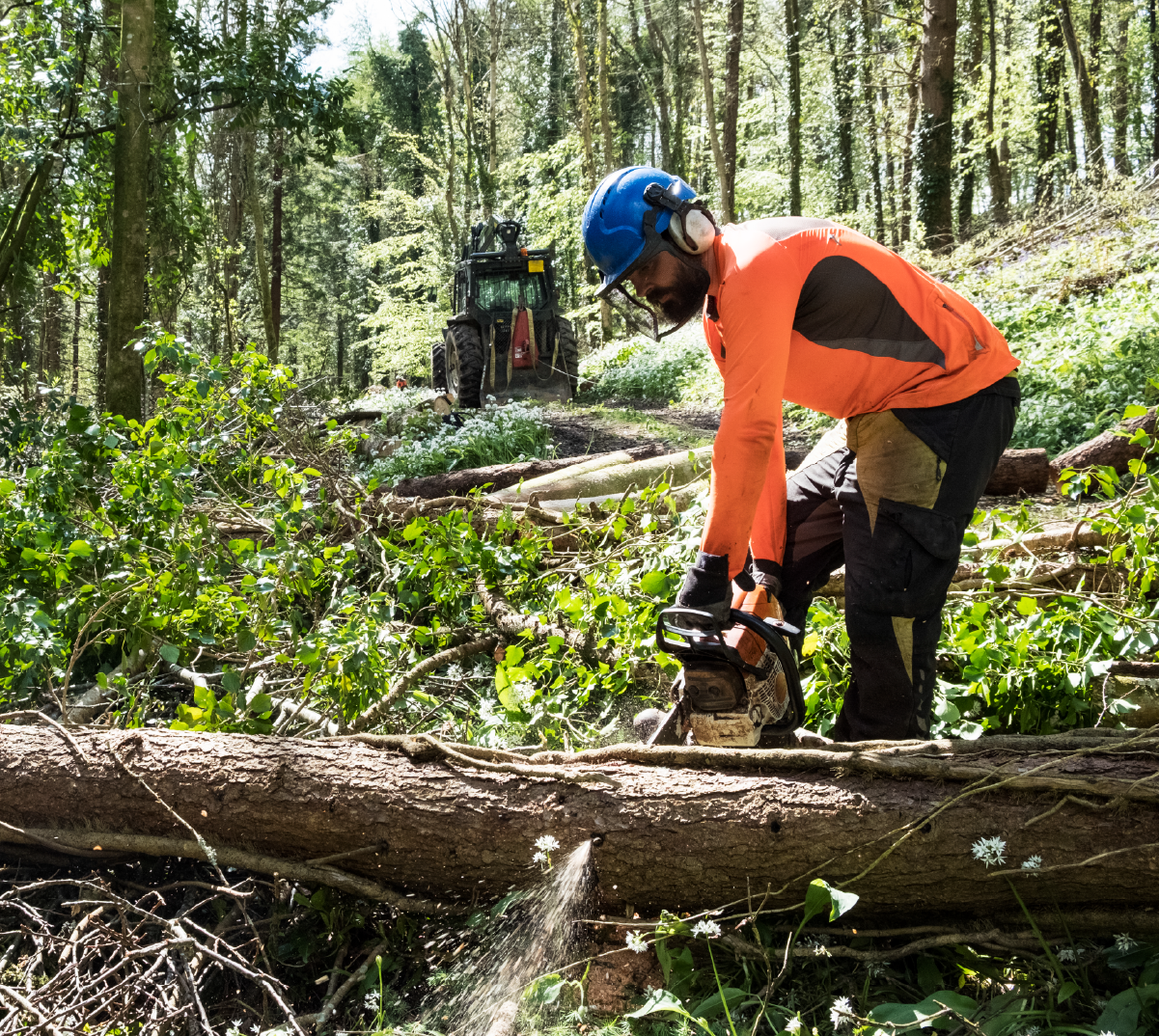
Windthrow is the recurring problem. Sitka spruce planted on exposed upland peat roots shallowly, and Atlantic weather brings stands down regularly, which means clearing tangled timber is routine work rather than an occasional emergency.
We recruit harvester and forwarder operators, windblow clearance specialists, chainsaw crews, arborists, foresters and planners, with certification verified against the awarding body before anyone reaches your shortlist.
Upland plantation, tree disease and devolved administration combine into varied and persistent demand.
Commercial forestry concentrates in upland Scotland, Wales and northern England, where conifer plantation reaching harvest sustains a substantial processing industry.
Windblow clearance recurs constantly, requiring crews competent with uprooted and tensioned timber rather than standing felling alone.
Ash dieback has affected trees across the wider landscape, generating extensive removal work on specimens that have become structurally unreliable.
Meanwhile, forestry policy and grant systems are devolved, so requirements and priorities differ between the constituent nations.
We recruit into forestry specifically rather than as general industrial staffing, and here that begins with windblow competence.
We assess experience with uprooted and tensioned timber specifically.
We check peat and soft ground competence rather than counting machine hours.
We confirm certification at source rather than accepting a card from a wallet.
We determine which national framework applies rather than assuming uniformity.
Workers pay nothing, and we decline where a fee has been paid to an intermediary upstream.
We confirm climbing teams can recover a casualty from the canopy.
Upland conifer plantation. Commercial forestry supplying sawmilling, panel and biomass industries.
Windblow clearance. Specialist operations following storm events on exposed plantation.
Public forest estates. Nationally managed holdings across the constituent nations.
Private and estate forestry. Holdings requiring contracted management, harvesting and establishment.
Arboriculture and tree services. Municipal, utility and residential tree work requiring climbing competence.
Ash dieback management. Removal and safety work on diseased trees across the landscape.
Sawmilling and wood processing. Mills requiring log yard, grading, sawing and maintenance personnel.
Woodland creation and establishment. Planting programmes with protection and maintenance requirements.
We confirm which felling certificates, machine tickets and additional competences the work requires before any sourcing begins.
We establish ground conditions, slope, stand type, access and distance from emergency services, because those determine who is genuinely suitable.
We source across the United Kingdom and internationally among operators experienced with windblown and soft ground conditions, since both are routine requirements here.
Chainsaw and felling certification is confirmed at source rather than accepted from a candidate copy, since a card proves nothing about its validity.
We assess judgement through real situations, including hung-up trees, windblown timber and when a candidate decided a tree was beyond their ticket.
We check first aid provision, emergency procedure, communications, lone working arrangements and how long definitive medical care would actually take.
Pay basis, protective equipment provision and any accommodation arrangement are documented in writing before anyone starts.
We stay in contact after placement and ask directly about safety practice, hours and whether equipment is actually being provided.
Forestry consistently ranks among the most dangerous occupations recorded anywhere, and the reasons are structural rather than a matter of carelessness.
The work combines cutting tools capable of severing a limb in an instant, trees weighing several tonnes falling under tension, unstable ground, and weather that changes what is safe within minutes.
Distance is what makes it different from equally hazardous work elsewhere. A serious chainsaw injury on a remote site is not measured against how quickly a first aider arrives. Still, against how long definitive medical care actually takes, and that is frequently measured in hours.
British upland conditions add exposure and ground. Sites can be a considerable distance from definitive care, weather changes rapidly on high ground, and a machine working saturated peat can become immobilised in a position that makes recovery hazardous.
Certification exists because of that. Felling qualifications are tiered by tree size and complexity for a reason, and someone working beyond their ticket is not being resourceful but operating without the competence the tier was designed to require.
Lone working multiplies every other risk, since an incapacitated worker alone in a stand cannot summon help, and arrangements that look adequate on paper frequently have not been tested.
We verify certification with the awarding body, assess judgement through real decisions rather than credentials, confirm emergency arrangements before placement, and decline work where the safety framework cannot be established.
Windblow is the defining operational and safety issue in British commercial forestry, and understanding it explains what competence means here.
Upland plantation sits on exposed ground, frequently peat, where conifer roots shallowly because the substrate offers limited anchorage.
Atlantic weather brings sustained strong winds across that terrain, and stands blow over in events that can flatten substantial areas at once.
Clearing the result is fundamentally different from harvesting standing timber, because uprooted and leaning stems hold tension in directions that are not visible.
A root plate that has lifted stores enormous energy and can swing back violently when the stem holding it is severed, which has killed people.
Stems pinned beneath others release unpredictably, and cutting one can set several moving simultaneously in a tangle nobody can fully read from outside.
Mechanised harvesting is substantially safer for exactly that reason, keeping the operator inside a protected cab rather than beneath material that may move.
Where ground or scale prevents machine access, manual clearance requires specific training, disciplined technique and genuine willingness to walk away from a stem that cannot be read.
We treat windblow as specialist work requiring demonstrated experience, verify that machine options have been considered, and decline to place general crews into tangled ground.
Three further conditions shape British placements, and each is established rather than assumed.
Peat and wet mineral soils carry machinery poorly, requiring continuous judgement about what ground will hold a loaded forwarder.
Brash mats and ground protection are routine, and an operator who uses them poorly causes damage that is both environmental and commercially visible.
Deep peat carries additional sensitivity, since disturbance affects carbon storage and water quality alongside the practical risk of immobilising a machine.
Forestry policy, grant systems and regulatory detail are devolved, which means requirements differ between the constituent nations rather than applying uniformly.
An employer or candidate assuming a single national framework may find that expectations, permissions and processes are not what they anticipated.
Ash dieback has affected trees widely, and diseased ash becomes brittle and unpredictable in ways that make standard climbing and felling assumptions unreliable.
Assessing whether a tree is safe to climb is a competence in itself, and the correct answer is frequently that it is not and must be dismantled from a platform.
Aerial rescue capability must be verified for any climbing work, since a casualty suspended in a canopy cannot be reached by conventional first aid.
We establish the applicable devolved framework, assess ground judgement explicitly, and verify aerial rescue capability without exception.
Forestry uses seasonal labour heavily, particularly for planting and thinning, and that is where the sector’s worst employment practices concentrate.
Payment by output rather than time is common in planting work, and it creates a direct incentive to work faster, longer and through conditions where stopping would be safer.
A worker paid per tree does not lose money by taking a break; they lose money by taking a break, which is a distinction that sounds pedantic until someone is exhausted on steep ground with a spade or a saw.
Recruitment fees compound it severely. Someone who paid an intermediary to obtain a season’s work arrives already in debt, needing to earn it back before anything counts as income.
Accommodation tied to the job creates the third layer, since a worker who leaves loses housing as well as pay, frequently in a remote area with no alternative and no transport.
Those three arrangements together produce a worker who cannot refuse unsafe instructions, cannot stop when tired and cannot leave, which is the condition every serious forestry incident report tends to describe in hindsight.
We charge workers nothing anywhere in the chain, decline where a fee has been paid upstream, insist that protective equipment is employer provided, and document pay basis and accommodation terms in writing before anyone starts.
Scotland. The largest commercial forest area with extensive upland plantation and windblow exposure.
Wales. Upland conifer with substantial harvesting and establishment activity.
Northern England. Upland plantation with processing capacity and windblow clearance work.
Northern Ireland. Forest and plantation with its own administrative framework.
Southern and lowland regions. Broadleaved woodland, estates and extensive arboriculture demand.
Sawmilling and processing centres. Log yard, grading, sawing and maintenance employment.
Ask whether the agency treats windblow clearance as specialist work requiring demonstrated experience.
Ask whether it establishes which devolved framework applies rather than assuming uniformity.
Ask what workers pay, where the only acceptable answer is nothing anywhere in the chain.
Shallow rooting on exposed peat and Atlantic weather bring stands down regularly.
A lifted root plate stores enormous energy and can swing back violently.
A protected cab keeps the operator out from under material that may move.
Disturbance affects carbon and water quality alongside machine risk.
Policy, grants and regulatory detail differ between the constituent nations.
Diseased ash is frequently unsafe and must be dismantled from a platform.
We require demonstrated experience with uprooted and tensioned timber.
We check peat competence rather than accepting general machine hours.
We determine which national requirements apply rather than assuming uniformity.
No climbing placement proceeds until a crew can demonstrate canopy rescue capability.
We charge no fee and decline where one has been paid upstream,without exceptionn.
We confirm certification at source rather than accepting a card presented by a candidate.
Woodland creation programmes are substantial across Britain, and the reason many plantings underperform is browsing rather than planting technique.
Deer populations are high across much of the country, and young broadleaves in particular are heavily browsed where numbers are not controlled.
An unprotected planting can be substantially destroyed within a season, with damage that is not always obvious until survival counts are done.
Protection options each carry trade-offs, since fencing is expensive and requires maintenance while individual guards are labour intensive and generate plastic waste.
Deer management is therefore part of woodland creation rather than a separate activity, requiring stalkers and managers alongside planting crews.
That work is skilled and carries its own safety requirements, including firearms competence, safe shooting judgement and awareness of who else may be in a wood.
Maintenance continues for years after planting, covering weeding, guard adjustment, fence repair and replacement of failures.
Establishment crews are therefore employed well beyond the planting season itself, which is worth stating to candidates expecting short seasonal work.
We recruit across the establishment cycle including protection and maintenance, and assess deer management competence separately where a role involves it.
Take the first step toward your forestry career or a fully crewed operation. Choose the option that fits you best.
Are you a harvester or forwarder operator, windblow clearance specialist, chainsaw crew member, arborist or forester? We verify aerial rescue before every climbing placement and never charge you a fee.
Register Now!Hire certificate-verified harvester operators, windblow specialists, chainsaw crews and arborists for your operation, with ground and tension competence established.
Register Now!Partner with our trusted European network to place certificated forestry professionals with verified employers on documented terms, with no worker-paid fees anywhere.
Register Now!It is a specialist firm that sources, certificate-verifies and places harvester operators, chainsaw crews, arborists and foresters with British employers.
In upland Scotland, Wales and northern England, where conifer plantations reaching harvest sustain a substantial processing industry.
Windblow. Upland plantation on exposed peat roots shallowly, and Atlantic weather brings stands down regularly.
Because peat and thin upland soils offer limited anchorage, so root systems spread rather than penetrate.
Fundamentally, because uprooted and leaning stems hold tension in directions that are not visible from outside.
A lifted root plate stores enormous energy and can swing back violently when the stem holding it is severed, which has killed people.
No. Cutting one can set several moving simultaneously in a tangle nobody can fully read.
Substantially, keeping the operator inside a protected cab rather than beneath material that may move.
Manual clearance requires specific training, disciplined technique and genuine willingness to walk away from a stem that cannot be read.
No. We treat windblow as specialist work requiring demonstrated experience.
It carries machinery poorly, requiring continuous judgement about what ground will hold a loaded forwarder.
Ground protection made from harvesting residue, routine here, and an operator who uses them poorly causes visible damage.
Yes. Disturbance affects carbon storage and water quality alongside the practical risk of immobilising a machine.
No. Policy, grant systems and regulatory detail are devolved, so requirements differ between the constituent nations.
It can. An employer or candidate assuming a single framework may find expectations, permissions and processes are not what they anticipated.
It has affected trees widely, and diseased ash becomes brittle and unpredictable in ways that make standard climbing and felling assumptions unreliable.
A competence in itself, and the correct answer is frequently that a tree is not safe to climb and must be dismantled from a platform.
Without exception for climbing work, because a casualty suspended in a canopy cannot be reached by conventional first aid.
Upland sites can be a considerable distance from definitive care, and weather changes rapidly on high ground.
Yes. Recovery from saturated peat is difficult, expensive and hazardous to everyone involved.
Yes, including planting programmes with protection and maintenance requirements.
Nothing, at any stage, and we decline where a fee has been paid to an intermediary upstream.
The employer, and we confirm that before placement rather than assuming it.
Scotland, Wales, northern England, Northern Ireland, southern and lowland regions and processing centres.
Nothing, at any stage, in any country. We also decline to proceed where a fee has been paid to an intermediary before someone reaches us.
Because a worker carrying recruitment debt cannot afford to stop, and stopping is frequently the safe decision in this work.
The employer. Chainsaw trousers, boots, helmet, hearing and eye protection are not optional and are not a worker expense.
No. An employer unwilling to provide protective equipment is telling you what its safety culture is.
With the awarding body rather than accepted from a candidate copy, since a card in a wallet proves nothing about current validity.
Because tree size, lean, tension and surroundings change the difficulty enormously, and each tier exists to match competence to complexity.
They are operating without the competence that tier was designed to require, which is where serious incidents concentrate.
Yes, through real situations including hung-up trees, windblown timber and the occasions a candidate decided a tree was beyond them.
Because knowing when to stop is the competence that keeps forestry workers alive, and someone who has never refused a tree has either not faced one or did not recognise it.
Yes. Harvester and forwarder competence depends on machine type, head, control system and terrain, and experience on one does not transfer automatically.
Considerably. Steep ground, wet ground, frozen ground and windblown stands each demand competence that flat clearfell work does not develop.
First aid provision, trauma equipment, communications coverage, extraction route and how long definitive medical care would genuinely take.
Because a catastrophic bleed is survivable within minutes and not within hours, and remote sites are frequently hours from a hospital.
Always. An incapacitated worker alone in a stand cannot summon help, and arrangements that look adequate on paper are frequently untested.
Yes. Where a safety framework cannot be established, we do not supply people into it, whatever the commercial consequence.
It creates a direct incentive to work faster and longer, and through conditions where stopping would be safer, which is why we document pay basis explicitly.
A serious one. Where housing depends on the job, leaving means losing both at once, frequently in a remote area with no alternative.
Before anyone starts, covering pay basis, hours, equipment provision and any accommodation arrangement.
Always. We do not participate in any arrangement involving retention of identity documents.
Yes. Aerial work requires climbing competence and aerial rescue capability, since a casualty in a canopy cannot be reached by ordinary first aid.
It is a distinct competence from ground felling and must be certified separately rather than assumed from experience.
Yes, and we treat it as specialist work, because windblown timber under tension behaves unpredictably and kills experienced operators.
Genuinely. Wind, ice and saturated ground change what is safe, and an employer who works regardless is one we would ask questions about.
Yes, asking directly about safety practice, hours and whether equipment is actually being provided rather than merely promised.
Where a role requires it, including chain of custody and sustainable management scheme competence.
Not by us. The same verification, the same fee prohibition and the same written terms apply regardless of contract length.
Because seasonal crews are where exploitation concentrates, and a shorter contract is not a reason for weaker protection.
The employing owner or contractor, covering safety, training, equipment and every other regulatory requirement.
No. Awarding bodies decide certification and employers decide appointments. We verify thoroughly and represent honestly.
An employer receives only what a specific vacancy requires, after the candidate has agreed. Records are held while a lawful reason exists.
Employers can register at atozserwisplus.com/employer/registration, candidates at atozserwisplus.com/jobseeker, and partner agencies at atozserwisplus.com/recruiter/registration. Workers are never charged a fee at any stage.
Speak to a specialist and skip the slow hiring cycle. Get certificate-verified harvester and forwarder operators, windblow clearance and tensioned timber specialists, peat and soft ground operators, chainsaw crews, arborists, foresters and planners for operations across Scotland, Wales, northern England, Northern Ireland, southern regions and processing centres. Windblown timber competence assessed rather than inferred from standing felling, peat and ground judgement checked as a core competence, devolved requirements established rather than assumed uniform, aerial rescue capability verified without exception for climbing placements, protective equipment confirmed as employer provided, and no fee charged to any worker anywhere.
Windblow is the defining operational and safety issue in British commercial forestry. Upland plantation sits on exposed ground, frequently peat, where conifer roots shallowly because the substrate offers limited anchorage, and Atlantic weather brings sustained strong winds across that terrain, flattening substantial areas at once. Clearing the result is fundamentally different from harvesting standing timber, because uprooted and leaning stems hold tension in directions that are not visible: a root plate that has lifted stores enormous energy and can swing back violently when the stem holding it is severed, which has killed people. Stems pinned beneath others release unpredictably, and cutting one can set several moving simultaneously. Mechanised harvesting is substantially safer for exactly that reason, and where ground prevents machine access, manual clearance requires genuine willingness to walk away from a stem that cannot be read.
Peat carries machinery poorly and deep peat adds sensitivity, since disturbance affects carbon storage and water quality alongside the risk of immobilising a machine. Forestry policy, grant systems and regulatory detail are devolved, so requirements differ between the constituent nations rather than applying uniformly.
Ash dieback has made assessing whether a tree is safe to climb a competence in itself, and aerial rescue capability must be verified for any climbing work.
The employing owner or contractor retains regulatory responsibility for safety, training and equipment. Requirements change, and nothing here is legal advice.






Copyright © 2009-2026 AtoZ Serwis Plus. All Rights Reserved.