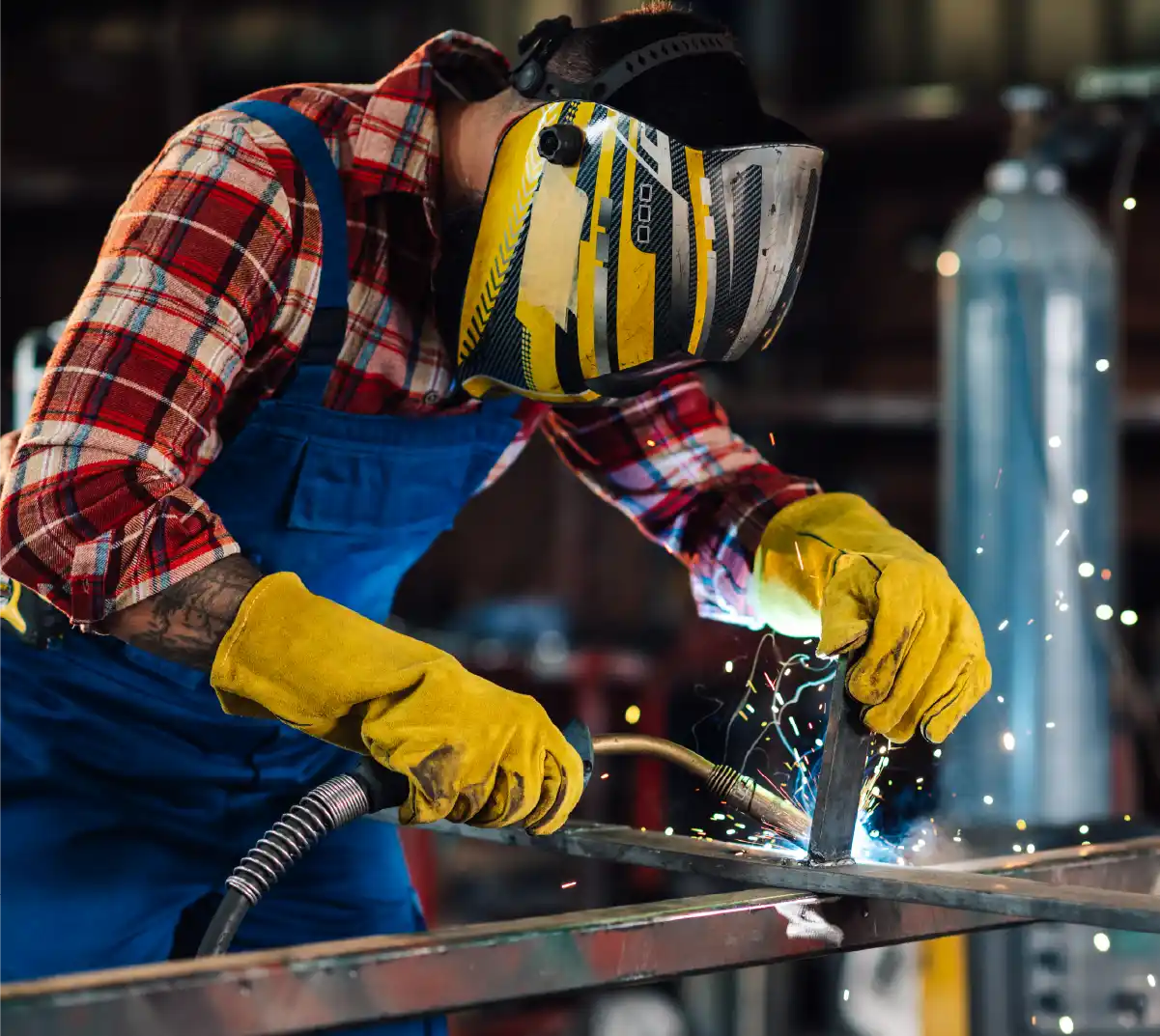
Your Gateway to Welder Jobs, Skilled Welding Hiring, and Industrial Recruitment in Germany.
Looking for a trusted welder recruitment agency in Germany? AtoZ Serwis Plus helps German automotive makers, steelmakers, shipbuilders, the Maschinenbau (machine-building) Mittelstand, and construction firms hire qualified welders — MIG/MAG welders, TIG (WIG) welders, coded welders, pipe welders, and structural welders — across the Ruhr region, Hamburg, Kiel, Bremen, Stuttgart, Munich, and beyond.
Germany is Europe’s industrial heartland and faces one of its largest skilled-worker shortages, with hundreds of thousands of vacancies. Welders (Schweißer) are a recognised bottleneck (Engpassberuf) occupation, and the reformed Skilled Immigration Act has opened broad, practical routes for hiring qualified welders from outside the EU.
Demand spans the entire industrial base. Automotive giants (Volkswagen, BMW, Mercedes-Benz, Audi, Porsche) and their supplier networks, steelmakers (thyssenkrupp Steel in Duisburg, Salzgitter), shipbuilders (Meyer Werft in Papenburg for cruise ships; thyssenkrupp Marine Systems in Kiel for submarines), rail, energy and plant construction, and the thousands of world-class Mittelstand machine-builders all rely on large welding workforces.
With an ageing population and around 600,000+ unfilled positions nationally, Germany cannot meet demand from local supply alone. The government has reformed immigration specifically to attract skilled trades, making welding one of the most accessible routes for international workers.
We focus on welding, so we understand the difference between a MIG/MAG welder for automotive and structural work, a TIG welder for stainless and aluminium, a coded welder for pressure, pipe, and marine work, a robotic-cell operator, and a senior welding foreman (Schweißfachmann) — and we screen accordingly.
You gain a pre-vetted talent pool, faster time-to-hire, lower hiring risk through practical weld testing, lower total cost, and full compliance with the Skilled Immigration Act, Federal Employment Agency procedures, and collective-agreement (Tarifvertrag) pay. We also share regional pay benchmarks and insights into bottleneck occupations.
We recruit MIG/MAG welders, TIG (WIG) welders, coded and pressure welders, pipe and pipeline welders, shipbuilding and marine welders, robotic cell operators, structural steel welders, sheet metal fabricators, maintenance welders, and welding supervisors. Services include permanent placement, contract and project hiring, bulk crew hiring, executive search, screening, DVS/EN ISO 9606 verification, Skilled Worker Visa and EU Blue Card coordination, qualification-recognition support, relocation and onboarding.
| Industry | Key Talent Needs |
|---|---|
| Automotive (VW, BMW, Mercedes, Audi, Porsche) | MIG/MAG welders, robotic-cell operators, body-in-white welders |
| Steel & Metallurgy (thyssenkrupp Steel, Salzgitter) | Structural welders, maintenance welders, coded welders |
| Shipbuilding (Meyer Werft, thyssenkrupp Marine Systems) | Hull welders, coded welders, pipe welders |
| Machine Building / Maschinenbau (Mittelstand) | TIG welders, structural welders, precision fabricators |
| Plant, Energy & Construction | Coded pipe welders, site welders, EN 1090 fabricators |
The figures below are indicative monthly gross pay (in euros) and vary by region, sector, collective agreement, certification, and experience.
| Role | Indicative Monthly Gross (EUR) |
|---|---|
| Entry / general welder (Schweißer) | €2,600 – €3,100 |
| Skilled MIG/MAG welder | €3,000 – €3,600 |
| TIG / coded / pipe welder | €3,500 – €4,500+ |
| Welding foreman / Schweißfachmann | €4,200 – €5,500+ |
Pay is typically governed by collective agreements (Tarifvertrag); coded, pipe, and shipbuilding welders command the upper bands. For the EU Blue Card, the 2026 salary threshold is €50,700 per year (€45,934.20 for shortage occupations), though most welders are hired via the Skilled Worker Visa rather than the Blue Card.
EU/EEA and Swiss nationals are free to work. For third-country welders, the main route is the Skilled Worker Visa (Fachkräftevisum) under the reformed Skilled Immigration Act. It offers three pathways: a qualification track (a recognised vocational welding qualification), an experience-based track (no German-recognised degree required — ideal for experienced welders with a home-country qualification and relevant experience), and a recognition partnership (complete recognition upon arrival). The Opportunity Card (Chancenkarte) allows qualified job seekers to apply for work, and the EU Blue Card is for higher-paid roles. Most cases involve approval and qualification assessment by the Federal Employment Agency (Bundesagentur für Arbeit) via ZAB. From 2026, a new Work-and-Stay Agency and fully digital processing aim to cut timelines.
We map your requirements and the best visa pathway, source through our database and networks, screen and DVS/EN ISO 9606-verify candidates, run practical weld and coding tests, complete reference checks, coordinate the Skilled Worker Visa or EU Blue Card and qualification recognition, and support relocation and onboarding.
We source qualified welders from the Western Balkans, India, the Philippines, Vietnam, Turkey, and across Eastern Europe, matching automotive, steel, and shipbuilding experience to German employers through the Skilled Worker Visa and the experience-based track.
The experience-based track has made it far easier to hire skilled welders without a German-recognised degree. EU Blue Card and salary thresholds rose for 2026, and Germany’s new Work-and-Stay Agency and digital visa processing aim to cut work-permit times by up to a quarter — strengthening the case for well-prepared, compliant applications.
Quality comes from our focus on welding and rigorous screening. Compliance comes from following the Skilled Immigration Act, Federal Employment Agency procedures, and collective-agreement pay at every step. Partnership comes from serving as a long-term welding workforce advisor. Employers stay with us because we help them build stronger welding teams faster and with less risk.
Take the first step toward your welding career in Germany. Choose the option that fits you best.
Are you a qualified Schweißer — MIG/MAG, TIG (WIG), coded, pipe, or structural — looking for legal welding work in Germany's automotive, steel, or shipbuilding sectors? Welders are a recognised bottleneck occupation, and the Skilled Worker Visa's experience-based track may suit you even without a German-recognised degree. Register today.
Register Now!Hire pre-screened MIG/MAG, TIG, and coded welders from our verified international talent pool for your German automotive, steel, shipbuilding, machine-building, or construction operation. We handle DVS/EN ISO 9606 verification, qualification recognition, and Skilled Worker Visa / EU Blue Card coordination.
Register Now!Partner with our recruitment network to place qualified MIG/MAG, TIG, and coded welders with verified German automotive, steel, shipbuilding, and machine-building employers.
Register Now!Yes. Welders (Schweißer) are a recognised bottleneck (Engpassberuf) occupation among Germany’s roughly 163 shortage professions, with hundreds of thousands of unfilled positions nationally across automotive, steel, shipbuilding, and machine building.
EU/EEA and Swiss nationals are free to work. Third-country welders most often use the Skilled Worker Visa (Fachkräftevisum) under the Skilled Immigration Act, which offers a qualification track, an experience-based track, and a recognition partnership. The Opportunity Card and EU Blue Card are additional routes.
Introduced by the 2023 reform, it allows experienced workers to qualify without a German-recognised degree, provided they hold a relevant home-country qualification, have sufficient work experience, and meet a salary threshold. It is especially valuable for skilled welders.
For the standard qualification track, the welding qualification is assessed for equivalence (often via ZAB or the relevant chamber). The experience-based track and recognition partnerships provide flexibility where full prior recognition is not yet in place. We coordinate this.
Indicative monthly gross pay ranges from about €2,600–€3,100 for entry-level welders to €3,500–€4,500+ for TIG, coded, and pipe welders, with supervisors earning higher. Collective agreements usually govern pay and vary by region and sector.
Employers expect EN ISO 9606 welder qualifications, with DVS standards, EN 1090 for structural steel, and EN ISO 3834 quality requirements widely applied. Coding is needed for pressure, pipe, and marine work. We verify all qualifications and run practical weld tests.
For 2026, the standard EU Blue Card salary threshold is €50,700 per year, with €45,934.20 for shortage occupations. The Blue Card targets university-level roles, so most welders are hired via the Skilled Worker Visa instead.
The Ruhr (steel), Hamburg, Kiel, Bremen, and Papenburg (shipbuilding), Stuttgart and Munich (automotive and machine building), and Wolfsburg and Lower Saxony (Volkswagen) lead demand.
Timelines depend on qualification recognition and Federal Employment Agency approval, typically a few months. Germany’s new Work-and-Stay Agency and digital processing aim to reduce this starting in 2026 materially. We prepare complete files to avoid delays.
Yes. We source from the Western Balkans, India, the Philippines, Vietnam, Turkey, and Eastern Europe, coordinating Skilled Worker Visa applications, the experience-based route, and qualification recognition.
No. All immigration decisions rest with the German authorities, including the Federal Employment Agency and the Foreigners’ Office (Ausländerbehörde), and hiring decisions with employers. We provide structured professional support, not guarantees.
Speak to a recruitment specialist. Get pre-vetted MIG/MAG welders, TIG welders, and coded, pipe, and structural Schweißer for your German automotive, steel, shipbuilding, machine-building, or construction operation — with DVS/EN ISO 9606 verification, qualification-recognition support, and full Skilled Worker Visa / EU Blue Card coordination. Trusted by manufacturers across the Ruhr, Hamburg, Stuttgart, and Wolfsburg.
Hiring the right welder is one of the most important decisions a German automotive maker, steelmaker, shipbuilder, machine-builder, or construction firm will make. The right hire delivers sound welds, passes inspection, and keeps production on schedule; the wrong hire fails weld tests, compromises safety, and drives up turnover costs.
AtoZ Serwis Plus combines welding-specific expertise, global talent reach, full compliance with the Skilled Immigration Act and Federal Employment Agency procedures, qualification-recognition support, and end-to-end help from sourcing to onboarding. Contact us today to build a stronger welding team in Germany.
AtoZ Serwis Plus provides professional recruitment and immigration-coordination services for German employers seeking qualified welders. We do not guarantee employment outcomes, visa or EU Blue Card approvals, or qualification-recognition decisions. All immigration and hiring decisions are made solely by the competent German authorities, including the Federal Employment Agency (Bundesagentur für Arbeit) and the Foreigners’ Office (Ausländerbehörde), as well as by registered employers. The information on this page is for general guidance only and may change with German regulations and individual circumstances. For specific advice, consult licensed professionals and official sources such as make-it-in-germany.com.






Copyright © 2009-2026 AtoZ Serwis Plus. All Rights Reserved.