Austria's technology, financial services, manufacturing, and public-sector organisations are expanding across Vienna, Graz, Linz, Salzburg, Innsbruck, and Klagenfurt, creating strong and sustained demand for skilled IT professionals and software specialists. As a prosperous EU economy with a robust digital transformation agenda, a growing startup and scale-up ecosystem centred on Vienna, world-class research institutions, and a manufacturing base that is increasingly dependent on Industry 4.0 automation and connected systems, Austrian employers require experienced technology professionals capable of designing, building, securing, and maintaining complex digital infrastructure and software products.
From software development and application engineering to cloud architecture, cybersecurity, data engineering, DevOps, ERP implementation, and IT infrastructure management, organisations across Austria rely on qualified technology professionals who understand modern development frameworks and toolchains, Austrian and EU data-protection requirements (DSGVO/GDPR), and the working practices of international software teams. Whether for product companies, consulting firms, financial institutions, or large industrial enterprises undergoing digital transformation, demand for capable, experienced IT talent consistently outpaces domestic supply.
AtoZ Serwis Plus provides specialised IT and software recruitment services in Austria, helping employers hire qualified software developers, cloud engineers, cybersecurity specialists, data professionals, IT infrastructure technicians, and digital transformation consultants from trusted international labour markets. Our recruitment solutions support technology companies, financial institutions, manufacturing organisations, consulting firms, and public-sector bodies in building reliable and capable technology teams.
Our recruitment strategy aligns with Austria's growing technology sector, digital transformation investment, expanding startup ecosystem, and the increasing technology needs of its manufacturing and financial services industries. We provide access to skilled international technology professionals while ensuring structured and compliant hiring processes.
Key strengths
Our services help Austrian employers reduce hiring timelines, access specialised skills not available domestically, and build stable long-term technology teams.
AtoZ Serwis Plus recruits qualified professionals for a wide range of IT and software roles in Austria:
These professionals support software product development, digital transformation programmes, IT infrastructure management, and technology operations across Austria's public and private sectors.
Our IT and software recruitment services support multiple high-demand sectors in Austria:
Each candidate is carefully matched based on employer requirements, technology stack, project type, and team culture.
AtoZ Serwis Plus sources qualified IT and software professionals from trusted international labour markets to meet Austria's technology workforce demand.
All candidates are screened based on:
Our candidates meet the technical and professional standards required in Austria's competitive technology market.
This ensures faster time-to-productivity, reduced onboarding friction, and high-quality technology output for Austrian employers.
We follow a structured and transparent recruitment process:
This ensures smooth hiring and compliance with Austrian labour regulations, the Arbeitszeitgesetz, and the applicable Kollektivvertrag for the IT and consulting sector.
Whether organisations require software developers for product engineering, cloud engineers for infrastructure migration, cybersecurity specialists for compliance programmes, ERP consultants for digital transformation, or IT infrastructure technicians for managed service delivery, AtoZ Serwis Plus provides skilled professionals ready to contribute from day one across Austria.
We are a trusted recruitment partner for IT and software jobs in Austria, delivering technology workforce solutions aligned with real market demand.
Employers in Austria can register to hire experienced technology professionals.
Employer benefits
https://www.atozserwisplus.com/employer/registration
Recruitment agencies can collaborate on IT and software workforce projects in Austria.
Recruiter benefits
https://www.atozserwisplus.com/recruiter/registration
Qualified IT and software professionals seeking job opportunities in Austria can register and apply.
Worker benefits
https://www.atozserwisplus.pl/work-in-europe
Registration ensures:
Austria offers strong and growing employment opportunities for software developers, cloud engineers, cybersecurity specialists, data professionals, and IT infrastructure technicians. Vienna's expanding tech ecosystem, the digital transformation demands of Austria's financial and industrial sectors, and the country's high quality of life and competitive net salaries make it an attractive destination for skilled international technology professionals. Those who combine genuine technical depth with the ability to work effectively in multilingual, collaborative teams are well-positioned to build successful careers in this advanced European economy.
AtoZSerwisPlus is a European workforce and immigration advisory platform specialising in compliant recruitment guidance, structured work authorisation support, and labour market insights across European countries.
Government of Austria – https://www.oesterreich.gv.at
Federal Ministry of Labour and Economy – https://www.bmaw.gv.at
Austrian Public Employment Service (AMS) – https://www.ams.at
Austrian Federal Economic Chamber (WKO) – https://www.wko.at
This content is independently created and provided for informational purposes only. It does not constitute legal advice, employment guarantees, or immigration approval. All recruitment and work authorisation decisions are subject to Austrian labour laws and approval by competent authorities.
It involves sourcing and placing qualified technology professionals — software developers, cloud engineers, cybersecurity specialists, data professionals, DevOps engineers, and IT infrastructure technicians — with Austrian employers across technology companies, financial institutions, manufacturing organisations, and the public sector. Austria has a persistently tight market for skilled IT talent, and the combination of Vienna's growing startup ecosystem, the digital transformation of its industrial and financial sectors, and a limited domestic pool of technology graduates means that international recruitment is a structural part of how Austrian employers build their technology teams.
Several factors converge. Austria's universities produce strong graduates in computer science and engineering, but not at the pace that a digitalising economy demands. Vienna's startup and scale-up ecosystem has grown significantly, competing with established employers for the same finite pool of talent. Large industrial companies — voestalpine, AVL, Anton Paar, and the automotive supply chain — are investing heavily in Industry 4.0, IIoT, and digital twins, adding industrial technology demand that previously did not exist at scale. Financial institutions in Vienna are modernising core banking and compliance systems. And the broader EU technology labour market is tight, meaning cross-border movement within the EU has not resolved the gap.
Yes. EU and EEA citizens work in Austria without a work permit, registering with the Einwohnermeldeamt (residents' registration office) for stays beyond three months and obtaining a Sozialversicherungsnummer and Steueridentifikationsnummer for payroll purposes. The process is administrative and straightforward.
The Red-White-Red Card (Rot-Weiß-Rot-Karte) is Austria's primary skilled-worker immigration route for non-EU professionals and is the most relevant pathway for qualified IT specialists. It grants both residency and work rights, initially tied to a specific employer, transitioning to open labour-market access after 12 months. IT and software roles appear on Austria's shortage-occupation list (Mangelberufsliste), which reduces the points threshold and accelerates the application. The EU Blue Card is an alternative for highly qualified professionals earning above a salary threshold — it is valid across most EU member states and provides a faster path to permanent residence.
The EU Blue Card (Blaue Karte EU) is a combined residence-and-work permit for highly qualified non-EU professionals who hold a relevant university degree and a job offer meeting a minimum salary threshold — currently approximately EUR 44,000 gross per year in Austria for most professions, with a reduced threshold for shortage occupations. Many senior software engineers, architects, and data scientists qualify. The Blue Card provides faster access to long-term residence rights and is portable within the EU, making it particularly attractive for internationally mobile technology professionals.
A relevant university degree (computer science, software engineering, information systems, or a related discipline) is the standard baseline for most developer and engineering roles. For cloud, cybersecurity, and infrastructure roles, vendor certifications — AWS Certified Solutions Architect, Microsoft Azure Administrator, Google Cloud Professional, CISSP, CISM, or CompTIA Security+ — carry significant weight alongside practical experience. For senior and specialist roles, the depth and quality of the project portfolio matters more than the specific institution. Austrian employers in software product companies tend to assess candidates through technical interviews and practical coding tasks, placing demonstrated skill above formal credential.
Java, Python, and C# are the most consistently in-demand backend languages, across both product companies and enterprise environments. JavaScript and TypeScript dominate frontend and full-stack development. Go and Kotlin are growing in product and cloud-native contexts. For data roles, Python with Pandas, Spark, and SQL is the core stack. Cloud platforms — AWS (most widely adopted), Azure (strong in enterprise and financial services), and GCP — drive infrastructure and DevOps demand. SAP skills remain valuable given Austria's large industrial base, which relies heavily on SAP ERP and S/4HANA. React, Angular, and Vue.js dominate frontend frameworks; Spring Boot, .NET, and Node.js dominate backend frameworks.
Software developers earn approximately EUR 45,000 to EUR 85,000 per year gross depending on experience, specialisation, and employer type. Senior and lead engineers, cloud architects, and cybersecurity specialists earn EUR 75,000 to EUR 110,000 and above. Vienna pays a premium over other Austrian cities, though Graz — home to a strong technology and automotive-technology cluster — is competitive. Austria's Kollektivvertrag for IT and consulting sets minimum rates by role category, but most technology employers pay above these minimums to compete for talent. The effective net salary after income tax and social-security contributions for a mid-level developer earning EUR 60,000 gross is approximately EUR 38,000–42,000 net per year.
Einkommensteuer is progressive: 0% on income up to EUR 11,693; 20% from EUR 11,694 to EUR 19,134; 32% from EUR 19,135 to EUR 32,075; 42% to EUR 62,080; 48% to EUR 93,120; and 50% above that. Social-insurance contributions for employees add approximately 18% of gross salary. The combined effective deduction for a developer earning EUR 70,000 gross is approximately 35–42%. Austria does not offer the flat-rate preferential tax regimes for new residents that some other EU countries provide, but does offer standard deductions for work-related expenses.
Yes — and the pandemic accelerated its normalisation. Most Austrian technology employers — particularly software product companies and consulting firms — offer hybrid arrangements as standard, with two to three days per week in the office being a typical model in Vienna. Fully remote roles exist, particularly in companies with distributed international teams. However, non-EU professionals requiring visa sponsorship typically must be employed and physically resident in Austria, which limits fully remote arrangements for international hires who are not yet in the country. Once resident, hybrid arrangements are generally available.
It depends significantly on the employer. Vienna's startup and scale-up ecosystem, and most software product companies, operate primarily in English — German is useful but not always required for technical roles. Enterprise environments — large banks, insurance companies, public-sector organisations, and industrial manufacturers — typically require working German (B2 level) for internal communication, documentation, and stakeholder engagement. For senior roles that involve client-facing work, pre-sales, or leading Austrian teams, fluent German is practically essential. The Red-White-Red Card application does not require German certification for the IT professional category, but language acquisition significantly improves integration and career progression.
Vienna has established itself as the leading technology hub in the DACH region (Germany, Austria, Switzerland) for central and eastern European markets. Organisations such as Wayra (Telefónica), i5invest, and the Vienna Business Agency support a growing cluster of early-stage and growth-stage technology companies. Notable Austrian technology companies include Bitpanda (fintech), GoStudent (edtech), Refurbed (circular economy), Studo (student platform), and Packhelp — as well as established software companies including Anexia and Runtastic (acquired by Adidas). Research institutes including the IST Austria (Institute of Science and Technology Austria) in Klosterneuburg add academic depth to the ecosystem.
Standard working time in IT is 38.5 hours per week under the Kollektivvertrag for IT and consulting. Most employers provide flexible working-time arrangements. Annual leave is a minimum of five weeks (30 working days), rising to six weeks after 25 years of service. Austrian IT employers typically provide a public transport subsidy (Jobticket), meal allowances or subsidised canteens, home-office equipment for hybrid workers, and training or conference budgets. The Kollektivvertrag for IT and consulting also provides for a 13th and 14th monthly salary payment (Urlaubsgeld and Weihnachtsremuneration) — effectively two extra months of salary per year, paid in summer and December.
The Kollektivvertrag for IT and consulting permits all-in salary arrangements (Überstundenpauschale) that include a fixed overtime component — common in IT where working hours fluctuate with project delivery cycles. Where this is not agreed, overtime is compensated at 150% of the normal hourly rate. Austrian IT professionals are generally entitled to equivalent time off in lieu as an alternative to cash overtime payment. The Arbeitszeitgesetz (Working Time Act) sets a maximum of 10 hours per day and 50 hours per week including overtime.
Austria implements the EU General Data Protection Regulation through the Datenschutz-Grundverordnung (DSGVO) — the Austrian transposition. All IT professionals working with personal data — which encompasses most development, DevOps, data, and infrastructure roles — must understand DSGVO data minimisation, purpose limitation, and data-subject rights requirements. Austrian employers are required to conduct Data Protection Impact Assessments (DPIAs) for high-risk processing activities. Many Austrian organisations — particularly in financial services and healthcare — appoint a Datenschutzbeauftragter (Data Protection Officer). Familiarity with GDPR/DSGVO principles is a practical requirement for most Austrian IT roles.
Vienna (Wien) is the dominant technology hub — home to the largest concentration of software product companies, financial-sector IT, consulting firms, and startup activity. Graz is the second-largest market, with a strong cluster of automotive technology companies (AVL List, Magna International, Anton Paar) and several software companies. Linz has industrial technology and a growing digital-services sector. Salzburg has technology companies serving the tourism and hospitality sector alongside general software and IT services. Innsbruck has university-linked technology companies and a growing startup community. Remote work has extended effective reach beyond these cities, but most employers expect some in-person presence.
Financial services and banking — Austria's large banking and insurance sector (Erste Group, Raiffeisen, UniCredit Bank Austria, UNIQA, Vienna Insurance Group) drives demand for Java and .NET developers, data engineers, cloud engineers, and cybersecurity specialists. Automotive and industrial technology — AVL List, Magna International, and the automotive supply chain drive demand for embedded systems, IIoT, and simulation-software engineers. Legal and regulatory technology — Austria's legal and compliance requirements create demand for RegTech platforms and the developers who build them. Healthcare and medtech — Fresenius, Greiner Bio-One, and Austria's hospital networks are investing in digital health infrastructure.
Yes. Permanent (unbefristet) contracts are the standard employment form in Austrian IT. Fixed-term contracts are used for specific project work but must have objective justification. After the agreed probationary period — typically one to three months — Austrian dismissal-protection law applies. For Red-White-Red Card holders, the card is initially tied to the sponsoring employer but transitions to open-market access after 12 months of legal employment, at which point changing employer is straightforward.
Yes. EU citizens bring family members under EU free-movement rules. Red-White-Red Card and EU Blue Card holders can apply for family reunification — spouses and registered partners receive their own Red-White-Red Card Plus, which grants unrestricted access to the Austrian labour market. Austria's education system, healthcare, and quality of life are strong draws for families. Vienna consistently ranks among the world's most liveable cities in the Mercer and EIU quality-of-life indices.
Yes — and it is one of the most consistently reported labour-market challenges in the country. The AMS (Arbeitsmarktservice) lists software development, cloud engineering, cybersecurity, and data science among the most difficult-to-fill vacancies. The Austrian Federal Economic Chamber (WKO) and industry associations report tens of thousands of unfilled IT vacancies annually. The combination of a growing technology sector, an industrially digitalising economy, and a relatively small domestic graduate pool makes international recruitment a structural necessity rather than a temporary measure.
AtoZ Serwis Plus sources and screens international IT and software professionals for verified Austrian employers across technology companies, financial institutions, manufacturing, and consulting. We conduct technical screening aligned with employer requirements, verify qualifications and project experience, and guide non-EU candidates through the Red-White-Red Card or EU Blue Card process. Register at atozserwisplus.com to begin.
Global clients share how AtoZ Serwis Plus helped them secure work permits, visas, and career support across Europe. Real stories. Real results.
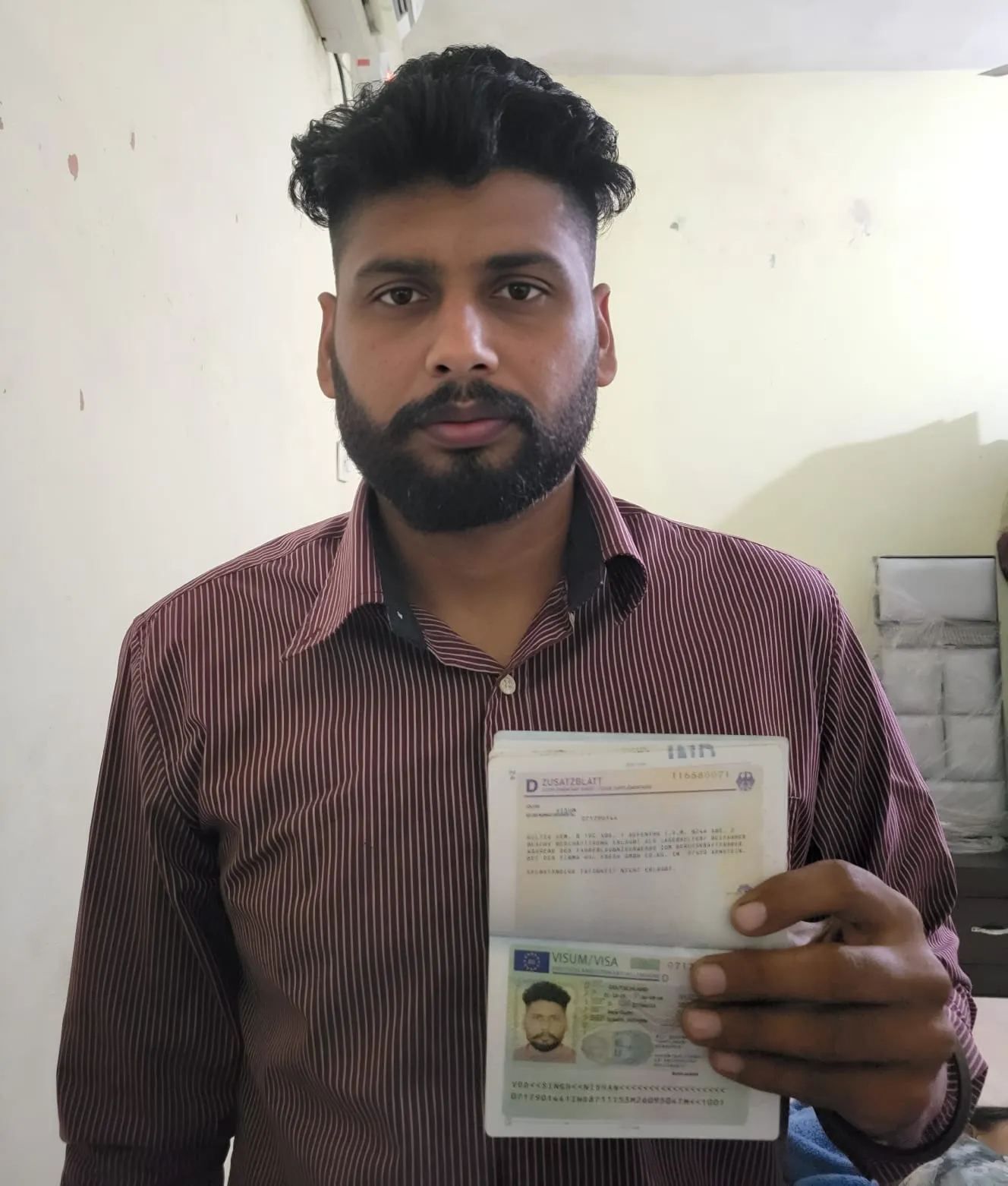
At AtoZ Serwis Plus, we help you become a global citizen with trusted support for jobs abroad, overseas education, and visa processing tailored to your goals.
Read More
Connecting employers, job seekers, students, and agencies across Europe and beyond.
Looking to hire skilled or semi-skilled workers from Asia, Africa, the CIS, or EU countries? AtoZ Serwis Plus supports your recruitment needs for Poland, Germany, Slovakia, Hungary, Lithuania, Estonia, and beyond. We deliver comprehensive legal recruitment services, visa support, and seamless onboarding solutions tailored to your business goals. Partner with us to build a reliable, compliant, and efficient workforce.
EmployerLooking to hire skilled or semi-skilled workers from Asia, Africa, the CIS, or EU countries? AtoZ Serwis Plus supports your recruitment needs for Poland, Germany, Slovakia, Hungary, Lithuania, Estonia, and beyond. We deliver comprehensive legal recruitment services, visa support, and seamless onboarding solutions tailored to your business goals. Partner with us to build a reliable, compliant, and efficient workforce.
Job SeekersAre you a recruiter looking to place workers in Poland, Germany, Slovakia, or other EU destinations? AtoZ Serwis Plus provides you with trusted employer connections, legal recruitment solutions, verified job placements, and full visa assistance. Expand your recruitment business with confidence, supported by clear processes, reliable documentation, and transparent migration services.
RecruiterLooking to work and live in Europe? At AtoZ Serwis Plus, we’re here to guide you every step of the way. Our experts provide support with job search assistance, work visa applications, qualification recognition, and European language learning. To connect with us and get started on your European journey, click one of the contact icons below.
Copyright © 2009-2026 AtoZ Serwis Plus. All Rights Reserved.