Moldova's technology, financial services, telecommunications, manufacturing, and public-sector organisations are creating growing demand for skilled IT professionals and software specialists in one of Eastern Europe's most rapidly developing IT ecosystems. As a small but increasingly internationally connected country - granted EU candidate status in June 2022, with an active IT export sector recognised for quality software development and nearshore services, and a government committed to digital transformation as a central pillar of its EU accession process - Moldova requires experienced technology professionals capable of supporting software development, digital infrastructure, financial systems, and enterprise IT across a sector that is growing significantly faster than the domestic talent supply.
From software development and IT outsourcing to cybersecurity, data engineering, nearshore development services, and digital government, organisations across Moldova rely on qualified technology professionals who understand modern development frameworks, Moldova's data-protection regulations, and the ambitious, internationally oriented working culture of a country that has established itself as a recognised nearshore software development destination for Western European and North American clients. Whether for Chisinau's growing IT outsourcing and startup community, the financial technology sector, the manufacturing industry's digitalisation, or the e-Government Centre's digital public services programme, demand for IT talent is growing at pace.
AtoZ Serwis Plus provides specialised IT and software recruitment services in Moldova, helping employers hire qualified software developers, IT infrastructure engineers, cybersecurity specialists, data professionals, and digital transformation consultants from trusted international labour markets. Our recruitment solutions support technology companies, financial institutions, nearshore development firms, manufacturing organisations, and public-sector bodies in building reliable and capable technology teams.
Our recruitment strategy aligns with Moldova's growing nearshore IT sector, its EU accession digital modernisation agenda, the financial sector's IT investment, and the e-Government programme driving public-sector digital transformation. We provide access to skilled international technology professionals while ensuring structured, compliant hiring processes in accordance with Moldovan labour law.
Key strengths
Our services help Moldovan employers access the technology talent that the domestic workforce cannot fully supply, and build reliable long-term technology teams.
AtoZ Serwis Plus recruits qualified professionals for a wide range of IT and software roles in Moldova:
These professionals support nearshore software development, digital public services, financial systems, and IT infrastructure management across Moldova's public and private sectors.
Our IT and software recruitment services support the key sectors of Moldova's technology economy:
Each candidate is carefully matched based on employer requirements, technology stack, and English or Romanian language proficiency appropriate to the employer's working environment.
AtoZ Serwis Plus sources qualified IT and software professionals from trusted international labour markets to meet Moldova's technology workforce demand.
All candidates are screened based on:
Our candidates meet the technical and professional standards required in Moldova's growing and internationally connected technology market.
This ensures effective technology delivery across Moldova's developing but rapidly growing digital economy.
We follow a structured and transparent recruitment process:
This ensures smooth hiring and compliance with Moldovan labour regulations under the Codul Muncii (Labour Code) and the applicable work-authorisation framework.
Whether organisations require software developers for nearshore project delivery, cybersecurity specialists for financial sector protection, IT infrastructure engineers for enterprise operations, data engineers for government analytics platforms, or IT support technicians for enterprise systems, AtoZ Serwis Plus provides skilled professionals ready to contribute from day one across Moldova.
We are a trusted recruitment partner for IT and software jobs in Moldova, delivering technology workforce solutions aligned with the specific demands of this fast-developing Eastern European economy.
Employers in Moldova can register to hire experienced technology professionals.
Employer benefits
https://www.atozserwisplus.com/employer/registration
Recruitment agencies can collaborate on IT and software workforce projects in Moldova.
Recruiter benefits
https://www.atozserwisplus.com/recruiter/registration
Qualified IT and software professionals seeking job opportunities in Moldova can register and apply.
Worker benefits
https://www.atozserwisplus.pl/work-in-europe
Registration ensures:
Moldova offers growing and increasingly attractive employment opportunities for software developers, IT infrastructure engineers, cybersecurity specialists, and digital transformation consultants. Moldova's EU candidate status since June 2022, the Moldova ICT Park's tax incentive framework, a growing nearshore reputation serving US and Western European clients, very low income-tax rates, a cost of living that makes Moldova one of Europe's most affordable IT employment destinations, and an EU accession trajectory that is driving both regulatory modernisation and technology investment all combine to make Moldova a compelling destination for internationally mobile IT professionals who seek a growing European economy with genuine EU career prospects. Chisinau's technology community is building momentum, and professionals who establish careers here during this growth phase will be well-positioned as Moldova's European integration deepens.
AtoZSerwisPlus is a European workforce and immigration advisory platform specialising in compliant recruitment guidance, structured work authorisation support, and labour market insights across European countries.
Government of Moldova – https://www.gov.md
Agency for Employment (ANOFM) – https://www.anofm.md
e-Government Centre (Centrul e-Guvernare) – https://egov.md
Moldova ICT Park – https://www.ictpark.md
This content is independently created and provided for informational purposes only. It does not constitute legal advice, employment guarantees, or immigration approval. All recruitment and work authorisation decisions are subject to Moldovan labour laws and approval by competent authorities.
It involves sourcing and placing qualified technology professionals - software developers, IT infrastructure engineers, cybersecurity specialists, data engineers, DevOps engineers, and IT support technicians - with Moldovan employers across nearshore development, financial services, telecommunications, manufacturing, and the public sector. Moldova is a small Eastern European country that has achieved EU candidate status, operates the Moldova ICT Park, which offers attractive tax incentives for IT companies, and has built a growing reputation as a quality nearshore software development destination for Western European and North American clients.
Moldova faces a structural IT skills gap driven by significant emigration of skilled workers - particularly to Romania, Germany, the UK, and other EU countries - and a rapidly growing technology sector that the domestic education system and remaining workforce cannot fully supply. Moldova's IT export sector has grown substantially, with Chisinau attracting outsourcing clients who value its competitive costs, quality technical education from the Technical University of Moldova (UTM) and the State University of Moldova, and improving English proficiency among IT graduates. The Moldova ICT Park's preferential tax regime has attracted hundreds of IT companies, intensifying demand for qualified professionals beyond what domestic supply can meet.
No. Moldova is not yet an EU member state, but it was granted EU candidate status in June 2022 - a significant milestone that reflects the EU's recognition of Moldova's reform progress and its European orientation. EU accession negotiations are ongoing, and alignment with EU standards - including data protection, labour law, and digital infrastructure - is advancing as part of the accession process. Moldova uses its own currency - the Moldovan leu (MDL) - and is not part of the Schengen Area. EU free movement does not apply to Moldova, and EU citizens require a work permit to work in Moldova, just as Moldovans require permits to work in most EU member states.
Foreign nationals require a permis de munca (work permit) from the Agentia Nationala pentru Ocuparea Fortei de Munca (ANOFM - National Agency for Employment) and a permis de sedere (residence permit) from the Biroul Migratie si Azil (BMA - Bureau of Migration and Asylum) to work in Moldova. The employer applies for the work permit, demonstrating the labour-market need. IT roles are on Moldova's shortage-occupation list, which supports applications. Processing takes approximately 30-60 days. The work permit is initially issued for one year and is renewable for the duration of the employment relationship. Moldova's work-permit system is relatively straightforward compared to larger economies.
The Moldova ICT Park (Parcul Tehnologic Informational al Republicii Moldova) is a specially designated economic zone for IT and technology companies established in 2018. Resident companies benefit from a single unified tax of approximately 7% of revenue in lieu of standard corporate income tax, VAT, and most other taxes, plus preferential conditions for employee income tax and social contributions. This framework dramatically reduces the tax burden for IT companies and their employees compared to standard Moldovan or regional tax rates. By 2024, hundreds of IT companies had registered as ICT Park residents. The park has been instrumental in attracting both domestic IT startups and international outsourcing operations to Moldova, and is considered one of the most successful IT investment zone frameworks in Eastern Europe.
A relevant degree from the Technical University of Moldova (Universitatea Tehnica a Moldovei - UTM), the State University of Moldova (Universitatea de Stat din Moldova - USM), or an internationally recognised institution is the standard baseline. Nearshore development companies serving international clients evaluate candidates primarily on practical technical ability - portfolio quality, GitHub contributions, and performance in technical interviews. English language proficiency is important for virtually all nearshore and internationally oriented roles. Cloud certifications (AWS, Azure), cybersecurity credentials, and project-management certifications add value. For financial sector IT, experience with core banking systems and regulatory compliance technology is relevant.
JavaScript and TypeScript - with React, Angular, and Node.js - are the most widely used languages in Moldova's nearshore development and startup sector. Java and .NET (C#) are used in financial services and enterprise applications. Python is growing in data analytics and automation. PHP is present in legacy web development and smaller e-commerce platforms. Mobile development using React Native and Flutter supports banking applications and consumer digital services. Cloud platforms - AWS and Azure most widely - drive DevOps demand in companies serving international clients. For the public sector's e-government programme, Java and Python with API integration capabilities are particularly relevant given the MDelivery and e-Government Centre's platform architecture.
Moldova has the lowest cost of living in Europe and correspondingly lower absolute salary levels than neighbouring countries. Standard employment software developers earn approximately EUR 800 to EUR 1,800 gross per month. However, IT professionals registered under the Moldova ICT Park framework benefit from very low effective tax rates - approximately 7% of revenue for companies plus preferential personal income-tax treatment for employees - which significantly improves net pay relative to gross. Senior engineers and specialists at ICT Park companies serving international clients earn EUR 1,500 to EUR 3,000 and above. The combination of ICT Park tax advantages and Chisinau's very low cost of living produces net purchasing power that is competitive within the regional context.
Moldova applies a progressive impozit pe venit (income tax) system: 12% on annual income up to MDL 360,000 (approximately EUR 18,000) and 18% above that threshold. Mandatory social insurance contributions (contributii de asigurari sociale de stat) add approximately 9% for employees, and mandatory health insurance (prima de asigurare obligatorie de asistenta medicala) adds approximately 4.5%, for a combined employee deduction of approximately 13.5% on gross salary. The Serviciul Fiscal de Stat (SFS - State Fiscal Service) administers the system. For IT professionals at Moldova ICT Park resident companies, the regime is substantially different - the unified 7% tax replaces most standard taxes, and personal income tax is calculated at a reduced flat rate of 7% on salaries paid by ICT Park residents.
Romanian (referred to as Moldovan in some legal contexts, though linguistically identical to Romanian) is Moldova's state language and is used universally in public administration, legal documents, and most domestic business communication. Russian remains widely spoken as a second language, particularly in Chisinau and in the Gagauzia autonomous region, reflecting Moldova's Soviet-era demographics. English is the working language in most nearshore development companies, outsourcing firms, and internationally oriented businesses. For most technology roles in the internationally connected sector, Romanian and English together cover virtually all professional requirements. Russian language capability is additionally useful for some domestic clients and in cross-community professional contexts.
Moldova has established a recognised nearshore software development presence, primarily serving US, Israeli, Western European, and UK clients. The combination of competitive costs, quality technical education from UTM and USM, improving English proficiency, geographic proximity to the EU, and the ICT Park's tax incentive framework makes Moldova attractive for clients seeking quality development capacity at lower cost than EU member states. The ICT Park hosts hundreds of companies including domestic startups, outsourcing companies, and subsidiaries of international technology groups. Moldova's IT export revenues have grown significantly year-on-year, and the EU candidate status is expected to further enhance Moldova's attractiveness for international IT investment.
The ANOFM (Agentia Nationala pentru Ocuparea Fortei de Munca - National Agency for Employment) issues work permits for foreign nationals and manages employment services. The BMA (Biroul Migratie si Azil - Bureau of Migration and Asylum) issues residence permits. The SFS (Serviciul Fiscal de Stat - State Fiscal Service) administers income tax. The CNAS (Casa Nationala de Asigurari Sociale - National Social Insurance House) manages social insurance. The CNAM (Compania Nationala de Asigurari in Medicina - National Health Insurance Company) administers health insurance. The Centrul National pentru Protectia Datelor cu Caracter Personal (CNPDCP - National Centre for Personal Data Protection) is Moldova's data-protection supervisory authority. The ANRE (National Regulatory Agency for Electronic Communications and Information Technology) oversees telecommunications.
Moldova's data-protection law - Legea nr. 133 din 2011 privind protectia datelor cu caracter personal (Law No. 133 of 2011 on personal data protection) - is substantially aligned with the principles of the EU GDPR framework, reflecting Moldova's EU accession commitments. The Centrul National pentru Protectia Datelor cu Caracter Personal (CNPDCP) is the national supervisory authority. EU adequacy status has not yet been formally granted to Moldova, meaning Standard Contractual Clauses or other transfer mechanisms are required for personal data flows from EU member states to Moldova. IT professionals working for companies serving EU clients must be familiar with EU GDPR requirements for those data flows. The accession process is driving Moldova's data-protection framework progressively closer to full GDPR alignment.
Standard working time is 40 hours per week under the Codul Muncii (Labour Code). Annual leave is a minimum of 28 calendar days per year - one of the more generous statutory entitlements in the region. Moldova has approximately 12 official public holidays per year. Overtime is compensated at premium rates under the Labour Code. The technology sector working culture in Chisinau is entrepreneurial, internationally oriented, and increasingly influenced by the working practices of international clients and partners. Hybrid and remote working are common in nearshore development companies. Chisinau's cost of living is very low by European standards, and the city offers improving urban amenities alongside easy access to Moldova's wine country and natural landscapes.
Moldovan nationals and those with permanent residence change employer freely. Foreign nationals on work permits must notify the ANOFM and BMA when changing employer and apply for updated permits linked to the new employer before the employment change takes effect. The work permit is employer-specific. Moldova's administrative processes for employment changes are developing progressively as part of EU accession alignment. For IT professionals in shortage occupations, the process is generally supported by ANOFM. Moldova's small professional community means that changing roles typically involves well-connected networks where reputation and references carry significant weight.
Legal employment in Moldova provides access to the social insurance system. Pension contributions through the CNAS (Casa Nationala de Asigurari Sociale) accumulate retirement entitlements. Health insurance through the CNAM provides access to the public healthcare system - the system covers basic medical services including GP consultations, specialist referrals, and hospital care within the public network. Indemnizatia de somaj (unemployment benefit) is available for qualifying contributors. Concediu de maternitate and concediu de ingrijire a copilului (maternity and child-care leave) provisions are available under the Labour Code. For ICT Park employees, some standard social contributions are replaced by the unified tax regime, which may affect the calculation basis for certain benefit entitlements.
Background checks are standard in regulated sectors. Financial institutions supervised by the Banca Nationala a Moldovei (National Bank of Moldova - BNM) conduct criminal record checks (cazier judiciar) and employment-history verification for technology roles with access to financial systems. Nearshore companies serving US, Israeli, and Western European clients typically apply background screening required by those clients, which may include international criminal record checks and employment verification. Public-sector IT roles at the e-Government Centre may require security screening appropriate to the systems and data involved. Moldova's relatively small professional community means that personal reputation and references are particularly visible and carry significant weight in hiring decisions.
Yes. Foreign workers who hold valid work and residence permits in Moldova can apply for family reunification through the BMA, bringing spouses and dependent children to join them. Moldova's very low cost of living, improving public services, genuine cultural warmth, and the unique quality of Moldovan wine culture and hospitality make it accessible and welcoming for families. Chisinau has improving international connectivity, a compact and safe urban environment, and a growing expatriate community particularly within the EU diplomatic and development community. International schooling options are limited but improving. Moldova's EU candidate status is driving improvements in public services and infrastructure that are progressively improving the quality-of-life proposition for internationally mobile families.
Yes. ANOFM and the Association of ICT Companies of Moldova (ATIC) consistently identify IT roles among the most difficult to fill in Moldova. The combination of emigration of skilled workers, rapid growth of the ICT Park ecosystem, the government's e-government programme, and the increasing attractiveness of Moldova to international outsourcing clients all sustain demand well beyond domestic STEM graduate output. Moldova's EU candidate status is expected to accelerate both technology investment and the regulatory framework improvements that will make it easier to recruit international IT professionals. The government's digital transformation commitment - reinforced by substantial EU accession-linked funding - is expanding public-sector IT demand significantly.
AtoZ Serwis Plus sources and screens international IT and software professionals for verified Moldovan employers across the ICT Park ecosystem, nearshore development, financial services, telecommunications, and the public sector. We conduct technical screening aligned with employer requirements, verify qualifications and project experience, confirm English and Romanian language proficiency as appropriate, and manage the ANOFM work-permit and BMA residence-permit process for non-Moldovan candidates. We give particular attention to the ICT Park employment framework and its implications for tax treatment and social contributions. Register at atozserwisplus.com to begin.
Global clients share how AtoZ Serwis Plus helped them secure work permits, visas, and career support across Europe. Real stories. Real results.
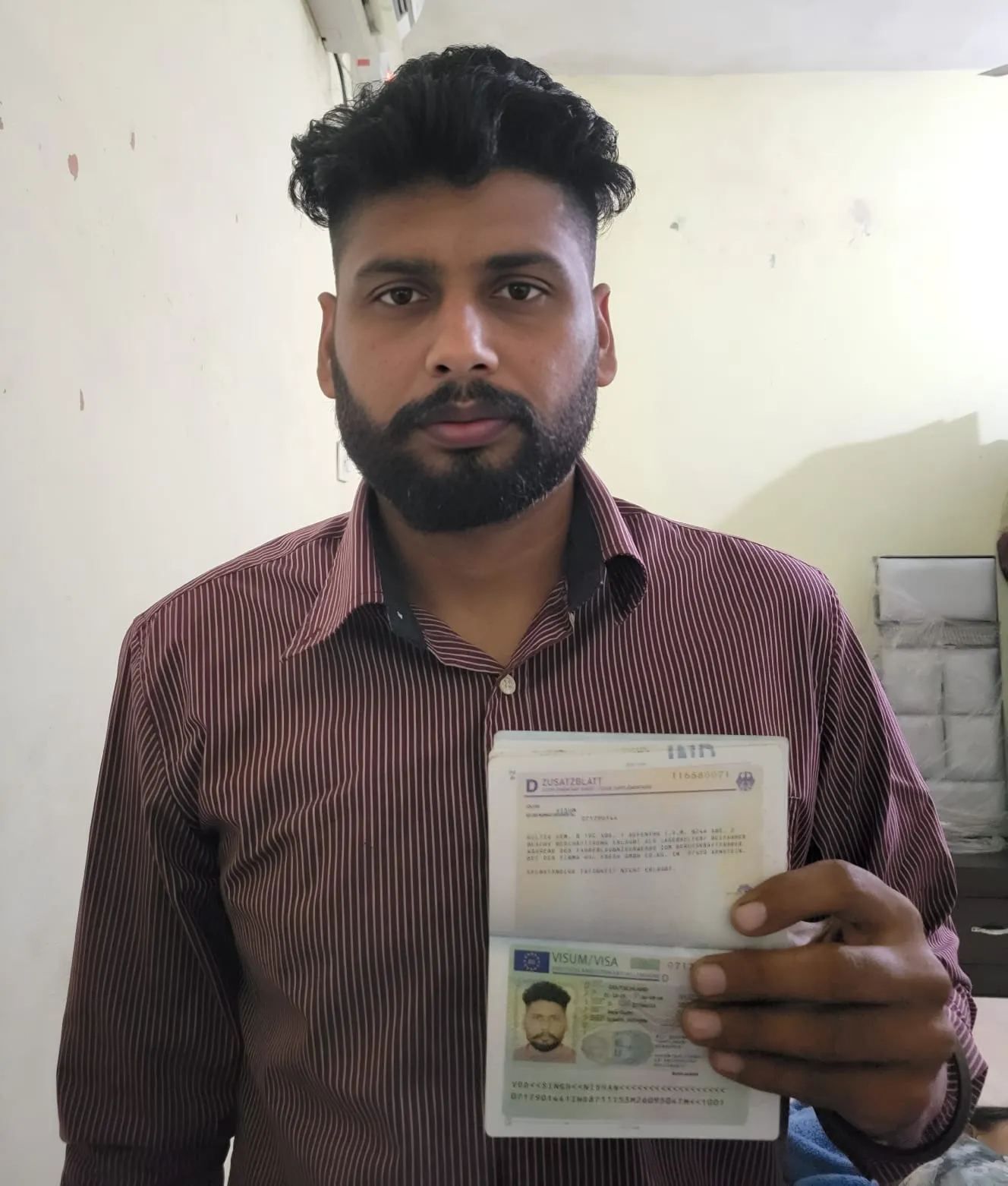
At AtoZ Serwis Plus, we help you become a global citizen with trusted support for jobs abroad, overseas education, and visa processing tailored to your goals.
Read More
Connecting employers, job seekers, students, and agencies across Europe and beyond.
Looking to hire skilled or semi-skilled workers from Asia, Africa, the CIS, or EU countries? AtoZ Serwis Plus supports your recruitment needs for Poland, Germany, Slovakia, Hungary, Lithuania, Estonia, and beyond. We deliver comprehensive legal recruitment services, visa support, and seamless onboarding solutions tailored to your business goals. Partner with us to build a reliable, compliant, and efficient workforce.
EmployerLooking to hire skilled or semi-skilled workers from Asia, Africa, the CIS, or EU countries? AtoZ Serwis Plus supports your recruitment needs for Poland, Germany, Slovakia, Hungary, Lithuania, Estonia, and beyond. We deliver comprehensive legal recruitment services, visa support, and seamless onboarding solutions tailored to your business goals. Partner with us to build a reliable, compliant, and efficient workforce.
Job SeekersAre you a recruiter looking to place workers in Poland, Germany, Slovakia, or other EU destinations? AtoZ Serwis Plus provides you with trusted employer connections, legal recruitment solutions, verified job placements, and full visa assistance. Expand your recruitment business with confidence, supported by clear processes, reliable documentation, and transparent migration services.
RecruiterLooking to work and live in Europe? At AtoZ Serwis Plus, we’re here to guide you every step of the way. Our experts provide support with job search assistance, work visa applications, qualification recognition, and European language learning. To connect with us and get started on your European journey, click one of the contact icons below.
Copyright © 2009-2026 AtoZ Serwis Plus. All Rights Reserved.