Luxembourg's construction sector has historically been one of the most dynamic and structurally important in the European Union — a reflection of the Grand Duchy's rapid population growth, sustained infrastructure investment, ambitious residential development programmes, and the continuous expansion of its financial, administrative, and logistics facilities. Construction consistently accounts for 13.8% of Luxembourg's total employees and 11% of registered enterprises, making it the second-largest employment sector after wholesale and retail trade. At its peak in late 2022, the sector employed close to 54,000 people and contributed substantially to Luxembourg's position as one of Europe's fastest-growing small economies. The sector has since undergone a sharp cyclical contraction — GVA in Construction fell 31% below 2019 levels, the deepest decline in the EU during this period, ahead of Nordic and German-speaking countries — driven by sharply rising interest rates, a collapse in residential transactions, and suppressed mortgage lending. Since early 2025, however, the first concrete signs of recovery have emerged: GVA in Construction rebounded +6% quarter-on-quarter in Q1 2025, residential investment rose +10% quarter-on-quarter in the same period, and STATEC data confirmed rising job vacancies in Construction in Q3 2025, signalling that the sector's workforce demand is returning.
Throughout this cyclical downturn, the structural characteristics of Luxembourg's construction labour market have remained constant: building and related trades workers (excluding electricians) were confirmed by EURES as one of the highest-occurrence shortage occupations in Luxembourg in 2024, and the OECD's 2025 Economic Survey explicitly categorises specialised construction jobs as "very high demand" occupations. Over 70% of Luxembourg's 508,013-strong workforce (January 2024) consists of cross-border workers or foreign nationals — 47% of the total are cross-border workers arriving daily from France (54%), Germany (23.2%), and Belgium (22.6%) — while only 26% of employees are Luxembourg nationals and 41% are foreign EU nationals. The construction sector's workforce has always reflected this cross-border and international character, with major projects drawing on skilled tradespeople from across the Greater Region and beyond. Luxembourg's ADEM (Agence pour le développement de l'emploi) published its updated shortage occupation list on 31 March 2025, confirming 22 roles in critical shortage. For construction roles on this list, ADEM issues the foreign workforce certificate within five working days of acknowledging receipt of the employer's declaration — the fastest track available under Luxembourg's labour market test system.
AtoZ Serwis Plus provides specialised construction recruitment services in Luxembourg, connecting employers across the general contracting, civil engineering, residential building, commercial Construction, road works, infrastructure, renovation, and finishing trades sectors with qualified international construction workers — bricklayers, concreters, formwork carpenters, scaffolders, roofers, plumbers, electricians, tile setters, plasterers, steel fixers, civil engineering operatives, and site supervisors — from trusted global labour markets. Our recruitment services support Luxembourg's most active construction employers — including Félix Giorgetti (the largest family-owned construction and property development company in Luxembourg, founded in the late nineteenth century, employing approximately 450 direct staff and over 700 including group partners, with completed projects including the 200,000m² Eurohub Sud logistics centre in Dudelange, the FM Insurance European headquarters at Kirchberg, and the Hosingen bypass cut-and-cover tunnel), Kuhn Construction (founded 1897, the oldest family construction business in Luxembourg, holder of the Made in Luxembourg label and Official Supplier to the Grand Ducal Court), Tralux, CBL, Thomas & Piron Bau, and hundreds of specialist subcontractors and SME contractors active across Luxembourg and the Greater Region — in building reliable, skilled, and fully compliant international construction workforces in accordance with the Luxembourg Labour Code, the social security obligations of the Centre commun de la sécurité sociale (CCSS), and the residence permit framework administered by the Ministry of Foreign and European Affairs and ADEM.
Our recruitment strategy is directly aligned with Luxembourg's recovery-phase construction market — a sector where GVA is rebounding, residential investment is picking up, major public infrastructure projects continue uninterrupted, and job vacancies are rising again after the 2022–2024 downturn — and the persistent structural shortage of skilled construction tradespeople that makes international recruitment a necessity rather than a contingency. We provide employers with structured access to skilled international construction workers while ensuring fully compliant and transparent hiring processes in accordance with the Luxembourg Labour Code, ADEM's foreign workforce certificate procedure, the residence permit for salaried workers managed by the Ministry of Foreign and European Affairs, and all CCSS social security registration obligations.
Key strengths
Our services help Luxembourg's construction employers close skilled-trades workforce gaps during the sector's recovery phase, maintain the quality and safety standards required by Luxembourg's rigorous construction regulatory environment, and build reliable international workforces capable of delivering the residential, commercial, and infrastructure projects that Luxembourg's growing population and dynamic economy demand.
AtoZ Serwis Plus recruits qualified professionals for a wide range of construction and civil engineering roles in Luxembourg, including:
These professionals support general contractors, civil engineering firms, residential developers, road and infrastructure contractors, commercial building companies, renovation specialists, and finishing trades subcontractors across Luxembourg's main construction activity zones.
Our construction recruitment services in Luxembourg support companies across several key sectors:
Each construction candidate is carefully matched to employer requirements, project type, trade specialisation, and the safety and quality standards required by Luxembourg's regulatory environment.
Our global recruitment reach includes:
This diversified talent pool enables fast response to labour shortages while supporting long-term workforce planning.
All candidates are thoroughly screened based on:
Our candidates meet the practical and technical standards required across Luxembourg's residential, commercial, civil engineering, roadworks, infrastructure, and finishing trades and construction sectors.
This delivers reliable construction output, consistent artistry quality, and strong site performance for employers across Luxembourg's recovering, demand-driven construction sector.
AtoZ Serwis Plus follows a structured, transparent, and fully compliant recruitment process designed for Luxembourg's labour market framework, ADEM procedures, and immigration system:
Whether companies need construction workers for residential housing projects, commercial office development, logistics facility construction, road and civil engineering works, public infrastructure, energy renovation programmes, or specialist finishing trades, AtoZ Serwis Plus delivers verified, skilled professionals ready to contribute to Luxembourg's recovery-phase construction market and its long-term pipeline of residential, commercial, and infrastructure development.
We are a trusted international recruitment partner for construction jobs and skilled trades workforce hiring in Luxembourg, supporting employers and professionals through structured, legally compliant, and operationally effective recruitment solutions.
Luxembourg construction companies, general contractors, civil engineering firms, residential developers, road works contractors, and finishing trades subcontractors can register on our platform to access pre-screened international candidates and receive end-to-end ADEM and immigration documentation support.
Employer benefits
https://www.atozserwisplus.com/employer/registration
Recruitment agencies, HR consultancies, and talent sourcers with knowledge of the Luxembourg or Greater Region construction labour market are welcome to join our partner network for Luxembourg and the wider Benelux and Western European construction region.
Recruiter benefits
https://www.atozserwisplus.com/recruiter/registration
Skilled bricklayers, concreters, formwork carpenters, scaffolders, roofers, plasterers, tile setters, plumbers, electricians, civil engineering operatives, and construction site supervisors seeking employment in one of Europe's highest-wage economies can register and apply for available verified construction positions in Luxembourg.
Worker benefits
https://www.atozserwisplus.pl/work-in-europe
Registration ensures:
1. What is construction recruitment in Luxembourg?
Construction recruitment in Luxembourg refers to hiring skilled bricklayers, concreters, formwork carpenters, scaffolders, roofers, plasterers, tile setters, plumbers, electricians, civil engineering operatives, road works operatives, crane operators, and site supervisors for the Grand Duchy's general contractors, civil engineering firms, residential developers, road and infrastructure contractors, commercial building companies, renovation specialists, and finishing trades subcontractors. Construction accounts for 13.8% of Luxembourg's total employees and 11% of registered enterprises — the second-largest employment sector in the country. Total construction employment reached approximately 49,120 (Eurostat, September 2024), and the sector's recovery is confirmed by a +6% rebound in GVAd in Q1 2025 and rising vacancies in Q3 2025.
2. Why are construction workers in demand in Luxembourg?
Construction workers are in demand in Luxembourg because building and related trades workers (excluding electricians) were confirmed by EURES as one of the highest-occurrence shortage occupations in the country in 2024, and the OECD's 2025 Economic Survey categorises specialised construction jobs as "very high demand" occupations. The structural reason is demographic: Luxembourg's population reached 682,000 on 1 January 2025 and continues to grow, driving sustained demand for residential housing, commercial premises, and public infrastructure that the domestic labour market cannot supply. Over 70% of the workforce comprises cross-border workers and foreign nationals, and the construction sector has historically relied on international skilled tradespeople to meet production requirements.
3. Are construction jobs in Luxembourg open to foreign professionals?
Yes. EU and EEA citizens and Swiss nationals have full freedom of movement to work in Luxembourg without a permit. Non-EU nationals who are salaried workers require a residence permit issued by the Ministry of Foreign and European Affairs, preceded by an ADEM foreign workforce certificate confirming that the position could not be filled from the national or EU labour market. Construction roles on the ADEM shortage occupation list (published 31 March 2025) qualify for an accelerated 5-working-day certificate procedure. Once legally employed, non-EU workers enjoy equal treatment with Luxembourg nationals in all employment conditions.
4. What is the ADEM foreign workforce certificate, and what is constructConstruction?
Before a Luxembourg employer can recruit a non-EU national, it must declare the vacant position to ADEM (Agence pour le développement de l'emploi), which conducts a labour market test to verify whether a suitable candidate is available domestically or within the EU. If the declared position corresponds to a profession on ADEM's shortage occupation list — which includes specialised construction roles — ADEM issues the foreign workforce certificate within 5 working days of acknowledging receipt. For positions not on the shortage occupation list, ADEM has 7 working days to check for available candidates, with a further 15 working days to propose candidates if any are found. Only once this certificate is issued can the employer sign the employment contract and the worker apply for the authorisation to stay. The ADEM certificate must accompany the residence permit application.
5. What is the minimum wage for construction workers in Luxembourg?
Luxembourg has the highest national minimum wage in the European Union, automatically adjusted through a wage indexation mechanism linked to the consumer price index. As of 1 May 2025, following a 2.5% indexation adjustment, the Social Minimum Wage (Salaire Social Minimum — SSM) is €2,703.74 gross per month for unskilled workers and €3,244.48 gross per month for skilled workers (a 20% premium above the unskilled rate). A skilled worker in Luxembourg is defined as a person holding a recognised official certificate at least equivalent to a CATP/DAP, or holding a manual skills certificate with at least two years' experience, or having at least six years of practical experience in a technical trade with a certificate of vocational ability, or — in the absence of any certificate — having at least ten years of practical professional experience. Many experienced construction tradespeople qualify for the skilled worker rate, which is particularly important given the technical demands of Luxembourg's construction sector.
6. What are the social security contributions in Luxembourg for construction workers?
Luxembourg's social security system — administered by the Centre commun de la sécurité sociale (CCSS) — requires contributions from both employers and employees. Employee contributions total approximately 12.45% of gross salary, covering pension insurance (8%), sickness/health insurance (2.80% for care + 0.25% for cash benefits), and dependency insurance (1.4%). Employer contributions are estimated at an additional 11.88% to 13.68% of gross salary, covering pension, health, and accident at work (rates vary by sector risk class based on a 0.85 to 1.5 bonus-malus coefficient), as well as mutual insurance funds. The construction sector's accident-at-work contribution is subject to higher risk coefficients than the office sector, reflecting the higher incidence of occupational injuries. All contributions are administered monthly through CCSS, and employers must register workers with CCSS before the first day of employment.
7. What are the income tax rates for construction workers in Luxembourg?
Luxembourg applies a progressive personal income tax system with rates ranging from 0% to 42%, plus a solidarity surcharge of 7% to 9% calculated on the tax due. Tax classes determine the applicable rate: Class 1 for single individuals, Class 1a for single parents or individuals over 65, and Class 2 for married or civil partner couples. Following income tax bracket amendments effective from January 2025 (incorporating 2.5 additional indexations into the brackets), taxes were reduced for all tax classes — an important benefit for construction workers earning at or near minimum wage levels. A Social Minimum Wage Tax Credit (CISSM) ensures that employees earning the unskilled minimum wage have no income tax liability in any tax class. The average single worker in Luxembourg faced a net average tax rate of 32.1% in 2024, meaning take-home pay was approximately 67.9% of gross salary.
8. What is the standard working week and overtime framework in Luxembourg?
The standard working week in Luxembourg under the Labour Code is 40 hours, typically 8 hours per day over 5 working days. In certain sectors or professions, and at certain times of year, the Minister of Labour may authorise a maximum of 12 hours per day, provided the weekly limit of 40 hours is not exceeded. Overtime — work beyond the contractual hours — must be compensated either by time off in lieu or by additional pay. Sunday work requires authorisation from the Ministry of Labour and is compensated at double the normal wage rate, and may be performed only with the employee's consent. Monthly payroll is standard, with wages due by the last day of the month. Luxembourg employers commonly pay a 13th-month salary, and Constructionive agreements in Construction provide additional holiday allowances.
9. What annual leave entitlement do construction workers have in Luxembourg?
All employees in Luxembourg are entitled to a minimum of 26 working days of paid recreational leave per year, regardless of age, employment contract type, or working hours. This is one of the highest statutory minimums in the EU. Sundays and statutory public holidays are not included in annual leave and are treated as separate entitlements. Luxembourg observes 10 public holidays per year. If an employee falls ill during annual leave and the illness is certified by a doctor, the sick days are not counted as annual leave — a significant employee protection. Collective bargaining agreements in the construction sector, or individual employment contracts, may provide additional leave above the statutory minimum of 26 working days.
10. Who is Félix Giorgetti, and why is it significant for Luxembourg construction?
Félix Giorgetti is the largest family-owned construction and property development company in Luxembourg, founded in the late nineteenth century by members of the Giorgetti family who emigrated from Italy to work in the Grand Duchy. Now in its fourth generation of family management, the group employs approximately 450 direct staff and more than 700 people, including those at partner companies. Félix Giorgetti covers construction engineering and the construction of residential, administrative, commercial, industrial, and public infrastructure buildings. Major completed projects include the 200,00 0m² Eurohub Sud logistics centre in Dudelange (built for the Ministry of the Economy, hosting clients including CFL's intermodal terminal and major logistics companies), the FM Insurance European headquarters (14,00 0m² The Waves office building at Kirchberg), and the Hosingen bypass cut-and-cover tunnel. The group also incorporates Kuhn Construction (founded 1897), the oldest family construction business in Luxembourg, which holds the Made in Luxembourg label and the distinction of Official Supplier to the Grand Ducal Court.
11. What is the current state of Luxembourg's construction market in 2025?
Luxembourg's construction sector experienced the sharpest GVA contraction of any EU member state between 2019 and 2024 — a cumulative decline of 31% in volume terms, deeper than the falls recorded in Finland (-25%), Denmark (-20%), Austria (-18%), and Germany (-17%). This downturn was driven by rapidly rising interest rates from 2022, a near-collapse in residential property transactions, and suppressed mortgage lending. Total construction employment fell by approximately 4,600 jobs from the sector's late-2022 peak. However, the recovery has begun: GVA rebounded by +6% quarter-on-quarter in Q1 2025 across all subsectors (building, civil engineering, and specialised works), residential investment rose by +10% quarter-on-quarter, and STATEC's Q3 2025 report states that job vacancies are rising again in construction. Building on public sector-led demand for infrastructure, schools, hospitals, and sustainable renovation, the sector's medium-term outlook is positive.
12. How does Luxembourg's wage indexation system benefit construction workers?
Luxembourg is one of only two European countries (with Belgium) that operate a fully automatic wage indexation system linked to the consumer price index (CPI). When inflation causes the CPI to exceed a legally defined threshold, all wages and social parameters — including the Social Minimum Wage, social security ceilings, and tax bracket thresholds — are automatically increased without requiring legislative action or negotiation. This mechanism was triggered multiple times in 2022 and 2023 in response to elevated inflation, and again in May 2025 (a 2.5% adjustment). For construction workers — whose wages are closely tied to the Social Minimum Wage and sectoral collective agreements — this system provides meaningful protection of purchasing power in an economy where housing costs are among the highest in Europe.
13. What is the residence permit process for non-EU construction workers in Luxembourg?
The process has several sequential stages. First, the employer declares the vacant construction position to ADEM; ADEM conducts the labour market test and issues the foreign workforce certificate (5 working days for shortage occupation roles; 7 to 22 working days for other roles). Second, the employer signs a dated employment contract with the future non-EU employee. Third, the worker submits a written application for temporary authorisation to stay to the General Directorate of Immigration (Ministry of Foreign and European Affairs) from their country of residence, attaching the ADEM certificate, signed employment contract, criminal record certificate, medical certificate, proof of accommodation in Luxembourg, and a valid passport. Fourth, upon approval (approximately 2 to 4 months), the worker travels to Luxembourg and files a declaration of arrival at their commune of residence within 3 working days. Fifth, the worker undergoes a mandatory medical check (a general medical examination and TB screening). Sixth, the formal residence permit for salaried workers is issued and is valid for 1 year for the first permit, for a specific job and sector identified by an ISCO code. From the first renewal, the permit is valid for up to 3 years with access to any sector and profession.
14. Can non-EU construction workers change employers in Luxembourg?
During the validity of the first residence permit for salaried workers — which is tied to a specific job and sector identified by the ISCO code on the permit — non-EU workers must seek authorisation from the Minister of Immigration and Asylum before changing their sector or profession. A change of employer within the same sector and profession may be possible, subject to conditions. From the first renewal, however, the permit gives access to any sector and profession in Luxembourg without restriction, providing full labour market mobility. Under the updated EU Single Permit Directive (2024 recast), permit holders who lose their job have three months (extendable to six months for workers who have held their permit for over two years) to find alternative employment before the permit can be withdrawn.
15. What collective agreements apply to construction workers in Luxembourg?
The construction sector in Luxembourg is covered by sectoral collective bargaining agreements (conventions collectives de travail) negotiated between employer federations and trade unions. These agreements typically set wage scales above the statutory Social Minimum Wage, define working time arrangements, regulate overtime compensation, establish additional leave provisions beyond the statutory 26 working days, and set out specific health and safety obligations applicable on construction sites. The construction sector collective agreement in Luxembourg is among the most detailed in the country, reflecting the historically strong union presence in the building trades. Employers must apply the relevant collective agreement alongside the statutory Labour Code minimum standards — whichever is more favourable to the employee prevails.
16. What safety requirements apply to construction workers in Luxembourg?
Luxembourg applies the EU's construction health and safety framework — primarily the EU Construction Sites Directive (Directive 92/57/EEC) — which has been transposed into national law. All construction sites must have a safety and health plan, and larger projects require the appointment of a safety and health coordinator (coordinateur sécurité-santé). Workers must receive site induction training, PPE provision, and specific training for hazardous activities, including work at height, use of scaffolding, operation of machinery, and handling of hazardous materials. The Inspection du Travail et des Mines (ITM) — Luxembourg's Labour Inspectorate — conducts site inspections and can halt work and impose penalties for non-compliance. Foreign workers on Luxembourg construction sites are subject to the same safety obligations as local workers from their first day on. What is the role of Luxembourg's cross-border workforce in construction? — 226,000 workers as of January 2024, representing 47% of the total workforce —play a central and structural role in the construction sector. The majority of cross-border construction workers commute daily from France (54% of all cross-border workers), Germany (23.2%), and Belgium (22.6%), many of whom are skilled construction tradespeople filling roles that cannot be filled by Luxembourg's resident population of only 682,000. Cross-border employment in Luxembourg has grown by 360% since 1994, compared to 80% growth in resident employment, confirming that Luxembourg's economic expansion is fundamentally dependent on the Greater Region's labour supply. Non-EU nationals already legally resident in another EU member state can also apply for a Luxembourg work permit as cross-border workers without relocating to Luxembourg, under a specific procedure for third-country nationals residing in other EU member states.
18. What is Luxembourg's unemployment rate, and how does it affect construction hiring?
Luxembourg's unemployment rate stabilised at approximately 6.-o 6.2% of the labour force in late 2025 (19,907 registered job seekers with ADEM as of 30 November 2025). This rate is above the EU average but reflects Luxembourg's specific labour market dynamics — the registered unemployed are predominantly residents. At the same time, a large proportion of the overall workforce (47%) consists of cross-border commuters who are not captured in Luxembourg's domestic unemployment figures. For construction employers, the pool of domestically available skilled construction tradespeople remains insufficient despite the headline unemployment rate, which is why building and related trades workers continue to appear on ADEM's shortage occupation list year after year.
19. Are there any construction employers employing undocumented workers in Luxembourg?
Yes. Luxembourg applies strict penalties under the Labour Code and immigration law for employing non-EU nationals without a valid authorisation to stay or residence permit. Employers who employ one or more third-country nationals without valid work authorisation face administrative and criminal sanctions. The Inspection du Travail et des Mines (ITM) conducts targeted inspections of construction sites — a sector historically associated with posted-worker violations and undeclared labour — and has the authority to halt work, impose fines, and refer cases to the criminal courts. Employers must verify the authorisation to stay or residence permit of any non-EU worker before beginning the working relationship, keep a copy throughout the contract, and notify the General Directorate of Immigration within 3 working days of the first day of work.
20. What is Luxembourg's social minimum wage compared to other EU countries?
Luxembourg consistently holds the top position for the highest national minimum wage in the European Union. As of May 2025, the unskilled Social Minimum Wage of €2,703.74 per month gross significantly exceeds the minimum wages of all other EU member states. This reflects Luxembourg's position as one of the world's wealthiest nations per capita, driven by its global financial Centre, European institutional presence, high-value professional services, and robust manufacturing and logistics sectors. For construction workers — a sector where wages are often closely tied to minimum wage benchmarks — Luxembourg's SSM means that even entry-level site workers earn substantially more in absolute terms than construction workers in most other European countries, making Luxembourg one of the most financially attractive construction employment destinations in the EU.
21. What language skills are important for construction workers in Luxembourg?
Luxembourg is a trilingual country with three official languages: Luxembourgish (Lëtzebuergesch), French, and German. On construction sites, French is the most commonly used working language for communication between workers, supervisors, and clients — particularly in Luxembourg City, Esch-sur-Alzette, and the southern industrial corridor. German is important in the northern and eastern regions of the Grand Duchy, and in dealings with German cross-border suppliers. Luxembourgish is the native language and is used informally between local colleagues. For international construction workers, basic French — sufficient to understand safety instructions, site directions, and daily communication — is the most practically important language skill. English is increasingly used in multinational construction companies and on international infrastructure projects. Candidates with functional French language ability are significantly more competitive in Luxembourg's construction job market.
22. Does Luxembourg require posted workers to meet specific documentation requirements?
Yes. Luxembourg has strict rules governing posted workers — employees dispatched by employers established in another EU member state to work temporarily in Luxembourg. Posted workers are entitled to the same minimum wages, working conditions, and safety standards as locally employed Luxembourg workers under the Posting of Workers Directive and Luxembourg's national transposing legislation. Employers posting workers to Luxembourg must notify the ITM before the posting, maintain specific documentation at the Luxembourg workplace, and comply with applicable collective bargaining agreements in the construction sector. For companies temporarily deploying construction workers from neighbouring countries — particularly France, Germany, and Belgium — compliance with Luxembourg's posted worker rules is essential and actively monitored by the ITM.
23. What sick leave provisions apply to construction workers in Luxembourg?
Under the Luxembourg Labour Code, employees are entitled to paid sick leave if they notify their employer and provide a medical certificate from a Luxembourg-recognised physician. The employer pays the employee's normal salary during the first 77 days of sickness absence in any rolling 12-month period. The social security system (CNS — Caisse nationale de santé) takes over payment from day 78 onward at a rate equal to the last salary received, up to a ceiling. For serious or long-term illness, extended sickness benefit provisions apply. Employees who fall ill during annual leave are protected — certified sick days do not count as leave days, and the leave entitlement is preserved. Luxembourg's construction sector collective agreement may provide additional sick leave protections above the statutory minimum.
24. What family reunification rights do non-EU construction workers have in Luxembourg?
Non-EU nationals holding a valid residence permit for salaried workers in Luxembourg may apply for family reunification for their spouse or registered partner and dependent children. Family members of third-country nationals legally residing in Luxembourg have unrestricted access to the Luxembourg job market and do not require work permits — they can take up any other employment immediately upon obtaining their family reunification residence permit. The family reunification application is submitted to the General Directorate of Immigration and requires proof of the primary permit holder's stable income, adequate accommodation, and valid residence status. Luxembourg's membership in the Schengen Area also provides family members with free movement rights for short stays across Schengen countries.
25. How does the construction sector collective agreement in Luxembourg affect wages above the minimum?
The construction sector in Luxembourg operates under collective agreements that typically set wage scales significantly above the Social Minimum Wage for experienced construction tradespeople. Young professionals entering large general contractors such as Tralux, CBL, or Félix Giorgetti can expect starting gross monthly salaries of €3,000 to €3,800 — well above the SSM — with experienced construction managers earning €35,000 to €65,000 annually, according to sector salary surveys. Experienced site managers and project directors in larger construction companies can earn €65,000 or more. These rates, combined with Luxembourg's automatic wage indexation, make the Grand Duchy one of the most financially rewarding destinations for construction employment in Europe, particularly for skilled tradespeople who meet the criteria for the higher €3,244.48 skilled-worker minimum wage.
26. What is Luxembourg's population, and why does it drive construction demand?
Luxembourg's population reached 682,000 on 1 January 2025, making it one of the fastest-growing populations in the European Union both in absolute and percentage terms. The country adds approximately 8,000 to 10,000 net new residents per year, driven by immigration of professionals attracted by the financial sector, European institutions, and cross-border employment opportunities. This continuous population growth generates sustained structural demand for housing — Luxembourg faces a significant housing shortage, with supply unable to keep pace with demand, as well as for commercial premises, schools, hospitals, transport infrastructure, and public buildings. The residential recovery in Q1 2025 (+10% investment quarter-on-quarter) and the pipeline of major public infrastructure projects confirm that construction demand in Luxembourg is durable rather than cyclical, even as the sector recovers from its 2022–2024 correction.
27. What types of construction projects are currently active in Luxembourg?
Luxembourg's active construction pipeline in 2025 includes the ongoing Findel tram extension infrastructure works (including the civil engineering ripage of a 2,500-tonne concrete frame under the Route de Trèves), residential housing and apartment developments across the southern industrial corridor and in Luxembourg City's Kirchberg, Hollerich, and Bonnevoie districts, the mixed-use 42,000m² Wickrange development centre, thermal renovation and energy retrofitting programmes across the existing housing stock under Luxembourg's energy transition commitments, data centre construction in Betzdorf, Windhof, and Kayl, road bypass and civil engineering works including the Hosingen bypass, logistics and industrial facility development in Dudelange and the southern industrial zone, and large-scale commercial and office building developments for financial sector and European institution clients in Kirchberg and the city centre.
28. What is Luxembourg's VAT rate on construction services?
Luxembourg applies the lowest standard VAT rate in the European Union at 17%. A super-reduced rate of 3% applies to renovation and improvement works on private residential dwellings, making Luxembourg's VAT framework particularly favourable for the renovation and energy retrofitting segment of the construction market. This reduced VAT treatment for residential renovation, combined with government grants for energy-efficient building improvements, has supported sustained demand for renovation and retrofitting work — a segment of Luxembourg's construction sector that has been more resilient than new-build residential during the 2022–2024 downturn and provides a consistent workflow for finishing trades, insulation installers, and sustainable construction specialists.
29. Can foreign construction companies post workers to Luxembourg sites?
Yes, subject to compliance with Luxembourg's posted worker rules. Foreign companies established in other EU member states that temporarily send their employees to carry out construction work in Luxembourg must: notify the ITM (Inspection du Travail et des Mines) before the posting begins; maintain required documentation at the Luxembourg workplace; comply with Luxembourg's minimum wage requirements (SSM) and applicable construction sector collective agreement conditions; and ensure that non-EU nationals among their posted workforce hold valid authorisation to work in Luxembourg (either through their EU resident status with a work permit, or via the Luxembourg-specific work permit process for third-country nationals cross-border workers). Failure to comply with Luxembourg's posted worker notification and documentation obligations attracts significant penalties from the ITM.
30. How can a Luxembourg construction company start recruiting internationally with AtoZ Serwis Plus?
Luxembourg construction employers should begin by registering as employers via the link below. Following registration, our team will arrange a vacancy analysis consultation within 5 working days to determine whether the role qualifies for the ADEM shortage occupation fast-track certificate, declare the vacancy to ADEM on the employer's behalf, and simultaneously begin sourcing candidates from our global talent database. We manage all documentation — employment contract preparation, ADEM foreign workforce certificate coordination, temporary authorisation to stay application support, commune declaration guidance, mandatory medical check arrangements, CCSS social security registration, and employer notification to the General Directorate of Immigration within 3 working days of first employment — so the Luxembourg construction employer can focus on project delivery from the worker's first day on site.
Luxembourg's construction sector is emerging from its deepest cyclical contraction since the 2008 financial crisis, with GVA rebounding, residential investment recovering, and job vacancies rising again as the Grand Duchy's population continues to grow and its pipeline of public infrastructure, residential, commercial, and logistics projects restores active demand for skilled construction workers. With the EU's highest minimum wage at €2,703.74 gross per month (unskilled) and €3,244.48 (skilled) from May 2025, automatic wage indexation protecting earnings against inflation, 26 working days of mandatory paid annual leave, a comprehensive CCSS social security system, and a straightforward ADEM-led residence permit process that fast-tracks applications for shortage occupation roles within 5 working days, Luxembourg offers one of the most financially rewarding and legally structured environments for international construction workforce recruitment in Europe. AtoZ Serwis Plus brings recruitment expertise, global candidate reach, and knowledge of Luxembourg immigration compliance to help construction employers across Luxembourg City, Esch-sur-Alzette, Differdange, Dudelange, and the wider Grand Duchy build reliable, skilled, and fully documented international construction workforces — efficiently and responsibly.
AtoZSerwisPlus is a European workforce and immigration advisory platform specialising in compliant recruitment guidance, structured work authorisation support, and labour market insights across European countries.
ADEM (Agence pour le développement de l'emploi) – https://www.adem.public.lu
General Directorate of Immigration (Ministry of Foreign and European Affairs) – https://maee.gouvernement.lu
Guichet. lu – Conditions of Residence for Salaried Workers – https://guichet.public.lu
CCSS (Centre commun de la sécurité sociale) – https://ccss.public.lu
ITM (Inspection du Travail et des Mines) – https://itm.public.lu
STATEC (National Institute of Statistics and Economic Studies) – https://statistiques.public.lu
EURES Luxembourg – https://eures.europa.eu
OECD Economic Survey Luxembourg 2025 – https://www.oecConstructionGiorgetti – https://www.gio.lu
Kuhn Construction – https://www.kuhn.lu
This content was created and provided for informational purposes only. It does not constitute legal advice, employment guarantees, or immigration approval. All recruitment and work authorisation decisions are subject to the Luxembourg Labour Code, the Law of 29 August 2008 on the Free Movement of Persons and Immigration, ADEM procedures, and approval by the General Directorate of Immigration of the Ministry of Foreign and European Affairs of Luxembourg. Minimum wages, social security contribution rates, income tax brackets, and immigration procedures in Luxembourg are subject to change through automatic indexation, legislative amendment, or regulatory update; employers and workers are advised to verify current requirements with qualified Luxembourg legal counsel before making recruitment or immigration decisions.
Global clients share how AtoZ Serwis Plus helped them secure work permits, visas, and career support across Europe. Real stories. Real results.
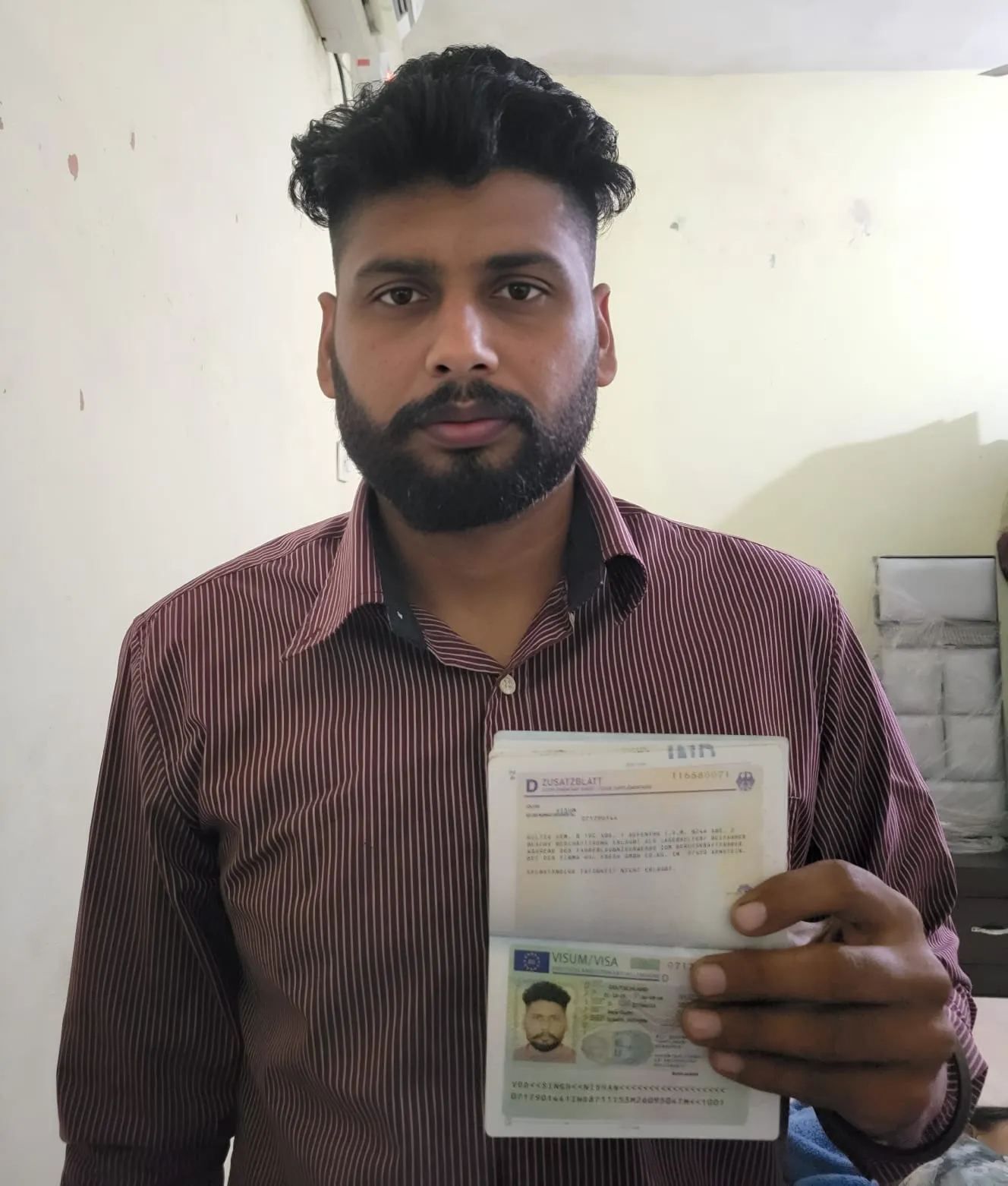
At AtoZ Serwis Plus, we help you become a global citizen with trusted support for jobs abroad, overseas education, and visa processing tailored to your goals.
Read More
Connecting employers, job seekers, students, and agencies across Europe and beyond.
Looking to hire skilled or semi-skilled workers from Asia, Africa, the CIS, or EU countries? AtoZ Serwis Plus supports your recruitment needs for Poland, Germany, Slovakia, Hungary, Lithuania, Estonia, and beyond. We deliver comprehensive legal recruitment services, visa support, and seamless onboarding solutions tailored to your business goals. Partner with us to build a reliable, compliant, and efficient workforce.
EmployerLooking to hire skilled or semi-skilled workers from Asia, Africa, the CIS, or EU countries? AtoZ Serwis Plus supports your recruitment needs for Poland, Germany, Slovakia, Hungary, Lithuania, Estonia, and beyond. We deliver comprehensive legal recruitment services, visa support, and seamless onboarding solutions tailored to your business goals. Partner with us to build a reliable, compliant, and efficient workforce.
Job SeekersAre you a recruiter looking to place workers in Poland, Germany, Slovakia, or other EU destinations? AtoZ Serwis Plus provides you with trusted employer connections, legal recruitment solutions, verified job placements, and full visa assistance. Expand your recruitment business with confidence, supported by clear processes, reliable documentation, and transparent migration services.
RecruiterLooking to work and live in Europe? At AtoZ Serwis Plus, we’re here to guide you every step of the way. Our experts provide support with job search assistance, work visa applications, qualification recognition, and European language learning. To connect with us and get started on your European journey, click one of the contact icons below.
Copyright © 2009-2026 AtoZ Serwis Plus. All Rights Reserved.