Latvia's technology, financial services, logistics, manufacturing, and public-sector organisations are expanding across Riga, Daugavpils, Jelgava, and the broader country, creating consistent demand for skilled IT professionals and software specialists. As one of the Baltic states' most active technology hubs — home to a growing fintech sector, a significant IT outsourcing and shared-services industry, and a government that has invested heavily in e-government and digital public services — Latvia requires experienced technology professionals capable of designing, building, securing, and maintaining complex digital infrastructure, financial platforms, and enterprise software across an increasingly internationally oriented business environment.
From software development and cloud engineering to cybersecurity, data engineering, fintech platform development, IT infrastructure management, and digital transformation, organisations across Latvia rely on qualified technology professionals who understand modern development frameworks, Latvian and EU data-protection requirements (Personas datu aizsardzības regula/GDPR), and the pragmatic, results-oriented working culture that characterises Latvian business. Whether for Riga's growing fintech and technology startup ecosystem, international companies using Latvia as a nearshore software development base, the financial services sector serving Baltic and Nordic markets, or Latvia's comprehensive e-government programme, demand for capable IT talent consistently exceeds what Latvia's domestic workforce and emigrating population can supply.
AtoZ Serwis Plus provides specialised IT and software recruitment services in Latvia, helping employers hire qualified software developers, cloud engineers, cybersecurity specialists, data professionals, IT infrastructure technicians, and digital transformation consultants from trusted international labour markets. Our recruitment solutions support technology companies, financial institutions, logistics operators, manufacturing firms, and public-sector bodies in building reliable and capable technology teams.
Our recruitment strategy aligns with Latvia's growing fintech and technology sector, its position as a nearshore development hub for Scandinavian and Western European clients, the digital transformation needs of its financial and logistics industries, and the e-government ambitions of its public sector. We provide access to skilled international technology professionals while ensuring structured and compliant hiring processes.
Key strengths
Our services help Latvian employers access technology talent and build stable, long-term technology teams in a market where domestic emigration has created a persistent skilled-worker gap.
AtoZ Serwis Plus recruits qualified professionals for a wide range of IT and software roles in Latvia:
These professionals support software product development, fintech platform engineering, digital transformation programmes, and IT infrastructure management across Latvia's public and private sectors.
Our IT and software recruitment services support the key sectors of Latvia's technology economy:
Each candidate is carefully matched based on employer requirements, technology stack, project type, and English or Latvian language proficiency appropriate to the employer's working environment.
AtoZ Serwis Plus sources qualified IT and software professionals from trusted international labour markets to meet Latvia's technology workforce demand.
All candidates are screened based on:
Our candidates meet the technical and professional standards required in Latvia's cost-competitive and internationally connected technology market.
This ensures faster time-to-productivity, reduced onboarding friction, and high-quality technology output for Latvian employers.
We follow a structured and transparent recruitment process:
This ensures smooth hiring and compliance with Latvian labour regulations, the Darba likums (Labour Law), applicable collective agreements, and the PMLP residence permit process.
Whether organisations require software developers for fintech platform engineering, cloud engineers for nearshore client infrastructure, cybersecurity specialists for financial data protection, data engineers for logistics analytics platforms, or IT infrastructure technicians for enterprise operations, AtoZ Serwis Plus provides skilled professionals ready to contribute from day one across Latvia.
We are a trusted recruitment partner for IT and software jobs in Latvia, delivering technology workforce solutions aligned with real market demand.
Employers in Latvia can register to hire experienced technology professionals.
Employer benefits
https://www.atozserwisplus.com/employer/registration
Recruitment agencies can collaborate on IT and software workforce projects in Latvia.
Recruiter benefits
https://www.atozserwisplus.com/recruiter/registration
Qualified IT and software professionals seeking job opportunities in Latvia can register and apply.
Worker benefits
https://www.atozserwisplus.pl/work-in-europe
Registration ensures:
Latvia offers competitive and growing employment opportunities for software developers, cloud engineers, cybersecurity specialists, fintech engineers, and data professionals. Riga's established position as a nearshore development hub for Scandinavian and Western European clients, the Baltic fintech ecosystem with Mintos and Twino among its notable names, Latvia's flat 20% income tax that makes compensation attractive relative to Western European alternatives, the Rail Baltic infrastructure programme adding technology demand, strong English proficiency across the technology sector, and an increasingly confident domestic startup community all combine to make Latvia an accessible and rewarding IT employment destination within the EU. International IT professionals who seek a dynamic European market with lower cost of living than Western Europe, strong English usage, and genuine EU career mobility will find Latvia a compelling professional base.
AtoZSerwisPlus is a European workforce and immigration advisory platform specialising in compliant recruitment guidance, structured work authorisation support, and labour market insights across European countries.
Government of Latvia – https://www.mk.gov.lv
Office of Citizenship and Migration Affairs (PMLP) – https://www.pmlp.gov.lv
State Employment Agency (NVA) – https://www.nva.gov.lv
Investment and Development Agency of Latvia (LIAA) – https://www.liaa.gov.lv
This content is independently created and provided for informational purposes only. It does not constitute legal advice, employment guarantees, or immigration approval. All recruitment and work authorisation decisions are subject to Latvian labour laws and approval by competent authorities.
It involves sourcing and placing qualified technology professionals — software developers, cloud engineers, cybersecurity specialists, data engineers, fintech platform developers, DevOps engineers, and IT infrastructure technicians — with Latvian employers across fintech, nearshore development, logistics technology, manufacturing, and the public sector. Latvia occupies a distinctive position in the European technology market: a cost-competitive EU member state with strong English proficiency, a flat income-tax system, and an established reputation as a nearshore development hub for Scandinavian and Western European clients.
Latvia has experienced significant net emigration since EU accession in 2004 — an estimated 300,000 people, disproportionately young and skilled, have left primarily for the UK, Germany, Ireland, and other EU member states. This emigration has created a structural deficit in the working-age population, particularly affecting skilled trades and technology roles. The fintech sector in Riga — with companies including Mintos, Twino, Sun Finance, and a cluster of peer-to-peer lending and payments platforms — has grown rapidly and competes for the same developers that nearshore outsourcing firms and domestic technology companies need. The Latvian IT industry body LIKTA consistently reports IT roles among the hardest vacancies to fill.
Yes. EU and EEA citizens work in Latvia without a work permit, registering with the Pilsonības un migrācijas lietu pārvalde (PMLP — Office of Citizenship and Migration Affairs) and obtaining a personas kods (personal identification number) for payroll, tax registration with VID (Valsts ieņēmumu dienests — State Revenue Service), and access to public services.
Non-EU nationals require a temporary residence permit (termiņuzturēšanās atļauja) with the right to work from PMLP. The employer notifies the Nodarbinātības valsts aģentūra (NVA — State Employment Agency), which confirms labour-market availability. For IT roles, which are on Latvia's shortage-occupation list, the NVA confirmation is generally straightforward. The employer must be registered as a legal entity in Latvia and must pay at least the average monthly gross wage for the sector. Processing takes approximately 30–60 days. The residence permit is issued initially for up to two years and is renewable.
A relevant university degree from the University of Latvia, Riga Technical University, or an internationally recognised institution is the standard baseline for most professional roles. Latvian technology companies — particularly those serving Scandinavian outsourcing clients — evaluate candidates on practical delivery capability: portfolio quality, experience with relevant technology stacks, and performance in technical interviews. For fintech roles, experience with payment systems, open-banking APIs, or peer-to-peer lending platform architecture is valued. Cloud certifications (AWS, Azure, GCP) and cybersecurity credentials are well-regarded.
Java is the most broadly in-demand backend language, dominant in financial services, enterprise applications, and outsourcing projects. Python is widely used in data engineering and machine learning. JavaScript and TypeScript cover frontend and full-stack development across product companies and nearshore projects. .NET and C# are used in enterprise and public-sector applications. For fintech platform development — Latvia's distinctive strength — Java with Spring Boot, REST API design, and payment protocol knowledge (SEPA, SWIFT, ISO 20022) are highly valued. Cloud platforms — AWS and Azure (most widely used) — drive DevOps demand. React and Angular dominate frontend frameworks.
Latvia offers competitive salaries relative to cost of living, though below Western European levels in gross terms. Software developers earn approximately EUR 1,800 to EUR 3,500 gross per month. Senior engineers, architects, and specialists earn EUR 3,000 to EUR 5,500 and above. Riga pays the highest rates nationally. Latvia's flat 20% income-tax rate, combined with a relatively low cost of living compared to Western Europe, means that net purchasing power for IT professionals is genuinely competitive — particularly for those who value a high quality of life at lower expenditure than in Helsinki, Stockholm, or Dublin.
Latvia applies a progressive income-tax rate (iedzīvotāju ienākuma nodoklis — IIN): 20% on income up to EUR 20,004 per year; 23% from EUR 20,004 to EUR 78,100; and 31% above EUR 78,100. A non-taxable minimum (neapliekamais minimums) reduces the effective rate for lower earners. Mandatory social-insurance contributions (VSAOI — valsts sociālās apdrošināšanas obligātās iemaksas) add 10.5% employee contributions on employment income. The VID (State Revenue Service) administers the system. Latvia introduced the progressive rate structure in 2018, replacing the previous flat 23% rate — for most IT professionals the effective combined rate is approximately 28–35%.
English is the dominant working language in most Latvian technology companies, nearshore development firms, and internationally oriented businesses. The majority of IT professional communication — technical documentation, code reviews, client calls, and team meetings — is conducted in English across the sector. Latvian proficiency becomes important for: public-sector IT roles and government technology programmes; client-facing roles serving Latvian-speaking customers; and roles in Latvian-owned SMEs that operate primarily in Latvian. Russian was historically widely spoken in Latvia — particularly in Riga and eastern Latvia — but its use has declined in professional contexts since Latvia's accession to the EU and further since 2022. For most technology roles, English alone provides access to the majority of the Latvian IT market.
Riga has established itself as one of the Baltic region's leading fintech centres. Mintos — Europe's largest peer-to-peer lending marketplace — is headquartered in Riga and serves investors across Europe. Twino, Sun Finance, and Eleving Group (formerly Mogo Finance) are further significant Latvian fintech companies. The ecosystem also includes payment service providers, insurance technology startups, and open-banking platform developers. Latvia's EU membership and access to the European single financial market, combined with a relatively lean regulatory environment through the FKTK (Finanšu un kapitāla tirgus komisija — Financial and Capital Market Commission), make it an attractive base for fintech product development. These companies create demand for payments platform engineers, risk-modelling data scientists, and regulatory-technology compliance developers.
Latvia — alongside Estonia and Lithuania — has established a significant reputation as a nearshore software development hub for Scandinavian, German, Dutch, and British clients. The combination of strong English proficiency, EU legal and data-protection frameworks, similar time zones to Western Europe, competitive costs relative to the clients' home markets, and high technical quality makes Latvian development teams attractive for outsourcing. Companies including Accenture, Tietoevry, Solveq, and numerous mid-sized IT services firms operate development centres in Riga. These companies create consistent demand for Java, .NET, Python, and full-stack developers experienced in agile delivery for international clients.
PMLP (Pilsonības un migrācijas lietu pārvalde — Office of Citizenship and Migration Affairs) handles residence permits for non-EU nationals. NVA (Nodarbinātības valsts aģentūra — State Employment Agency) manages employment services and confirms labour-market availability. VID (Valsts ieņēmumu dienests — State Revenue Service) administers taxation and social insurance. VSAA (Valsts sociālās apdrošināšanas aģentūra — State Social Insurance Agency) manages social-benefit payments. Datu valsts inspekcija (DVI — Data State Inspectorate) is Latvia's GDPR supervisory authority. FKTK (Financial and Capital Market Commission) regulates the financial sector and its IT systems.
Latvia implements the EU GDPR through the Fizisko personu datu apstrādes likums (Personal Data Processing Law). The Datu valsts inspekcija (DVI — Data State Inspectorate) is the national supervisory authority. Latvia's data-protection approach is broadly aligned with the EU GDPR framework. For fintech and financial services IT, additional requirements apply under FKTK regulations covering information security, incident reporting, and outsourcing risk management. IT professionals working in Latvia's financial sector are expected to understand both the GDPR framework and FKTK's technology-risk guidance, which aligns with EBA (European Banking Authority) ICT risk management guidelines.
Standard working time is 40 hours per week under the Darba likums (Labour Law). Annual leave is a minimum of four calendar weeks (20 working days) per year. Overtime is compensated at a minimum of 100% premium (double rate) for the first two hours and 200% premium thereafter — among the more generous statutory overtime provisions in the EU. Flexible working arrangements are common across Latvia's technology sector, with hybrid and remote-first models widespread particularly in outsourcing and product companies. Latvia's technology employer community tends to be practical and non-bureaucratic, with flat hierarchies and direct communication styles.
EU citizens change employer freely at any time — their right to work in Latvia is based on their EU status and is not employer-tied. Non-EU permit holders must notify PMLP when changing employer. The residence permit is tied to the sponsoring employer, and changing employer requires either an amendment to the existing permit or, in most cases, a new permit application linked to the new employer. This process should be initiated before the employment change takes effect. For IT professionals in shortage-occupation roles, the process is generally supported by NVA and does not affect the overall residence-permit validity during the application period.
Legal employment in Latvia provides access to the VSAOI (mandatory social insurance) system. Health insurance contributions fund access to the public healthcare system through the National Health Service (NHS Latvia — Nacionālais veselības dienests). Pension contributions accumulate in both the first-pillar state pension and the second-pillar funded pension (kapitālā pensija). Unemployment benefit (bezdarbnieka pabalsts) is paid at 50–65% of the insurance-contribution salary for up to nine months in cases of job loss. Sick pay (slimības nauda) is paid from the third day of illness — the employer pays for the first ten days, after which the VSAA takes over. Maternity and paternity leave benefits are among the more generous in the EU, with parental benefit paid at 60–80% of prior salary for up to 18 months.
Yes. Most Latvian IT employers verify qualifications, employment history, and professional references as standard. For financial sector roles — banks, fintech companies, and payment institutions — additional due-diligence checks apply under FKTK licensing and fit-and-proper requirements, including criminal record checks (sodāmības izziņa) and anti-money-laundering background verification. For public-sector IT roles involving access to sensitive government data, security clearance at the appropriate level may be required. Outsourcing companies serving international clients may apply background screening standards required by those clients, particularly those operating under ISO 27001 or SOC 2 compliance frameworks.
Yes. EU citizens bring family members under EU free-movement rules. Non-EU permit holders apply for family reunification through PMLP, demonstrating adequate income and housing. Latvia's EU membership, affordable cost of living, English-friendly professional environment, and improving public services make it a viable base for family relocation. Riga has international schools and a growing expatriate community. The city offers genuine European urban culture at a cost substantially below Helsinki, Stockholm, or Copenhagen, which is a practical advantage for families evaluating quality of life alongside professional opportunity.
Yes. LIKTA (Latvijas Informācijas un komunikācijas tehnoloģiju asociācija — Latvian Association of Information and Communication Technology) consistently reports significant unfilled IT vacancies, particularly in software development, cybersecurity, and data engineering. Structural emigration has removed a substantial portion of Latvia's working-age skilled population over the past two decades, creating a deficit that domestic education output cannot fully address. Latvia's government has recognised international IT recruitment as a necessary response, reflected in the NVA's shortage-occupation designations and the streamlined residence-permit process for qualifying roles.
AtoZ Serwis Plus sources and screens international IT and software professionals for verified Latvian employers across fintech, nearshore development, financial services, logistics, and the public sector. We conduct technical screening aligned with employer requirements, verify qualifications and project experience, confirm English and relevant language proficiency, and manage the PMLP residence permit process for non-EU candidates. Register at atozserwisplus.com to begin.
Global clients share how AtoZ Serwis Plus helped them secure work permits, visas, and career support across Europe. Real stories. Real results.
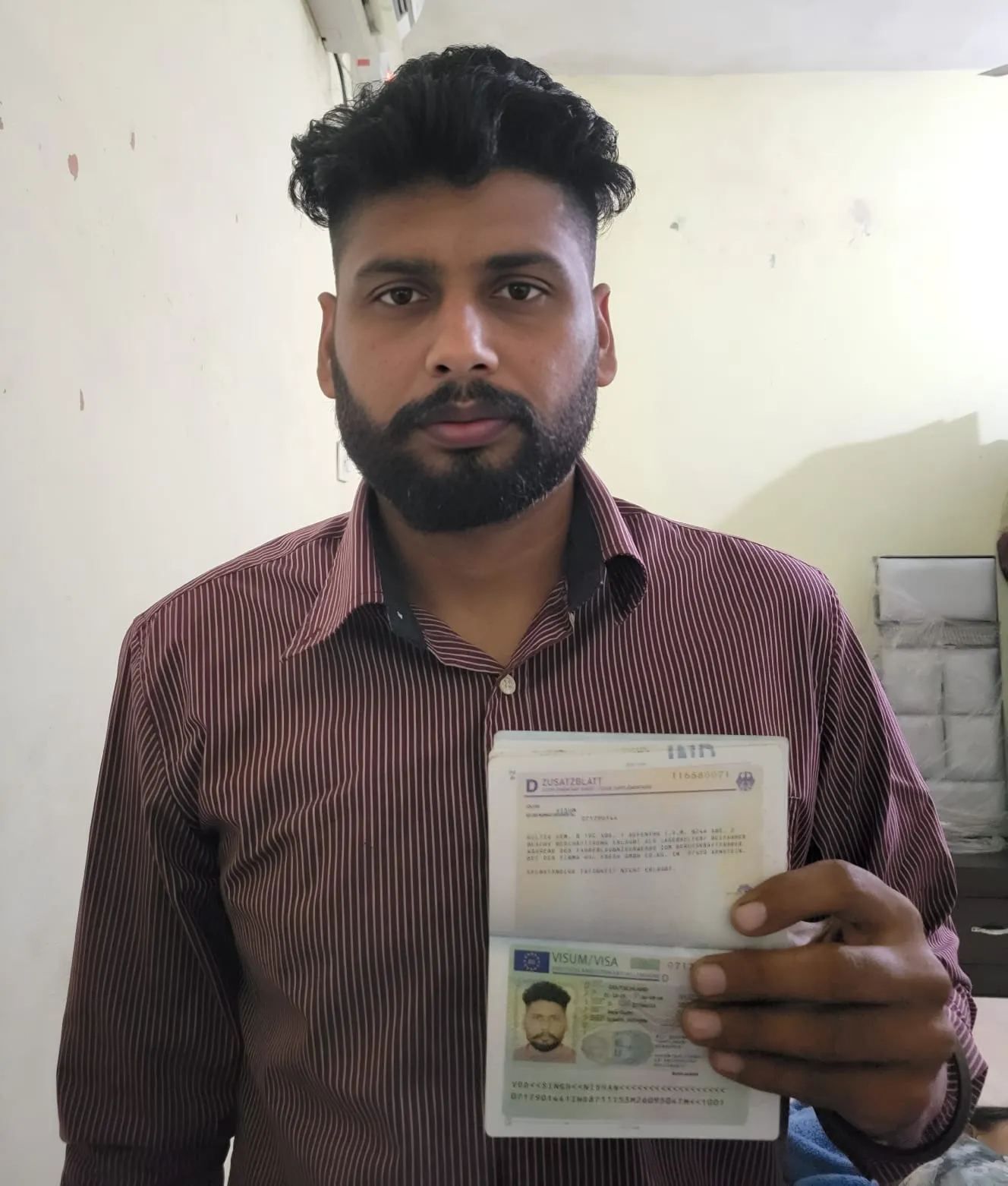
At AtoZ Serwis Plus, we help you become a global citizen with trusted support for jobs abroad, overseas education, and visa processing tailored to your goals.
Read More
Connecting employers, job seekers, students, and agencies across Europe and beyond.
Looking to hire skilled or semi-skilled workers from Asia, Africa, the CIS, or EU countries? AtoZ Serwis Plus supports your recruitment needs for Poland, Germany, Slovakia, Hungary, Lithuania, Estonia, and beyond. We deliver comprehensive legal recruitment services, visa support, and seamless onboarding solutions tailored to your business goals. Partner with us to build a reliable, compliant, and efficient workforce.
EmployerLooking to hire skilled or semi-skilled workers from Asia, Africa, the CIS, or EU countries? AtoZ Serwis Plus supports your recruitment needs for Poland, Germany, Slovakia, Hungary, Lithuania, Estonia, and beyond. We deliver comprehensive legal recruitment services, visa support, and seamless onboarding solutions tailored to your business goals. Partner with us to build a reliable, compliant, and efficient workforce.
Job SeekersAre you a recruiter looking to place workers in Poland, Germany, Slovakia, or other EU destinations? AtoZ Serwis Plus provides you with trusted employer connections, legal recruitment solutions, verified job placements, and full visa assistance. Expand your recruitment business with confidence, supported by clear processes, reliable documentation, and transparent migration services.
RecruiterLooking to work and live in Europe? At AtoZ Serwis Plus, we’re here to guide you every step of the way. Our experts provide support with job search assistance, work visa applications, qualification recognition, and European language learning. To connect with us and get started on your European journey, click one of the contact icons below.
Copyright © 2009-2026 AtoZ Serwis Plus. All Rights Reserved.