The Netherlands' technology, financial services, semiconductor, logistics, agricultural technology, and creative industries are expanding across Amsterdam, Eindhoven, Rotterdam, Utrecht, The Hague, Delft, and Brainport, creating strong and sustained demand for skilled IT professionals and software specialists. As one of Europe's most digitally advanced economies — consistently ranked among the top five globally for digital competitiveness — and home to world-class technology organisations including ASML, Philips, NXP Semiconductors, Booking.com, TomTom, Adyen, and a thriving startup and scale-up ecosystem anchored in Amsterdam and the Brainport Eindhoven region, the Netherlands requires experienced technology professionals capable of designing, building, securing, and maintaining complex digital infrastructure, semiconductor systems, financial platforms, and innovative software products.
From software development and cloud engineering to cybersecurity, data science, semiconductor EDA software, fintech platform engineering, DevOps, and digital transformation consulting, organisations across the Netherlands rely on qualified technology professionals who understand modern development frameworks, Dutch and EU data-protection requirements (AVG/GDPR), and the open, internationally oriented working culture that characterises Dutch business. Whether for high-tech semiconductor companies in Eindhoven, global fintech scale-ups in Amsterdam, logistics technology platforms in Rotterdam, or the Dutch public sector's ambitious digital transformation programme, demand for capable IT talent consistently outpaces domestic supply.
AtoZ Serwis Plus provides specialised IT and software recruitment services in the Netherlands, helping employers hire qualified software developers, cloud engineers, cybersecurity specialists, data professionals, IT infrastructure technicians, semiconductor software engineers, and digital transformation consultants from trusted international labour markets. Our recruitment solutions support technology companies, financial institutions, semiconductor groups, logistics operators, consulting firms, and public-sector bodies in building reliable and capable technology teams.
Our recruitment strategy aligns with the Netherlands' world-leading semiconductor technology sector, its dominant fintech and payments ecosystem, the digital transformation ambitions of its financial and logistics industries, and the expanding startup and scale-up community centred on Amsterdam and Brainport Eindhoven. We provide access to skilled international technology professionals while ensuring structured and compliant hiring processes.
Key strengths
Our services help Dutch employers reduce hiring timelines, access specialised skills not available domestically, and build stable, long-term technology teams.
AtoZ Serwis Plus recruits qualified professionals for a wide range of IT and software roles in the Netherlands:
These professionals support software product development, semiconductor technology programmes, digital transformation initiatives, and technology operations across the Netherlands' public and private sectors.
Our IT and software recruitment services support multiple high-demand sectors in the Netherlands:
Each candidate is carefully matched based on employer requirements, technology stack, project type, and Dutch or English language proficiency appropriate to the employer's working environment.
AtoZ Serwis Plus sources qualified IT and software professionals from trusted international labour markets to meet the Netherlands' technology workforce demand.
All candidates are screened based on:
Our candidates meet the technical and professional standards required in the Netherlands' open, internationally oriented, and technically advanced technology market.
This ensures faster time-to-productivity, reduced onboarding friction, and high-quality technology output for Dutch employers.
We follow a structured and transparent recruitment process:
This ensures smooth hiring and compliance with Dutch labour regulations, the Arbeidsomstandighedenwet, applicable CAO (collectieve arbeidsovereenkomst) requirements, and the IND (Immigratie- en Naturalisatiedienst) permit process.
Whether organisations require software developers for product engineering, semiconductor software engineers for ASML or NXP projects, cloud engineers for financial infrastructure migration, cybersecurity specialists for NCSC-aligned programmes, fintech engineers for payments platform development, or IT infrastructure technicians for enterprise operations, AtoZ Serwis Plus provides skilled professionals ready to contribute from day one across the Netherlands.
We are a trusted recruitment partner for IT and software jobs in the Netherlands, delivering technology workforce solutions aligned with real market demand.
Employers in the Netherlands can register to hire experienced technology professionals.
Employer benefits
https://www.atozserwisplus.com/employer/registration
Recruitment agencies can collaborate on IT and software workforce projects in the Netherlands.
Recruiter benefits
https://www.atozserwisplus.com/recruiter/registration
Qualified IT and software professionals seeking job opportunities in the Netherlands can register and apply.
Worker benefits
https://www.atozserwisplus.pl/work-in-europe
Registration ensures:
The Netherlands offers outstanding employment opportunities for software developers, cloud engineers, semiconductor software specialists, cybersecurity professionals, fintech engineers, data scientists, and IT infrastructure technicians. ASML's central role in global semiconductor supply chains, Amsterdam's world-class fintech and e-commerce ecosystem, the Netherlands' extraordinary English proficiency that makes it one of the most accessible European markets for international IT professionals, the kennismigrant permit's streamlined process, and the 30% ruling's significant tax benefit for newly relocated professionals all combine to make the Netherlands one of Europe's most attractive IT employment destinations. International IT professionals who bring genuine technical depth and an appreciation of the Netherlands' direct, collaborative working culture are exceptionally well-positioned in this dynamic and innovative economy.
AtoZSerwisPlus is a European workforce and immigration advisory platform specialising in compliant recruitment guidance, structured work authorisation support, and labour market insights across European countries.
Government of the Netherlands – https://www.government.nl
Immigration and Naturalisation Service (IND) – https://ind.nl
Netherlands Enterprise Agency (RVO) – https://www.rvo.nl
UWV (Employee Insurance Agency) – https://www.uwv.nl
This content is independently created and provided for informational purposes only. It does not constitute legal advice, employment guarantees, or immigration approval. All recruitment and work authorisation decisions are subject to Dutch labour laws and approval by competent authorities.
It involves sourcing and placing qualified technology professionals — software developers, cloud engineers, semiconductor software specialists, cybersecurity analysts, fintech engineers, data scientists, DevOps engineers, and IT infrastructure technicians — with Dutch employers across technology companies, semiconductor groups, financial institutions, e-commerce platforms, logistics operators, and the public sector. The Netherlands combines world-class technical employers — led by ASML, NXP, Adyen, and Booking.com — with one of Europe's most open and English-friendly technology labour markets, making it one of the most accessible and rewarding IT employment destinations on the continent.
The Netherlands consistently ranks among the top five most digitally competitive economies in the world, and the combined technology demand from its semiconductor, fintech, e-commerce, logistics, and agricultural technology sectors is among the most intense in Europe. ASML alone employs over 40,000 people globally and is rapidly expanding its software engineering teams as photolithography systems become increasingly software-defined. The Amsterdam fintech ecosystem — anchored by Adyen, Mollie, Bunq, and dozens of scale-ups — competes aggressively for the same developers that established banks and logistics operators require. The domestic STEM graduate pipeline, though high-quality, is structurally insufficient to meet combined demand at this scale.
Yes. EU and EEA citizens work in the Netherlands without a work permit. They register with the gemeente (municipality) and obtain a BSN (Burgerservicenummer — citizen service number) for payroll, tax, and public-services purposes. Registration at the municipality is required for stays beyond four months and must be completed promptly after arrival.
The kennismigrant (highly skilled migrant) permit is the Netherlands' primary and most streamlined immigration route for qualified non-EU technology professionals. It is employer-sponsored — the employer must be registered as a recognised sponsor (erkend referent) with the IND (Immigratie- en Naturalisatiedienst) — and it operates on a salary-threshold basis rather than a points or quota system. There is no annual cap on kennismigrant permits. The salary threshold for 2024 is approximately EUR 4,612 gross per month for those aged 30 and above, and EUR 3,381 for those below 30 (a lower threshold to facilitate younger talent). Most mid-level and senior IT professionals comfortably exceed these thresholds. Processing typically takes 2–4 weeks for recognised sponsors — one of the fastest non-EU work visa processes in Europe.
The 30% ruling (30%-regeling) is a tax benefit for highly skilled workers recruited from abroad to work in the Netherlands. It allows employers to pay up to 30% of gross salary as a tax-free reimbursement for extraterritorial costs — effectively reducing the income-tax burden on the first 30% of gross salary to zero. For an IT professional earning EUR 80,000 gross per year, this is a tax saving of approximately EUR 10,000–14,000 per year, significantly improving net-pay compared to standard Dutch income-tax rates. The ruling applies for a maximum of five years, requires that the employee was not living within 150km of the Dutch border for more than 16 months in the 24 months prior to starting Dutch employment, and that the employer applies for it through the Belastingdienst. The 30% ruling makes the Netherlands substantially more attractive in net-pay terms for internationally recruited IT professionals than gross salary comparisons alone suggest.
A relevant university degree (bachelor's or master's) in computer science, software engineering, information systems, or a related discipline is the standard baseline for most roles. Dutch technology companies — particularly in the startup and scale-up ecosystem — tend to evaluate candidates heavily on demonstrated technical ability: portfolio quality, GitHub contributions, practical coding assessments, and system design problem-solving. For semiconductor and embedded roles at ASML and NXP, advanced degrees (master's or PhD) in computer science, electrical engineering, or mathematics are frequently expected. Cloud and cybersecurity vendor certifications (AWS, Azure, GCP, CISSP) are well-regarded alongside practical experience.
Python is the most broadly in-demand language, dominant in data engineering, machine learning, and backend development across fintech, e-commerce, and technology companies. Java is critical in financial services and enterprise applications. JavaScript and TypeScript cover frontend and full-stack development. C++ is essential in semiconductor, embedded, and high-performance computing contexts at ASML, NXP, and their supply chains. Rust is growing in systems programming and high-performance contexts. For fintech and payments — where the Netherlands is a European leader given Adyen and the Amsterdam ecosystem — Java, Go, and microservices architecture are widely used. Cloud platforms — AWS (most widely adopted), GCP (strong at fintech and data companies), and Azure (enterprise and government) — drive DevOps and infrastructure demand. Kafka, Spark, and dbt are common in data engineering.
Software developers earn approximately EUR 55,000 to EUR 95,000 per year gross. Senior engineers, cloud architects, semiconductor software specialists, and data scientists earn EUR 85,000 to EUR 130,000 and above. Amsterdam and Eindhoven pay the highest premiums. The Netherlands' Box 1 income-tax rates are significant — but the 30% ruling, where applicable, substantially improves net-pay for internationally recruited professionals in their first five years. Without the 30% ruling, the effective combined deduction for a developer earning EUR 75,000 gross is approximately 37–43%. With the 30% ruling applied, the effective rate on the same gross salary is approximately 25–30% — a meaningful difference that makes Dutch compensation genuinely competitive in net terms.
Box 1 (werk en woning — employment and home) income tax applies at 36.97% on taxable income up to EUR 73,032 and 49.50% above that. Employee social-security contributions (volksverzekeringen — national insurance for AOW pension, ANW survivors, and WLZ long-term care) are included within the Box 1 rate for income up to the first bracket threshold. The Belastingdienst (Dutch Tax and Customs Administration) administers the system. The combination of the two-bracket system and the 30% ruling creates a distinctive situation where internationally recruited IT professionals with the ruling pay significantly less than the headline rates suggest, while those without it — including long-term Dutch residents — pay rates broadly comparable to Germany.
The Netherlands has the highest English proficiency of any non-native English-speaking country in the world, and English is the effective working language across the vast majority of Dutch technology employers, fintech companies, and international businesses. Most Amsterdam-based startups, scale-ups, and technology companies operate entirely in English — Dutch language skills are useful for social integration but are not required for most technical roles. The exceptions are: Dutch public-sector IT roles, which increasingly require Dutch proficiency; some Mittelstand-equivalent Dutch industrial companies that operate primarily in Dutch; and client-facing roles where Dutch customers are involved. For most IT professionals joining the Dutch technology sector, English alone provides access to 80–90% of available roles — a practical advantage over most other European markets.
ASML, headquartered in Veldhoven near Eindhoven, is the world's sole manufacturer of extreme ultraviolet (EUV) lithography machines — the equipment without which advanced semiconductor chips (below 7nm) cannot be produced. Every advanced chip in every smartphone, data centre, and AI accelerator globally depends on ASML's technology. ASML employs over 40,000 people and is one of Europe's most valuable companies by market capitalisation. Its software engineering teams — developing embedded software for lithography systems, machine-learning-based defect detection, optical simulation, and factory automation — are among the most technically demanding and best-compensated IT roles in Europe. The broader Brainport Eindhoven ecosystem, which also includes NXP Semiconductors, Philips (now Signify and Philips Healthcare), and dozens of high-tech suppliers, creates a dense cluster of embedded systems, EDA software, and engineering software demand that is unique in Europe.
Amsterdam is consistently ranked among Europe's top three startup ecosystems by funding volume. Its fintech cluster is anchored by Adyen — one of Europe's most valuable technology companies and a global payments infrastructure provider whose technology processes transactions for Spotify, Netflix, eBay, and thousands of other merchants — alongside Mollie (SME payments), Bunq (digital banking), Tikkie (P2P payments, owned by ABN AMRO), and dozens of fintech scale-ups. The broader startup ecosystem includes Booking.com, Bol.com (the leading Dutch e-commerce platform), TomTom, Coolblue, and a growing cluster of AI, healthtech, and sustainability technology companies. The Amsterdam Science Park, the Amsterdam Internet Exchange (AMS-IX — one of the world's largest internet exchanges), and the density of data centres in the Amsterdam metropolitan area create a distinctive digital infrastructure environment.
The Netherlands implements the EU GDPR through the Algemene Verordening Gegevensbescherming (AVG). The Autoriteit Persoonsgegevens (AP) is the Dutch data-protection supervisory authority, and it is among the more active GDPR enforcement bodies in the EU. Dutch data-protection culture is notably strong — privacy is treated as a fundamental value rather than a compliance obligation, which is reflected in how Dutch technology companies approach data architecture, data minimisation, and user consent. IT professionals in the Netherlands — particularly those working with consumer data in fintech, e-commerce, and healthcare — are expected to approach data-protection as a first-order engineering concern rather than an afterthought. AVG/GDPR familiarity is a baseline expectation for most Dutch IT roles.
The standard working week is 40 hours, with a common contractual week of 36–40 hours in IT. Part-time work is more common in the Netherlands than in most EU countries — including part-time at senior professional levels — and many employers accommodate 32- or 36-hour working weeks. Annual leave is a minimum of 20 working days under the Wet minimumloon en minimumvakantiebijslag, with most IT employers providing 25 days. An 8% vakantiegeld (holiday allowance) on annual salary is paid separately, typically in May — effectively a 13th month equivalent. Dutch IT employers typically provide an NS Business Card (train travel), a laptop and home-office equipment, a pension contribution through the applicable bedrijfstakpensioenfonds, and increasingly a Mobility as a Service (MaaS) allowance replacing the traditional lease car. Hybrid working — two to three days in the office — is the norm.
Amsterdam has the largest concentration of software product companies, fintech, e-commerce, and international technology companies. Eindhoven and the Brainport region are the primary market for semiconductor software, embedded systems, and high-tech industrial IT — anchored by ASML, NXP, and Philips. Utrecht has a strong technology services, consulting, and healthcare IT cluster. Rotterdam has logistics technology, port-operations digital infrastructure, and financial services IT. The Hague has government and public-sector IT, defence technology, and international organisations including the International Court of Justice and Europol (relevant for cybersecurity roles). Delft — home to TU Delft, one of Europe's top technical universities — has a strong deeptech and engineering software cluster.
The Netherlands is among the most internationally accessible European labour markets for IT professionals. The kennismigrant permit processes in 2–4 weeks for recognised-sponsor employers, requires no annual quota, and is based on salary rather than a points system. The 30% ruling provides a meaningful tax benefit for the first five years. The Dutch government's Highly Skilled Migrant programme includes an orientation year visa (zoekjaar) for recent graduates of recognised foreign universities, allowing them to seek employment in the Netherlands for up to one year. The Netherlands is also notably accommodating of highly skilled migrants who change employers — the kennismigrant permit can be transferred to a new sponsor-employer within 90 days of ending previous employment.
Yes. The Wet werk en zekerheid (WWZ) and its successor the Wet arbeidsmarkt in balans (WAB) govern employment contract law. Fixed-term contracts can be offered for a maximum of three years across a maximum of three consecutive contracts — after which a permanent (onbepaalde tijd) contract is legally required. Dutch dismissal law provides strong protection — termination requires either UWV approval (for economic dismissal) or court authorisation — but the Dutch system also allows for reasonable termination by mutual agreement (vaststellingsovereenkomst), which is commonly used in the technology sector. After 24 months of continuous employment, workers are generally entitled to a transitievergoeding (transition allowance) on dismissal.
Yes. EU citizens bring family members under EU free-movement rules. Kennismigrant holders can apply for family reunification — spouses and registered partners of kennismigranten receive their own mvv and residence permit with full labour-market access, making the Netherlands' family reunification regime among the most favourable in the EU for highly skilled migrant families. The Netherlands' English-language environment, international school network (particularly in Amsterdam, Eindhoven, and The Hague), high quality of life, cycling infrastructure, and culturally open society make it highly attractive for families relocating internationally.
Yes — and it is among the most acute in Europe. Techniek Nederland and the Dutch digital economy association Nederland ICT consistently report structural shortfalls of tens of thousands of IT professionals annually. The UWV (Employee Insurance Agency) classifies software developers, cloud engineers, data scientists, and cybersecurity specialists among the most difficult vacancies to fill in the Dutch labour market. The combination of ASML's global semiconductor importance, the Amsterdam fintech ecosystem's rapid growth, the e-commerce and logistics sectors' technology investment, and the public sector's digital transformation all sustain demand well beyond domestic supply.
AtoZ Serwis Plus sources and screens international IT and software professionals for verified Dutch employers across semiconductor technology, fintech, e-commerce, financial services, logistics, and the public sector. We conduct technical screening aligned with employer requirements — including semiconductor software, fintech platform, and cybersecurity specialisms — verify qualifications and project experience, confirm English proficiency and Dutch language skills where required, guide non-EU candidates and their employers through the kennismigrant permit process with recognised-sponsor employers, and advise on the 30% ruling application timeline and requirements. Register at atozserwisplus.com to begin.
Global clients share how AtoZ Serwis Plus helped them secure work permits, visas, and career support across Europe. Real stories. Real results.
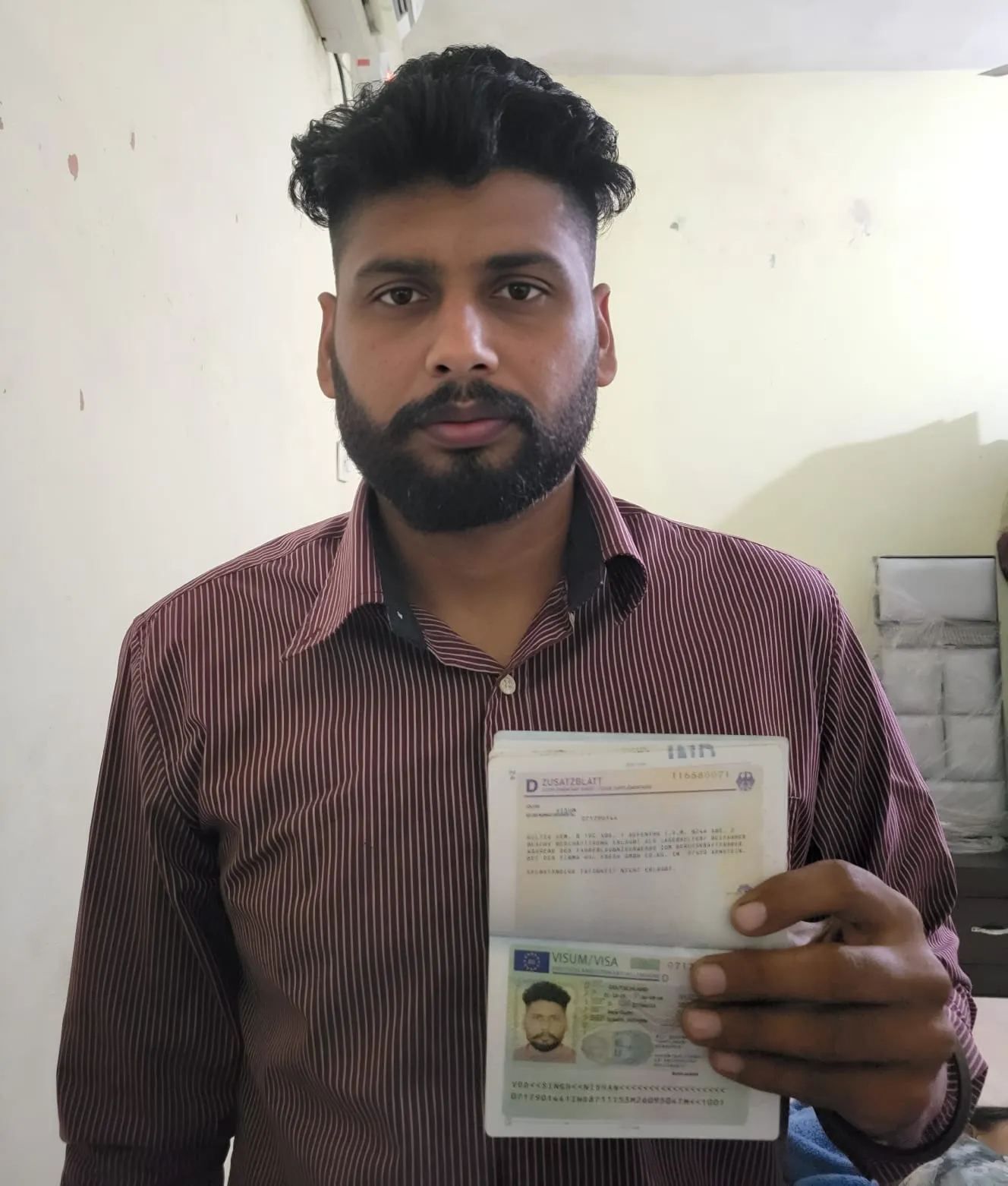
At AtoZ Serwis Plus, we help you become a global citizen with trusted support for jobs abroad, overseas education, and visa processing tailored to your goals.
Read More
Connecting employers, job seekers, students, and agencies across Europe and beyond.
Looking to hire skilled or semi-skilled workers from Asia, Africa, the CIS, or EU countries? AtoZ Serwis Plus supports your recruitment needs for Poland, Germany, Slovakia, Hungary, Lithuania, Estonia, and beyond. We deliver comprehensive legal recruitment services, visa support, and seamless onboarding solutions tailored to your business goals. Partner with us to build a reliable, compliant, and efficient workforce.
EmployerLooking to hire skilled or semi-skilled workers from Asia, Africa, the CIS, or EU countries? AtoZ Serwis Plus supports your recruitment needs for Poland, Germany, Slovakia, Hungary, Lithuania, Estonia, and beyond. We deliver comprehensive legal recruitment services, visa support, and seamless onboarding solutions tailored to your business goals. Partner with us to build a reliable, compliant, and efficient workforce.
Job SeekersAre you a recruiter looking to place workers in Poland, Germany, Slovakia, or other EU destinations? AtoZ Serwis Plus provides you with trusted employer connections, legal recruitment solutions, verified job placements, and full visa assistance. Expand your recruitment business with confidence, supported by clear processes, reliable documentation, and transparent migration services.
RecruiterLooking to work and live in Europe? At AtoZ Serwis Plus, we’re here to guide you every step of the way. Our experts provide support with job search assistance, work visa applications, qualification recognition, and European language learning. To connect with us and get started on your European journey, click one of the contact icons below.
Copyright © 2009-2026 AtoZ Serwis Plus. All Rights Reserved.