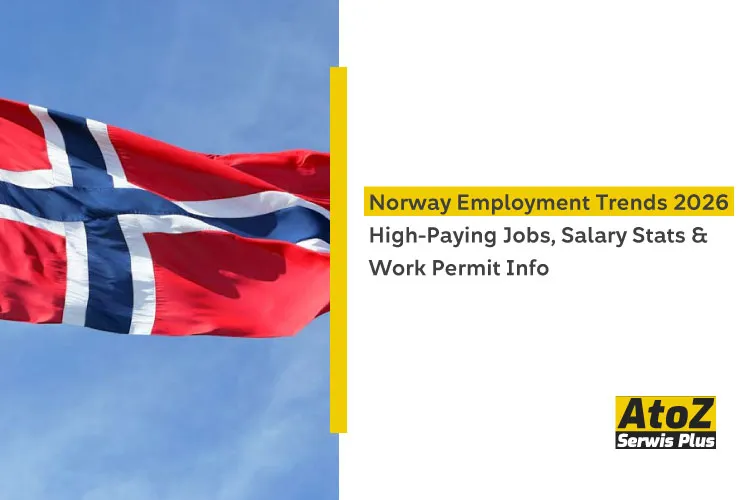

Overview of Norway’s Job Market in 2026
Norway, one of Europe’s wealthiest and most developed nations, remains a top destination for skilled professionals seeking high salaries, work-life balance, and long-term career opportunities. As part of the Nordic region, Norway combines innovation, strong labour laws, and exceptional living standards — making it an ideal place for foreign workers.
According to the Norwegian Labour and Welfare Administration (NAV) – https://www.nav.no, the country faces a significant skills shortage across multiple industries due to an ageing population and ongoing industrial expansion. By 2026, Norway is expected to need over 100,000 new skilled workers to sustain its economic growth, particularly in healthcare, construction, technology, and logistics sectors.
The Government of Norway – https://www.regjeringen.no – is actively reforming immigration policies to attract non-EU workers, offering easier residence permit procedures and faster recognition of qualifications for global professionals.
Why Norway Needs Foreign Workers
Norway’s economy relies heavily on key industries, including oil and gas, renewable energy, engineering, and healthcare. However, as the native workforce ages and younger generations shift toward academic careers, the country faces critical workforce gaps.
To maintain economic growth and innovation, Norway is actively recruiting skilled non-EU workers in high-demand occupations. The Norwegian Directorate of Immigration (UDI) – https://www.udi.no – has streamlined the process for skilled worker visas, enabling faster application timelines and digital submissions.
Foreign professionals also play a crucial role in supporting Norway’s ambitious green energy goals and technological advancement, making it one of the most open and worker-friendly European destinations in 2026.
Top Industries Facing Skill Shortages
Norway’s economy is highly diversified, offering strong employment opportunities across multiple fields. The most critical skill shortages in 2026 include:
Healthcare and Elderly Care: Nurses, doctors, and care assistants are urgently needed to meet the needs of an ageing population.
IT and Technology: Software engineers, data analysts, cybersecurity experts, and system architects are in high demand as Norway expands its digital infrastructure.
Engineering and Construction: Civil, mechanical, and electrical engineers are needed for major public infrastructure and housing projects.
Oil, Gas, and Renewable Energy: Technicians, engineers, and offshore operators are in high demand as Norway continues to invest in sustainable energy.
Logistics and Transportation: Truck drivers, warehouse staff, and logistics coordinators are essential for supporting trade and industrial supply chains.
Hospitality and Tourism: Chefs, hotel staff, and cleaning professionals are in high demand to support Norway’s growing tourism sector.
You can view the complete labour demand overview on the Work in Norway portal – https://www.workinnorway.no.
Most In-Demand Jobs in Norway 2026
Based on NAV’s and UDI’s projections, the following professions will be the most in-demand in 2026:
- Registered nurses, medical specialists, and caregivers
- Software developers, cybersecurity specialists, and data scientists
- Civil, electrical, and mechanical engineers
- Construction workers, plumbers, and electricians
- Truck drivers and warehouse operators
- Oil rig technicians, renewable energy engineers, and wind turbine specialists
- Chefs, hotel receptionists, and cleaning staff
These roles offer attractive salaries, stable contracts, and opportunities for long-term residency and family reunification.
Salary Expectations by Sector and Experience
Norway offers some of the highest wages in Europe, along with strong employment rights and benefits. Salaries depend on qualifications, experience, and industry, but average monthly gross wages in 2026 are expected to be:
- Healthcare: NOK 45,000 – NOK 65,000
- IT & Software: NOK 55,000 – NOK 80,000
- Engineering: NOK 50,000 – NOK 75,000
- Construction: NOK 40,000 – NOK 55,000
- Logistics & Transport: NOK 35,000 – NOK 50,000
- Renewable Energy: NOK 55,000 – NOK 85,000
- Hospitality: NOK 30,000 – NOK 40,000
Skilled professionals with higher education, extensive experience, and fluency in English or Norwegian can expect salaries at the upper end of these brackets.
Language Requirements for Foreign Workers
Norway’s work environment is highly international, and English is commonly spoken, especially in multinational companies. However, Norwegian language skills (A2–B1) significantly improve job prospects and are often mandatory for public-sector positions such as healthcare or education.
Many employers also offer free Norwegian language training to new hires. You can find information on language courses and integration programs on the Work in Norway portal: https://www.workinnorway.no.
Eligibility Criteria to Work in Norway
To work legally in Norway as a non-EU citizen, you must meet the requirements set by the Norwegian Directorate of Immigration (UDI) – https://www.udi.no. Applicants must prove their skills match the country’s labour shortages and secure employment before entry.
Key eligibility requirements:
- A valid job offer from a Norwegian employer meeting labour law standards.
- Relevant education or vocational qualification that matches the offered position.
- A salary that meets the official minimum for the role (usually NOK 450,000 – 600,000 annually for skilled positions).
- Proof of work experience in the same field.
- Financial stability and health insurance.
- Clean criminal record and medical fitness certificate.
- Language skills in English or Norwegian (depending on occupation).
Healthcare, education, and engineering roles require official recognition of foreign qualifications through the Norwegian Agency for Quality Assurance in Education (NOKUT) – https://www.nokut.no.
Types of Work Permits and Visas in Norway
Norway offers several residence and work permits for foreign workers, depending on skills and job type:
1. Skilled Worker Visa
For qualified professionals with vocational training or university degrees and an approved employment offer from a Norwegian employer.
2. Seasonal Worker Visa
For temporary jobs in agriculture, fishing, hospitality, and tourism (usually valid for up to six months).
3. Job Seeker Residence Permit
Allows skilled workers to enter Norway for up to six months to search for employment.
4. EU Blue Card
For highly qualified workers earning above the annual salary threshold set by the government (NOK 550,000 in 2026).
5. Intra-Company Transfer Permit
For employees relocating within international companies operating in Norway.
For more details, visit Work in Norway – https://www.workinnorway.no.
Step-by-Step Process to Apply for a Norwegian Work Visa
Step 1: Secure a Job Offer
Find a legitimate job through NAV (https://www.nav.no) or Work in Norway (https://www.workinnorway.no). Ensure the employer is registered and authorised to hire foreign workers.
Step 2: Employer Submits Application
The employer may apply on your behalf to the Norwegian Directorate of Immigration (UDI) for a residence and work permit.
Step 3: Prepare Documents
Collect and translate your documents into English or Norwegian before submission.
Step 4: Submit Application
Apply online via UDI or through the Royal Norwegian Embassy in India – https://www.norway.no/en/india. Submit biometrics and pay fees.
Step 5: Processing and Approval
Processing typically takes 6–8 weeks, depending on the application volume and job category.
Step 6: Travel and Register
After arrival, register your address with the local police and apply for a Norwegian personal ID number through the Tax Administration – https://www.skatteetaten.no.
Documents Required for Work Permit Application
- Valid passport (minimum 6 months validity)
- Signed an employment contract with salary details
- Academic and vocational qualification certificates
- Proof of work experience and references
- Health insurance proof
- Police clearance certificate
- Bank statements or proof of funds
- Two passport-size photographs
- Language certificate (if required)
All foreign documents must be translated, notarised, and apostilled.
Processing Time and Visa Fees
Fees and processing times vary by permit type:
|
Visa Type |
Fee (NOK) |
Processing Time |
|---|---|---|
|
Skilled Worker Visa |
NOK 6,300 – 7,000 |
6 – 8 weeks |
|
EU Blue Card |
NOK 6,500 – 7,500 |
6 – 10 weeks |
|
Seasonal Visa |
NOK 3,700 – 4,000 |
4 – 6 weeks |
|
Job Seeker Permit |
NOK 3,700 – 4,000 |
6 – 8 weeks |
All applications are submitted through UDI – https://www.udi.no.
Recognition of Foreign Qualifications
Foreign degrees and certificates must be validated by the Norwegian Agency for Quality Assurance in Education (NOKUT) – https://www.nokut.no.
Recognition ensures that your qualification meets Norwegian standards — a mandatory step for regulated professions such as nursing and engineering.
Where to Find Job Opportunities in Jaipur – Official Government Websites
Job seekers in Jaipur and across India should only use verified platforms to apply for overseas employment:
- National Career Service (NCS): https://www.ncs.gov.in
- eMigrate – Ministry of External Affairs: https://emigrate.gov.in
- NSDC International: https://nsdcindia.org
These platforms connect Indian workers with approved international recruiters for safe migration.
Government Office Resources for Work Permit and Visa Information
- Government of Norway: https://www.regjeringen.no
- Norwegian Directorate of Immigration (UDI): https://www.udi.no
- Norwegian Labour and Welfare Administration (NAV): https://www.nav.no
- Work in Norway Portal: https://www.workinnorway.no
- Royal Norwegian Embassy in India: https://www.norway.no/en/india
Living Costs and Quality of Life in Norway
Norway consistently ranks among the world’s top countries in terms of living standards, safety, and social equality. It offers free public healthcare, outstanding education, and world-class infrastructure — all supported by a strong welfare system.
Average Monthly Living Costs (for a single person):
- Rent: NOK 9 000 – 15 000 (higher in Oslo and Bergen)
- Utilities & Internet: NOK 1 200 – 2 000
- Food & Groceries: NOK 3 500 – 5 000
- Transport Pass: NOK 800 – 1 200
- Healthcare: Free for residents under public coverage
While everyday costs are high, salaries and benefits balance them. Employees enjoy 25 paid vacation days per year, paid parental leave, and strong employment protections.
More information is available at the Government of Norway – https://www.regjeringen.no.
Permanent Residency and Citizenship in Norway
Norway offers clear and transparent paths for foreign professionals wishing to settle in the country long-term.
Permanent Residence Permit:
After three years of continuous legal residence and full-time work on a skilled-worker permit, you may apply for permanent residence (permanent oppholdstillatelse). This status grants an indefinite stay and equal labour-market rights as a Norwegian citizen.
Norwegian Citizenship:
You can apply after 7 years of legal residence (5 years for Nordic nationals or spouses of Norwegians). Applicants must demonstrate good conduct, stable income, and sufficient proficiency in the Norwegian language and social studies.
Official details are available from the Norwegian Directorate of Immigration (UDI) – https://www.udi.no.
Tips to Increase Your Chances of Getting Hired
- Learn Norwegian: Even basic A2–B1 skills significantly boost employability. Free courses are available through municipalities.
- Have Your Qualifications Recognised: Apply through NOKUT – https://www.nokut.no.
- Optimise Your CV for Norwegian Employers: Highlight relevant experience and keep it concise (1–2 pages).
- Apply on Official Platforms: Use NAV (https://www.nav.no) and Work in Norway (https://www.workinnorway.no).
- Show Adaptability: Norwegian employers value punctuality, teamwork, and cultural awareness.
Mistakes to Avoid During a Visa and Job Application
- Submitting incomplete or untranslated documents
- Forgetting apostilles or notarisation
- Providing inconsistent employment information
- Missing minimum salary requirements
- Ignoring the language or qualification recognition step
Always apply only through official channels listed by UDI and NAV.
Top Cities in Norway for International Workers
- Oslo: Capital and financial hub – IT, finance, and consulting.
- Bergen: Energy, maritime, and shipping industries.
- Stavanger: Oil and gas capital with offshore jobs.
- Trondheim: Technology and Engineering Innovation Centre.
- Tromsø: Tourism and northern logistics gateway.
Each city offers an excellent quality of life, multicultural communities, and career growth opportunities.
Norway Job Shortages 2026 – Sector Overview
|
Sector |
Job Title |
Avg. Salary (NOK) |
Contract Duration |
Language Level |
Demand |
|---|---|---|---|---|---|
|
Healthcare |
Nurse, Doctor, Care Assistant |
45 000 – 65 000 |
1–2 Years Renewable |
B1–B2 |
Very High |
|
IT & Technology |
Software Engineer, Cybersecurity Expert |
55 000 – 80 000 |
2+ Years Permanent |
B1 |
Very High |
|
Engineering |
Civil, Mechanical, Electrical Engineer |
50 000 – 75 000 |
2+ Years Permanent |
B1 |
High |
|
Construction |
Electrician, Plumber, Welder |
40 000 – 55 000 |
1 Year Renewable |
A2–B1 |
High |
|
Logistics & Transport |
Truck Driver, Warehouse Operator |
35 000 – 50 000 |
1 Year Renewable |
A2 |
Very High |
|
Oil & Energy |
Offshore Technician, Wind Engineer |
55 000 – 85 000 |
2+ Years Permanent |
B1 |
High |
|
Hospitality |
Chef, Housekeeper, Receptionist |
30 000 – 40 000 |
1 Year Renewable |
A2 |
Medium |
Final Thoughts – Why 2026 Is the Best Time to Work in Norway
With stable economic growth, low unemployment, and thousands of open positions, 2026 is the perfect time to launch your career in Norway.
Whether you’re a healthcare professional, IT expert, engineer, or skilled technician, Norway offers competitive salaries, secure employment, and long-term residency options.
By carefully preparing your documents, learning the basics of Norwegian, and collaborating with trusted immigration partners, you can achieve a successful career and a comfortable life in one of Europe’s most advanced countries.
Official Resources:
- Government of Norway: https://www.regjeringen.no
- UDI (Norwegian Directorate of Immigration): https://www.udi.no
- NAV (Labour and Welfare Administration): https://www.nav.no
- Work in Norway: https://www.workinnorway.no
- Royal Norwegian Embassy in India: https://www.norway.no/en/india
About AtoZ Serwis Plus
AtoZ Serwis Plus is a trusted European recruitment and immigration agency assisting skilled, semi-skilled, and professional workers in obtaining legal employment, work permits, and residence in Slovakia and across the EU.
Our services include:
- Verified employer connections and job placements
- Legal work permit and visa application assistance
- Document translation and qualification recognition support
- Post-arrival integration and relocation services
With AtoZ Serwis Plus, candidates receive transparent, step-by-step guidance to ensure a secure and compliant migration process.
Visit: https://atozserwisplus.com
Find Jobs, Hire Workers, or Become a Recruiter with AtoZ Serwis Plus
Seeking a reliable approach to work or hire internationally? AtoZ Serwis Plus makes it simple for job seekers, employers, and recruitment agents to connect and grow together. Whether you’re dreaming of working abroad or searching for reliable employees for your company, everything you need starts here.
We offer convenient registration options for truck drivers, welders, healthcare professionals, interns, and employers and agents seeking to expand their networks across Europe.
Explore Your Path Below
|
Category |
Description |
Apply / Register Here |
|---|---|---|
|
Truck Driver Jobs |
Looking for a truck driving job in Europe? Register here and get matched with top logistics companies that offer competitive salaries and provide legal work permits. |
|
|
Healthcare Professionals |
Nurses, caregivers, doctors, and other healthcare workers can apply here for hospital and clinic jobs across Europe. |
|
|
Welders |
Certified welders and metal fabricators are in high demand abroad. Apply today and secure a skilled job with accommodation support. |
|
|
Internship / Traineeship Programs |
Students and fresh graduates can gain international experience through our professional internship programs in Europe. |
|
|
Employers |
Are you an employer looking to hire skilled, semi-skilled, or unskilled workers from abroad? Register your company with us to start hiring globally. |
|
|
Become a Recruiter / Agent |
Want to become our recruitment partner? Join us to help candidates find legal jobs abroad and earn commissions for each successful placement. |
Why Choose AtoZ Serwis Plus?
- Legal and Transparent Process – All job offers and visa processes are conducted entirely in accordance with European labour laws.
- Multiple Job Categories – From truck driving to healthcare and technical fields, we cover a wide range of industries.
- Worldwide Opportunities – We work with employers and recruiters from across Europe and beyond.
- Personal Guidance – Our experienced team supports you at every stage—from registration to visa assistance.
Join Us Today
Whether you’re a job seeker, employer, or recruitment partner, your journey to success begins with one click.
Visit AtoZSerwisPlus.com or AtoZSerwisPlus.pl to register now.
FAQs – Norway Employment Trends 2026
1. Which jobs are most in demand in Norway in 2026?
High demand continues in healthcare, engineering, information technology, construction, renewable energy, logistics, and skilled trades such as electricians and welders.
2. What are the top high-paying careers in Norway?
Doctors, software engineers, petroleum engineers, data scientists, and finance managers rank among the best-paid professionals.
3. What is the average monthly salary in Norway?
The average gross salary ranges from NOK 55,000 to NOK 60,000 per month, depending on the industry, experience, and education.
4. What is the minimum wage in Norway?
Norway has no single national minimum wage. Instead, each sector has collective agreements that set minimum pay levels—typically between NOK 180 and NOK 210 per hour.
5. Do foreign workers need a work permit to work in Norway?
Yes. Non-EU/EEA citizens must hold a valid residence permit for work before starting any employment.
6. What types of work permits are available?
Common categories include:
- Skilled Worker Residence Permit
- Seasonal Work Permit
- Job-Seeker Permit for Graduates
- Self-Employment and Specialist Permits
7. What are the eligibility requirements for a Skilled Worker Permit?
Applicants must have a job offer from a Norwegian employer, relevant education or vocational training, and a salary that meets Norway’s minimum requirements for skilled roles.
8. What salary qualifies for a Skilled Worker Permit?
The required salary typically starts from NOK 450,000 per year for university graduates, and is higher for experienced or specialised positions.
9. How long does it take to process a work permit?
Processing typically takes 4 to 8 weeks once all documents are submitted, although complex applications may require longer processing times.
10. Do I need to speak Norwegian to work there?
Not always. Many multinational companies and IT roles operate in English; however, learning Norwegian is essential for the healthcare, education, and service industries.
11. Can I switch employers while on a work permit?
Yes, but you must apply for a new permit or modify the existing one before starting a new job.
12. How long is a Norwegian work permit valid?
Most are initially granted for up to two years and can be renewed, or they may lead to permanent residency after three consecutive years of lawful employment.
13. Can I bring my family with me?
Yes. Family members of skilled workers are eligible to apply for dependent residence permits and may also work or study in Norway.
14. What are the typical working hours in Norway?
The standard full-time schedule is 37.5 hours per week, accompanied by generous paid leave and robust worker protection laws.
15. What is the income tax rate in Norway?
Income tax rates vary between 22% and 38%, depending on earnings and the municipality.
16. How much does it cost to live in Norway?
Living costs are high. On average, a single person spends NOK 20,000–25,000 monthly, excluding rent. Oslo and Bergen are the most expensive cities in Norway.
17. Are there job opportunities for semi-skilled or blue-collar workers?
Yes. Construction, transport, warehousing, fishing, and agriculture regularly hire foreign semi-skilled workers.
18. How can I find a job in Norway from abroad?
You can apply directly to Norwegian companies, recruitment agencies, or job portals. Having recognised qualifications and experience increases your chances.
19. What are the benefits of working in Norway?
Norway offers strong job security, high wages, a safe work environment, free healthcare, paid parental leave, and an excellent work-life balance.
20. Why consider Norway for employment in 2026?
Because of its growing demand for skilled professionals, world-leading salaries, low unemployment rate, and reputation for fairness, equality, and quality of life.