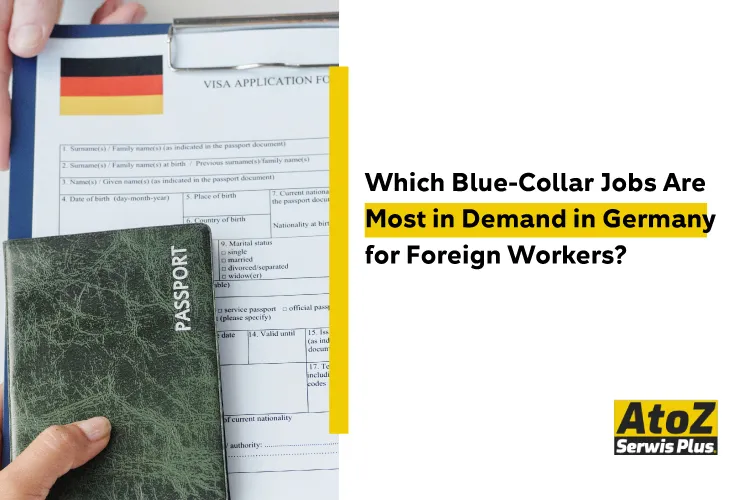
Which Blue-Collar Jobs Are Most in Demand in Germany for Foreign Professionals?
Blue-collar jobs in Germany are in critically high demand, driven by one of the most severe skilled trades shortages in Europe. Germany's Federal Employment Agency (Bundesagentur für Arbeit) consistently identifies hundreds of thousands of unfilled positions across electrical trades, construction, plumbing, metalworking, logistics, and automotive maintenance. The German government has responded with significant immigration reforms — including the expanded Skilled Immigration Act (Fachkräfteeinwanderungsgesetz) — that make it easier than at any previous point for qualified foreign trade workers to obtain legal work authorisation. For foreign manual and trade workers, Germany offers the highest blue-collar wages in continental Europe, strong statutory employment protections, and a clear pathway to permanent residence.
What Are Blue-Collar Jobs in Germany?
Blue-collar jobs involve physical or manual labour, skilled trades, and hands-on operational work. In Germany, these jobs are found across construction, manufacturing, automotive servicing, logistics and transport, electrical installation, plumbing and heating, metalworking, food processing, agriculture, and facility services.
The defining characteristics of blue-collar jobs in Germany include:
- Work performed on construction sites, factory floors, workshops, warehouses, farms, and in vehicles
- Many roles require a formal vocational qualification (Berufsausbildung) obtained through Germany's renowned dual education system
- Physical skill, technical competence, and professional reliability are core requirements
- Shift-based or standard working patterns with strong overtime and weekend premium pay
- Strong collective bargaining agreements (Tarifverträge) providing above-minimum wages in many trade sectors
Germany's blue-collar job market is distinctive in the European context because of the Berufsausbildung system. This formally structured three-year vocational apprenticeship produces highly qualified tradespeople with both practical and theoretical credentials. Foreign workers who hold equivalent vocational qualifications from their home countries can have these recognised under the German qualification recognition framework, unlocking access to regulated trades and higher pay bands. This recognition process is central to successfully entering the German blue-collar labour market as a foreign worker.
Why Germany Has Such High Demand for Foreign Blue-Collar Workers
Fachkräftemangel — The Skilled Labour Shortage
Germany's Fachkräftemangel (skilled worker shortage) is one of the most discussed economic challenges in the country. The shortage is acute not only in white-collar professional sectors but equally — and in some cases more severely — in skilled trades. Electricians, plumbers, heating engineers, and construction specialists are among the most critically undersupplied occupations in the entire German labour market. The Federal Employment Agency regularly publishes shortage occupation lists that specifically include these trade categories.
Baby Boomer Retirement Wave
Germany is experiencing a large-scale retirement of baby boomer tradespeople. Hundreds of thousands of experienced electricians, mechanics, plumbers, and construction workers are leaving the workforce annually, while the domestic apprenticeship pipeline is insufficient to replace them at scale. The resulting gap is structural and is expected to widen over the coming decade.
Construction and Infrastructure Investment
Germany has ambitious targets for new residential housing construction, transport infrastructure investment, and energy transition projects — including wind farm installations, solar panel deployments, and district heating network expansions. These programmes require sustained large-scale deployment of construction labourers, electricians, pipefitters, steel workers, and specialist energy transition tradespeople that the domestic workforce cannot supply.
Automotive Sector Transformation
Germany's automotive industry — home to BMW, Mercedes-Benz, Volkswagen, Audi, and Porsche — is transitioning to electric vehicle production. This transformation requires retraining and new hiring of automotive mechanics and technicians with EV-specific knowledge, creating additional demand in the automotive servicing and maintenance sector alongside sustained manufacturing workforce needs.
Logistics and E-Commerce Growth
Germany is Central Europe's largest logistics market. The expansion of e-commerce and the growth of automated distribution networks have driven major investment in warehouse and logistics infrastructure, creating sustained demand for forklift operators, warehouse operatives, HGV drivers, and logistics technicians across the country.
Top 15 Most In-Demand Blue-Collar Jobs in Germany for Foreign Workers
The table below lists the most in-demand blue-collar jobs in Germany for foreign workers, with current indicative salary ranges and demand levels. All figures are gross annual estimates in Euro (EUR) and may vary by region, employer, collective agreement, and experience level.
|
No. |
Job Title |
Sector |
Avg. Gross Salary (EUR/year) |
Demand Level |
|---|---|---|---|---|
|
1 |
Electrician (Elektriker / Elektroniker) |
Construction / Industry / Energy |
36,000 – 58,000 |
Very High |
|
2 |
Construction Worker / Labourer (Bauarbeiter) |
Construction |
30,000 – 48,000 |
Very High |
|
3 |
Welder (Schweißer) |
Manufacturing / Metal |
34,000 – 56,000+ |
Very High |
|
4 |
HGV / Truck Driver (LKW-Fahrer) |
Logistics / Transport |
36,000 – 58,000+ |
Very High |
|
5 |
Plumber / Sanitary Installer (Installateur) |
Construction / Maintenance |
34,000 – 54,000 |
Very High |
|
6 |
HVAC / Heating Engineer (Anlagenmechaniker SHK) |
Energy / Construction |
34,000 – 56,000 |
Very High |
|
7 |
CNC Machine Operator (CNC-Fachkraft) |
Precision Manufacturing |
32,000 – 52,000 |
High |
|
8 |
Automotive Mechanic / Technician (Kfz-Mechatroniker) |
Automotive |
32,000 – 52,000 |
High |
|
9 |
Carpenter / Joiner (Tischler / Zimmerer) |
Construction / Furniture |
30,000 – 50,000 |
High |
|
10 |
Warehouse Operative / Logistics Worker |
Logistics / E-commerce |
26,000 – 38,000 |
Very High |
|
11 |
Bricklayer / Mason (Maurer) |
Construction |
30,000 – 50,000 |
High |
|
12 |
Painter / Decorator (Maler / Lackierer) |
Construction / Industry |
28,000 – 46,000 |
High |
|
13 |
Food Processing Worker |
Food & Beverage |
26,000 – 38,000 |
High |
|
14 |
Agricultural / Farm Worker (Landwirtschaftshelfer) |
Agriculture |
22,000 – 32,000 (+ housing) |
High (Seasonal) |
|
15 |
Cleaner / Facility Operative (Reinigungskraft) |
Facilities / Services |
22,000 – 30,000 |
Moderate-High |
1. Electrician (Elektriker / Elektroniker)
Electricians are the single most critically undersupplied trade in Germany. The Federal Employment Agency consistently lists electrical trades among the top shortage occupations nationally. Demand spans residential and commercial construction wiring, industrial installation and maintenance, renewable energy systems (solar PV, wind turbine electrical systems), and EV charging infrastructure installation. Germany's Energiewende (energy transition) has created an entirely new dimension of demand for electricians, specifically focused on renewable energy systems. Foreign electricians with a formally recognised vocational qualification equivalent to the German Elektroniker für Energie- und Gebäudetechnik can command strong salaries and exceptional job security.
2. Construction Worker / Labourer (Bauarbeiter)
General construction labourers and specialist construction tradespeople are in sustained high demand across Germany's active building sector. The government's targets for new residential housing construction — significantly behind schedule due to labour shortages — create acute demand for workers at all levels of the construction skill spectrum. Major infrastructure projects, including motorway expansion, rail network upgrades, and urban development programmes, add further sustained demand. Entry-level labouring roles are accessible without formal German qualifications, though formal recognition significantly increases earning potential and career progression.
3. Welder (Schweißer)
Certified welders are among the best-compensated and most sought-after blue-collar workers in Germany. Demand comes from automotive manufacturing, steel construction, shipbuilding (particularly in Hamburg and Bremen), mechanical engineering, and energy infrastructure. MIG, TIG, MAG, and electrode welding certifications are all valued. EN ISO 9606 qualified welders can command significant premiums. Germany's transition to hydrogen infrastructure and offshore wind energy adds new dimensions of demand for specialist industrial welding capabilities.
4. HGV / Truck Driver (LKW-Fahrer)
Germany is Europe's largest road freight market, and the driver shortage is one of the most severe on the continent. The Bundesverband Güterkraftverkehr Logistik und Entsorgung (BGL) — Germany's freight transport association — estimates a shortage of tens of thousands of drivers. Category C and C+E licence holders are in acute demand. International route drivers operating lanes to Eastern Europe, Scandinavia, and the Benelux countries command the highest compensation. German transport companies typically offer additional per diem allowances (Spesen) for international runs that supplement base income on a partially tax-exempt basis.
5. Plumber / Sanitary Installer (Installateur)
Plumbers and sanitary installers are in high demand across Germany's residential construction market, commercial renovation sector, and the growing energy transition programme. The replacement of gas boilers with heat pumps — strongly incentivised by German federal subsidy programmes — has created a surge in demand for heating installers specifically qualified in heat pump installation and commissioning. Plumbers who combine traditional skills with certifications in heat pumps and renewable heating are among the most sought-after tradespeople in the current German market.
6. HVAC / Heating Engineer (Anlagenmechaniker SHK)
Heating, ventilation, and air conditioning (HVAC) engineers — formally Anlagenmechaniker für Sanitär-, Heizungs- und Klimatechnik (SHK) — are in exceptional demand driven by Germany's heating system transition programme. Federal incentives for heat pump installations, district heating connections, and energy-efficient building retrofits have created a backlog of installation work, severely constrained by a shortage of qualified SHK engineers. Foreign tradespeople with equivalent HVAC or heating engineering qualifications who obtain German recognition are entering a market with extraordinary demand and limited competition.
7. CNC Machine Operator (CNC-Fachkraft)
Germany's precision manufacturing sector — covering automotive components, aerospace parts, medical devices, industrial machinery, and tool manufacture — requires large numbers of CNC machine operators and programmers. Professionals experienced with Fanuc, Siemens, or Heidenhain control systems are particularly valued. Germany's deep industrial base across Baden-Württemberg, Bavaria, and North Rhine-Westphalia provides consistent demand from hundreds of precision manufacturing SMEs alongside large industrial employers.
8. Automotive Mechanic / Technician (Kfz-Mechatroniker)
Germany's large vehicle fleet and its position as the global home of premium automotive brands create consistent demand for qualified Kfz-Mechatroniker (automotive mechatronic technicians). Authorised dealership service networks for BMW, Mercedes-Benz, Volkswagen, Audi, and Porsche, as well as independent workshops and fleet maintenance operations, all recruit foreign mechanics. The transition to electric vehicles is creating a specific demand for technicians qualified in high-voltage EV systems — a growing, highly paid specialism within automotive maintenance.
9. Carpenter / Joiner (Tischler / Zimmerer)
Carpenters and joiners are employed across Germany's construction sector — in formwork, timber frame construction, roofing, and interior fit-out — as well as in furniture manufacturing and bespoke joinery. Germany has a strong tradition of high-quality woodworking and joinery, and skilled Tischler (furniture joiners) and Zimmerer (structural carpenters) are in consistent demand. The growing interest in timber frame (Holzrahmenbau) construction as a sustainable building method is driving further demand for qualified structural carpenters.
10. Warehouse Operative / Logistics Worker
Warehousing and logistics roles are among the most accessible entry points for foreign workers arriving in Germany. E-commerce fulfilment centres, freight logistics hubs, and retail distribution operations across major German logistics corridors — including the Rhine-Ruhr region, Frankfurt, Munich, Hamburg, and Berlin — employ large numbers of warehouse operatives, forklift drivers, and logistics technicians. While no formal qualification is required for entry-level operative roles, forklift licences (Staplerschein) and warehouse logistics certifications significantly increase earning potential.
11. Bricklayer / Mason (Maurer)
Bricklayers and masons are in sustained demand across Germany's new residential construction and renovation markets. Germany's ambitious housing construction targets — driven by strong demand in major cities — require sustained input from the bricklaying and masonry workforce. Foreign bricklayers with formally recognised qualifications or with demonstrable experience can find strong opportunities, particularly in Bavaria, Baden-Württemberg, and North Rhine-Westphalia, where construction activity is most intense.
12. Painter / Decorator (Maler / Lackierer)
Painters and decorators are required across residential and commercial construction projects throughout Germany. Industrial coating specialists — working on anti-corrosion applications for manufacturing plants, bridges, and infrastructure — represent a higher-paid specialism within the painting trade. Automotive body painters with refinishing certification find particularly strong demand in Germany's large vehicle repair sector.
13. Food Processing Worker
Germany has a large food processing industry covering meat processing, dairy production, bakeries, and frozen food manufacturing. Processing facilities employ foreign workers extensively, particularly in Niedersachsen and North Rhine-Westphalia, where large meat processing operations are concentrated. Working conditions in food processing have come under increased regulatory scrutiny in Germany, and the sector has undergone significant legal reforms regarding subcontracting and worker accommodation standards — improvements that specifically benefit foreign workers.
14. Agricultural / Farm Worker (Landwirtschaftshelfer)
Germany's agricultural sector creates seasonal demand for foreign farm workers, particularly during asparagus (Spargel) harvesting in spring — one of Germany's most labour-intensive agricultural activities — and during fruit and vegetable harvesting through summer and autumn. Asparagus harvesting regions in Lower Saxony, Bavaria, and Baden-Württemberg recruit foreign workers in large numbers each season. Accommodation on or near the farm is typically provided.
15. Cleaner / Facility Operative (Reinigungskraft)
Cleaning and facility services represent the most accessible no-experience entry point into the German labour market. The Gebäudereiniger trade — building cleaning — has its own collective wage agreement (Tarifvertrag) that sets above-minimum wage rates for cleaning workers, making this sector somewhat better compensated than equivalent entry-level roles in some other European countries. Demand is consistent across offices, hospitals, transport infrastructure, and industrial facilities across all German cities.
4. Current Salary Ranges for Blue-Collar Jobs in Germany
Germany offers the highest blue-collar wages in continental Europe, and a strong minimum wage floor combined with widespread collective bargaining agreements means that even entry-level manual workers earn meaningfully above the legal minimum. The following table provides current indicative gross annual salary ranges by employment tier:
|
Employment Tier |
Gross Annual Salary (EUR) |
Typical Roles |
|---|---|---|
|
Entry-Level / Unskilled |
22,000 – 30,000 |
Cleaners, farm labourers, basic assembly, kitchen porters |
|
Semi-Skilled Operatives |
28,000 – 40,000 |
Warehouse staff, production line, food processing, packaging |
|
Skilled Trades (Recognised) |
34,000 – 56,000 |
Electricians, plumbers, welders, SHK engineers, carpenters |
|
Master Craftsperson (Meister) |
42,000 – 68,000+ |
Meister-qualified tradespeople in leadership/senior roles |
|
HGV / Specialist Vehicle Drivers |
36,000 – 58,000+ |
Category C and C+E international route drivers |
Beyond base wages, blue-collar workers in Germany benefit from a strong statutory and collectively negotiated benefit framework. Employers must contribute to health insurance (Krankenversicherung), pension insurance (Rentenversicherung), unemployment insurance, and long-term care insurance — collectively known as Sozialabgaben — at approximately 20% of gross salary (shared equally between employer and employee). Many trade-sector collective agreements also provide holiday pay supplements (Urlaubsgeld), Christmas bonuses (Weihnachtsgeld), and shift allowances that meaningfully increase total annual compensation.
Germany's statutory minimum wage (Mindestlohn) is reviewed and adjusted periodically by the Minimum Wage Commission. All workers — regardless of nationality — are entitled to at least this amount. Many trade sectors have collective agreements that set rates significantly above the statutory minimum. Check the current Mindestlohn figure at the Federal Ministry of Labour (bmas.de) before evaluating any job offer.
Work Permit Options for Foreign Blue-Collar Workers in Germany
Germany's 2023 Skilled Immigration Act (Fachkräfteeinwanderungsgesetz) significantly expanded the legal routes available for foreign trade workers to obtain work authorisation. Non-EU and non-EEA nationals have the following main options:
|
Permit Type |
Best For |
Key Requirement |
Duration |
|---|---|---|---|
|
Skilled Worker Visa — Vocational (Fachkräftevisum) |
Tradespeople with recognised vocational qualifications |
Recognised Berufsausbildung equivalent + job offer |
Up to 4 years, renewable |
|
Skilled Worker Visa — Experience-Based |
Experienced workers from comparable education systems |
Minimum 2 years of experience + qualification from the approved country list |
Up to 4 years, renewable |
|
Opportunity Card (Chancenkarte) |
Qualified workers seeking employment in Germany |
Points-based; no job offer required upfront |
1-year job-search period |
|
Seasonal Agricultural Work Permit |
Short-term agricultural seasonal workers |
Employer declaration: simplified process |
Up to 8 months per year |
Skilled Worker Visa — Vocational Route (Fachkräftevisum)
The vocational Fachkräftevisum is the primary route for foreign tradespeople entering Germany with a formally recognised vocational qualification. The relevant recognition authority must recognise the qualification as equivalent to a German Berufsausbildung. For many trades, this recognition is handled by the relevant Chamber of Crafts (Handwerkskammer) or Chamber of Industry and Commerce (IHK). Once recognised, the worker requires a concrete job offer from a German employer and can apply for the visa at the German embassy in their home country.
Experience-Based Route
New under the 2023 reforms, the experience-based pathway allows foreign workers from countries with comparably structured education systems to obtain a Skilled Worker Visa based on professional experience rather than formal qualification equivalency. This route requires at least two years of relevant professional experience and a qualification from an approved country. It significantly expands access for experienced tradespeople who may not hold a formal vocational certificate equivalent to German standards.
Opportunity Card (Chancenkarte)
The Chancenkarte allows qualified foreign workers to enter Germany for up to one year to search for employment without a pre-confirmed job offer. Points are awarded for qualifications, relevant work experience, German language skills, age, and prior connections to Germany. This is particularly valuable for tradespeople who want to present themselves to German employers in person, attend trade fairs, and negotiate employment terms before committing to a specific role.
Seasonal Agricultural Work Permit
A simplified seasonal work permit is available for short-term agricultural employment in Germany. Employers can register seasonal workers through a streamlined process at the Federal Employment Agency for periods of up to eight months per calendar year. This is the main route for foreign workers seeking Spargel harvesting, fruit picking, and other seasonal agricultural roles.
EU and EEA Citizens
Citizens of EU and EEA member states have full freedom of movement and may work for any German employer in any role without any permit. They must complete the mandatory Anmeldung (residence registration) at the local Einwohnermeldeamt within two weeks of establishing a primary residence in Germany.
Qualification Recognition — The Key to Higher Pay in Germany
Qualification recognition (Anerkennung) is the single most important step for foreign tradespeople seeking to maximise their earning potential in Germany. Germany's Berufsausbildung system means that formally recognised qualifications unlock access to regulated trades, higher pay bands under collective agreements, and direct equivalency with German-trained tradespeople in the eyes of employers.
The recognition process works as follows:
- Use the Recognition in Germany portal (anerkennung-in-deutschland.de) to identify the correct recognition authority for your trade and country of qualification
- For crafts trades (Handwerk) — such as electricians, plumbers, carpenters, and painters — the relevant Handwerkskammer (Chamber of Crafts) in your target region handles recognition.
- For industrial and commercial trades — such as CNC operators and logistics specialists — the relevant IHK (Chamber of Industry and Commerce) handles recognition.n
- For some trades, partial recognition may be granted, with an adaptation course or knowledge test required to achieve full equivalency.
- Free advisory support is available through the BRAIN network (Beratungsnetzwerk Anerkennung) in multiple languages. ges
Even partial recognition improves employability and salary prospects compared to entering the German market with an unrecognised foreign qualification. Employers are often willing to support workers through the recognition process for in-demand trades where the shortage is acute.
Step-by-Step: How to Get a Blue-Collar Job in Germany as a Foreign Worker
- Identify your trade and target sector. Determine whether your skills align with Germany's most acutely undersupplied trades — electricians, SHK engineers, and welders offer the fastest entry and highest pay. Construction and logistics offer more accessible entry points.
- Begin the qualification recognition process. Submit your vocational qualifications for recognition assessment at the relevant Handwerkskammer or IHK. Use anerkennung-in-deutschland.de to identify the correct authority. Start this process early — it can run concurrently with your job search.
- Learn German to at least the A2 or B1 level. German language ability is significantly more important for blue-collar roles in Germany than in some other European markets. Safety regulations, workplace instructions, and client communication all require functional German in most trade settings. B1 level is recommended for safety-critical trades.
- Search for vacancies. Use the Bundesagentur für Arbeit job portal (arbeitsagentur.de), StepStone, Indeed Deutschland, and Handwerk.de — a specialist portal for craft trades vacancies. Many Handwerkskammern also maintain regional vacancy boards for their member firms.
- Vet any recruitment agency. Only use legitimately registered agencies. Legitimate German employment agencies are registered with the Federal Employment Agency. Never pay upfront placement fees — these are prohibited under German law. Verify any agency at arbeitsagentur.de.
- Secure a written employment contract (Arbeitsvertrag). Before any visa application, obtain a signed contract specifying role, gross salary, working hours, notice period, and any benefits.
- Apply for your Fachkräftevisum at the German embassy. Submit your visa application with passport, employment contract, qualification recognition documents (or evidence of pending recognition), proof of German language skills, a clean criminal record certificate, and proof of health insurance.
- Arrive in Germany and complete Anmeldung. Register your residence address at the local Einwohnermeldeamt within two weeks. Obtain your tax identification number (Steueridentifikationsnummer) and register with a statutory health insurance fund (gesetzliche Krankenversicherung).
Your Legal Rights as a Foreign Blue-Collar Worker in Germany
Foreign workers in Germany benefit from some of the strongest employment protections in the world. Your key rights under German law include:
- Statutory minimum wage (Mindestlohn): All workers are entitled to at least the current Mindestlohn, regardless of nationality — check the current rate at bmas.de
- Written employment contract: Your employer must provide a written Arbeitsvertrag specifying role, salary, working hours, and notice period
- Paid annual leave: Minimum 20 days per year by law (based on 5-day week); most collective agreements provide 25–30 days
- Overtime protections: The Working Hours Act (Arbeitszeitgesetz) limits maximum working hours and mandates minimum rest periods
- Social insurance coverage: Employers must register you with all statutory Sozialabgaben systems — health, pension, unemployment, and long-term care
- Holiday and Christmas bonuses: Many trade collective agreements (Tarifverträge) provide Urlaubsgeld and Weihnachtsgeld supplements
- Works council rights: At companies with five or more employees, a Betriebsrat may be established with co-determination rights on key employment decisions
- Protection from discrimination: The General Equal Treatment Act (AGG) prohibits workplace discrimination on grounds of nationality, race, gender, religion, age, or disability.
- Right to report violations: Minimum wage violations can be reported to the Customs Investigation Office (Finanzkontrolle Schwarzarbeit). Other labour law violations can be reported to the relevant state labour court (Arbeitsgericht)
Top Regions in Germany for Blue-Collar Work
Bavaria (Bayern)
Bavaria is Germany's most economically dynamic state and consistently records the lowest unemployment rate in the country. Munich and the wider Bavarian region host BMW's manufacturing operations, a dense network of precision-engineering SMEs, active construction markets, and large-scale logistics operations. Electricians, SHK engineers, CNC operators, and automotive mechanics find exceptional demand and top wages in Bavaria.
Baden-Württemberg
Baden-Württemberg is Germany's engineering heartland — home to Mercedes-Benz, Porsche, Bosch, and hundreds of world-leading mechanical and electrical engineering Mittelstand companies. The region has the highest manufacturing employment-to-population ratio of any German state. Welders, CNC machinists, electricians, and automotive technicians are in particularly strong demand across Stuttgart, Karlsruhe, and Mannheim.
North Rhine-Westphalia (NRW)
NRW is Germany's most populous state and encompasses the Rhine-Ruhr metropolitan region — one of Europe's largest industrial agglomerations. The region hosts major logistics hubs, chemical industry operations, construction activity, and food processing facilities. Warehouse operatives, construction workers, HGV drivers, and trades workers find consistent demand across Cologne, Düsseldorf, Dortmund, and Essen.
Hamburg and Northern Germany
Hamburg is home to Germany's largest port, major shipbuilding and ship repair facilities, and significant logistics and aviation industry operations (Airbus). Welders, marine engineering trades, port logistics workers, and HGV drivers find strong demand in the Hamburg region and across the northern German coastal states.
Berlin and Brandenburg
Berlin has a large and active construction market driven by ongoing residential and commercial development. The city also hosts growing logistics and food industry operations. Brandenburg and the wider Berlin commuter region add further construction and agricultural demand. Berlin's large market for cleaning and facility services is one of the most accessible entry points for newly arriving foreign workers in Germany.
Lower Saxony (Niedersachsen)
Lower Saxony hosts Volkswagen's headquarters and main production plant in Wolfsburg, large food-processing operations, and asparagus-growing regions, creating significant seasonal agricultural demand. Automotive production workers, food processing operatives, and agricultural seasonal workers all find employment opportunities across the state.
How to Avoid Job Scams Targeting Foreign Workers in Germany
Fraudulent agencies sometimes target foreign workers seeking blue-collar employment in Germany. Be alert to the following warning signs:
- Any agency charging upfront fees for job placement — this is illegal under German law
- Job offers with unrealistically high wages for unskilled work, with no formal documentation provided
- Employers or agents asking you to travel to Germany before your visa has been approved
- Accommodation arrangements where opaque deductions from wages are not documented in the contract
- Requests to surrender your passport or identity documents — confiscating a worker's documents is a criminal offence in Germany.
- Verbal-only job offers with no written Arbeitsvertrag provided before work begins.s
Verify every employer through the German commercial register at unternehmensregister.de or handelsregister.de. Report suspected exploitation or minimum wage violations to the Customs Investigation Office (Zoll — Finanzkontrolle Schwarzarbeit) at zoll.de.
Frequently Asked Questions
1. Which blue-collar jobs are most in demand in Germany for foreign workers?
The most in-demand blue-collar jobs in Germany for foreign workers include electricians, construction workers, welders, HGV drivers, plumbers, HVAC/SHK engineers, CNC machine operators, automotive mechanics, carpenters, warehouse operatives, bricklayers, painters, food processing workers, and agricultural seasonal workers.
2. What is the average salary for a blue-collar job in Germany?
Blue-collar salaries range from approximately 22,000 EUR per year for entry-level unskilled roles to over 58,000 EUR per year for experienced HGV drivers and master-qualified tradespeople. Formally recognised skilled tradespeople — electricians, SHK engineers, welders — typically earn between 34,000 and 56,000 EUR gross per year.
3. Do foreign workers need a work permit for blue-collar jobs in Germany?Non-EU and non-EEA nationals need a Skilled Worker Visa (Fachkräftevisum) for vocational trade work, or an experience-based visa under the new 2023 Skilled Immigration Act provisions. EU and EEA citizens have full freedom of movement and require no permit.
4. What is the Fachkräftevisum for trades workers in Germany?
The vocational Fachkräftevisum allows non-EU tradespeople with a recognised vocational qualification equivalent to a German Berufsausbildung to work in Germany in their trained trade. It requires a concrete job offer and formal recognition of qualifications from the relevant Handwerkskammer or IHK.
5. What is the Berufsausbildung, and why does it matter for foreign workers?
The Berufsausbildung is Germany's formal three-year vocational apprenticeship programme that produces highly qualified tradespeople. Foreign workers whose home-country qualifications are recognised as equivalent to a Berufsausbildung gain access to regulated trades, higher pay bands under collective agreements, and full professional standing in the German labour market.
6. How do I get my trade qualifications recognised in Germany?
Use the Recognition in Germany portal (anerkennung-in-deutschland.de) to identify the correct recognition authority. The relevant Handwerkskammer handles crafts trades, industrial and commercial trades by the IHK. Free advisory support is available through the BRAIN network in multiple languages. The process typically takes eight to twelve weeks.
7. Can I get a blue-collar job in Germany without speaking German?
Basic German is strongly recommended and in many cases required, particularly in safety-critical trades such as electrical work and construction. Some large manufacturing and logistics operations accommodate multilingual teams, but A2 or B1 German significantly improves employment prospects and is typically required for the Fachkräftevisum application.
8. What is the Opportunity Card (Chancenkarte) and how can it help trade workers?
The Chancenkarte allows qualified foreign workers to enter Germany for up to one year to search for employment without a confirmed job offer. It is particularly valuable for tradespeople who want to present themselves to German employers in person and negotiate employment terms before committing to a specific role. Points are awarded for qualifications, experience, language skills, and age.
9. Which trades are most in shortage in Germany?
Electricians, SHK engineers (plumbers and heating installers), construction workers, welders, and HGV drivers are the trades in the most acute shortage nationally. The Federal Employment Agency publishes a regularly updated shortage occupation list (Positivliste) that specifically identifies these and other undersupplied trades.
10. What is the German minimum wage, and does it apply to foreign workers?
Germany's Mindestlohn (statutory minimum wage) applies to all workers regardless of nationality. It is reviewed periodically by the Minimum Wage Commission. Check the current rate at bmas.de. Many trade sector collective agreements set rates significantly above the statutory minimum, benefiting workers in unionised sectors.
11. Are there blue-collar jobs in Germany that include accommodation?
Accommodation is most commonly provided in seasonal agricultural work and on some large construction projects. Any accommodation deducted from wages must be agreed in writing in the employment contract and must not reduce net take-home pay below the Mindestlohn. Accommodation costs deducted from wages are strictly regulated under German law.
12. What is the Handwerkskammer and how does it relate to trade jobs in Germany?
The Handwerkskammer (Chamber of Crafts) is the regional professional body responsible for regulated craft trades in Germany. It handles qualification recognition for foreign tradespeople, administers master craftsperson (Meister) examinations, and maintains regional vacancy boards for member firms. Contacting the Handwerkskammer in your target region is an important early step for any foreign tradesperson seeking work in Germany.
13. Is welding a good career for foreign workers in Germany?
Yes. Certified welders — particularly those with EN ISO 9606 qualifications — are in acute shortage across Germany's manufacturing, construction, and energy sectors. Experienced welders in Germany can earn 40,000–56,000+ EUR gross per year. Germany's hydrogen infrastructure programme and offshore wind expansion are adding new dimensions of demand for specialist industrial welding capabilities.
14. Are HGV driving jobs in Germany well paid for foreigners?
Yes. HGV driving is among the best-compensated blue-collar positions in Germany. Category C+E international route drivers can earn 42,000–58,000+ EUR gross per year. German transport companies additionally pay Spesen (per diem allowances) for international runs on a partially tax-exempt basis, meaningfully supplementing take-home income.
15. What are the standard working hours for blue-collar jobs in Germany?
The Working Hours Act (Arbeitszeitgesetz) limits working time to a maximum of 10 hours per day and 48 hours per week, averaged over six months. Standard employment contracts typically specify 38–40 hours per week. Overtime must be compensated as specified in the employment contract or applicable collective agreement.
16. What is the Tarifvertrag, and how does it affect blue-collar workers?
A Tarifvertrag is a collective wage agreement negotiated between employers' associations and trade unions that sets minimum wages, working hours, holiday entitlements, and bonus payments above the statutory minimum for specific trade sectors. Workers covered by a Tarifvertrag — including construction workers under the BRTV-Bau agreement and building cleaners under their sector agreement — receive legally guaranteed minimum rates above the general Mindestlohn.
17. What labour rights do foreign blue-collar workers have in Germany?
Foreign workers have the same rights as German nationals under the Arbeitsrecht. These include: Minimum wage entitlement, written Arbeitsvertrag, paid annual leave (minimum 20 days), Arbeitszeitgesetz working hour protections, Sozialabgaben coverage (health, pension, unemployment, long-term care), Betriebsrat co-determination rights, AGG non-discrimination protection, and the right to report violations to the Arbeitsgericht or the Finanzkontrolle for Schwarzarbeit.
18. Which regions of Germany have the most blue-collar jobs for foreigners?
Bavaria (automotive and precision engineering), Baden-Württemberg (engineering and manufacturing), North Rhine-Westphalia (logistics, construction, food processing), Hamburg and Northern Germany (shipbuilding, port logistics, aviation), Berlin and Brandenburg (construction, logistics), and Lower Saxony (automotive, food processing, agriculture) are the leading regions for blue-collar employment.
19. Are seasonal agricultural jobs in Germany worth taking?
Seasonal agricultural work — particularly asparagus (Spargel) harvesting and fruit picking — is a well-established route for foreign workers to enter the German labour market on a short-term basis. Accommodation is typically provided. The work is physically demanding and seasonal, running from spring through autumn. Germany's seasonal agricultural work permit allows up to eight months of employment per year.
20. How do I verify a German employer is legitimate?
Verify any company through the German commercial register at unternehmensregister.de or the Handelsregister at handelsregister.de. For craft businesses, check registration with the relevant Handwerkskammer. A legitimate employer will always provide a written Arbeitsvertrag, will never charge you placement fees, and will never confiscate your personal documents.
21. What is Finanzkontrolle Schwarzarbeit, and how does it protect workers?
Finanzkontrolle Schwarzarbeit (FKS) is the enforcement unit within Germany's Customs Administration (Zoll) responsible for combating undeclared work and minimum wage violations. It conducts workplace inspections — particularly in construction, logistics, and food services — and investigates worker complaints. Reports can be submitted at zoll.de. FKS is particularly active in enforcing the Mindestlohn for foreign workers.
22. Do blue-collar workers in Germany pay income tax?
Yes. All employees in Germany pay income tax (Einkommensteuer) and Solidaritätszuschlag, which is deducted at source from gross salary. Sozialabgaben (social contributions) are also deducted — approximately 20% of gross salary shared between employer and employee. Your employer provides an annual Lohnsteuerbescheinigung for tax return purposes. The effective tax wedge at entry-level blue-collar wages is lower than at professional salary levels.
23. Are there blue-collar jobs in Germany for workers with no experience?
Yes. Warehouse operatives, food processing workers, farm labourers, and cleaners require no prior professional experience. Physical fitness, reliability, and willingness to work shifts are the primary requirements. However, German language ability at the A1 or A2 level is generally required to follow safety instructions and communicate in the workplace.
24. Are construction sites and factories in Germany safe for foreign workers?
German workplaces are regulated by rigorous occupational health and safety legislation (Arbeitsschutzgesetz). Employers must provide safety induction training, supply PPE at no cost, and maintain safe working conditions. The German Social Accident Insurance (DGUV — Deutsche Gesetzliche Unfallversicherung) provides mandatory accident insurance for all workers and investigates workplace incidents. Standards at large construction and manufacturing sites are generally high.
25. Can I apply for permanent residence in Germany after working in a blue-collar job?
Yes. After five years of continuous legal residence in Germany — including periods of employment on a Fachkräftevisum — foreign nationals can apply for a permanent residence permit (Niederlassungserlaubnis). Requirements include sufficient pension insurance contributions, adequate income, German language proficiency (B1 level minimum), and a clear criminal record. Germany's pathway to permanent residence and eventual citizenship is accessible to trade workers who build their careers in Germany over the long term.
26. What is the Meister qualification, and how does it benefit foreign workers in Germany?
The Meister (Master Craftsperson) is the highest formal qualification in the German craft trades system, obtained through advanced examination after several years of journeyman-level work. Meister-qualified tradespeople are entitled to operate their own business, supervise apprentices, and access the highest pay bands in their trade. Foreign tradespeople who achieve full recognition of their Berufsausbildung can subsequently pursue a Meister qualification in Germany, significantly enhancing long-term earning potential and career options.
27. What is the best blue-collar job for a foreign worker entering Germany with a trade qualification?
Electricians, SHK engineers, and welders offer the strongest combination of demand, salary, and long-term career prospects for foreign tradespeople entering Germany with formally recognised qualifications. All three trades are on the Federal Employment Agency shortage occupation list, command above-average blue-collar wages, and offer strong collective agreement coverage. HGV driving is the strongest option for workers with a Category C or C+E licence.
28. Do German employers provide health insurance for foreign workers?
Employers who register workers under a standard employment contract must enrol the worker in a statutory health insurance fund (Gesetzliche Krankenversicherung — GKV) and pay their half of the contribution. This provides comprehensive access to the German public healthcare system. Workers must promptly register with a GKV insurer of their choice (e.g., TK, AOK, Barmer) upon arrival and provide the employer with their health insurance number.
29. Are there blue-collar jobs in Germany for women?
Yes. Women work across a broad range of blue-collar roles in Germany, with strong representation in food processing, textile manufacturing, cleaning and facility services, agricultural work, pharmaceutical production, and electronics assembly. Anti-discrimination provisions under the AGG protect all workers equally. Germany's trade union movement (DGB) actively advocates for equal pay and safe working conditions for all workers, regardless of gender or nationality.
30. What is the long-term outlook for blue-collar jobs in Germany for foreigners?
The long-term outlook is extremely strong. Germany's Fachkräftemangel in skilled trades is projected to worsen significantly over the coming decade as baby boomer tradespeople retire and domestic apprenticeship output remains insufficient to replace them. Government projections and employer association studies point to a structural shortage of hundreds of thousands of skilled trade workers. Combined with the immigration reforms of the 2023 Fachkräfteeinwanderungsgesetz and continued investment in the Energiewende, Germany will remain one of the strongest and most accessible labour markets in Europe for qualified foreign blue-collar and trade workers for the foreseeable future.